Day 163: Ghostwritten

Cover for GhostwrittenBest Book of the Week!

Ghostwritten, one of David Mitchell’s earlier books, is about the nature of fate and the strange interconnections between people and events in the modern world. In this unusual novel, Mitchell illustrates his points through the narrations of nine different characters, who at first seem only vaguely connected.

The novel begins with the crazed Quasar, a member of a religious cult who has fled to Okinawa after placing poisonous bombs in the Tokyo subway. As his sect falls apart, he waits for word and instructions from his leader, His Serendipity.

In Tokyo, Satoru, a teenage employee of a record store, falls in love with a pretty customer. In Hong King, Neal Brose, a financier who has conducted some shady business with a mysterious Russian, is letting his life fall apart after his wife leaves him.

In China, an old lady lives through the various upheavals of the 20th century while she tries to keep her tea shop on a sacred mountain from being destroyed, again. In Mongolia, an entity that can move from one human being to another tries to find out what it is and where it came from.

In Russia, Margarita Latumsky, a woman who has made her way in life by seducing powerful men and has landed a job at the Hermitage, is plotting with her gangster boyfriend to steal a Delacroix. In London, Marco Chance is a drummer, ghostwriter, and womanizer whose day isn’t going very well.

Mo Muntervary is a world-famous physicist who returns home to a remote Irish island after fleeing from the CIA for several months. Her decision to stop running has fateful results. Finally, Bat Segundo is a late-night DJ in New York who begins getting annual phone calls from the mysterious Zookeeper.

As these characters pursue their own activities and thoughts in a way that seems completely organic to their natures, Mitchell slowly and skillfully weaves their stories into a dystopian nightmare that works in actual events from the late 1990’s, when the book was written.

I am continually amazed by Mitchell’s imagination and intellect and his ability to write novels that are completely engrossing. Although not every technique he uses is completely successful–for example, there are real and metaphorical ghosts in the novel (in addition to the entity, whatever it is)–his approaches are all still interesting. Ghostwritten reminds me a bit of one of his later books, Cloud Atlas, which I admire very much.
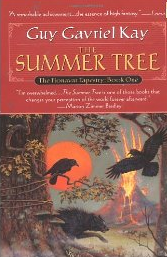
Day 154: The Summer Tree

Cover for The Summer TreeLong ago I read books one and two of Guy Gavriel Kay’s The Fionavar Tapestry but was unable to find the third book. Awhile back, I found copies of all the books and decided to re-read the trilogy. It is going to be very hard for me to divorce my review of The Summer Tree, the first book, from that of the entire trilogy, because my impressions are of the complete trilogy, but I remember thinking that it was the best of the three books.

Five friends attend a lecture by Professor Lorenzo Marcus on the University of Toronto campus. After the lecture, he reveals that he is actually the mage Loren Silvercloak who has come to them from Brennin on another world to ask them to travel there and celebrate the reign of High King Ailell. (Of course, they decide to go.) One of them lets go of the others during the transfer and finds he is separated from the others for much of the action of the novel. On Brennin, it turns out to be the eve of a great battle, during which each of the five find they have their special parts to play.

I had more to say in my notes about my impressions of this book than the plot, which is complicated. I feel that the book, while interesting and beautifully written, is much more immature than the other Kay books I have read. (It is his first.) The strangers coming to save another world idea has been done to death, and the second and third books become even more trite with the introduction of a King Arthur and Queen Guinevere plot, which I find tiresome. The five main characters are relatively uninteresting, and some of the male characters, particularly, are a little juvenile. Finally, the entire trilogy seems dated, particularly in the behavior and attitudes of the characters. My impressions of other Kay books, such as Tigana or The Song for Arbonne, are that they are more rich and subtle.

Day 141: Shadow of Night

Cover for Shadow of NightAs with most second books of a trilogy, Shadow of Night is transitional and therefore harder to describe than the first book.

At the end of the A Discovery of Witches, the first book of Deborah Harkness’s “All Souls Trilogy,” Diana Bishop, an Oxford scholar and nonpracticing witch, and her husband Matthew Clairmont, a geneticist and vampire, were forced to flee because a union between a witch and a vampire is forbidden. Using Diana’s newly discovered time-travel skills, they have arrived in Elizabethan England so that Diana can find a witch to help her learn her powers. Even more importantly, they want to look for Ashmole 782, an enchanted manuscript that Matthew believes may hold the secret to the existence of witches, vampires, and daemons. This decision proves potentially hazardous, though, as the age they’ve chosen is one of persecution of witches and Diana has a tendency to draw attention to herself.

In Tudor England Matthew of the past is part of an intellectual group called the School of Night, the members of which include Sir Walter Raleigh and Kit Marlowe. Kit is a deeply disturbed daemon who is insanely jealous of Diana. Another hazard is that Matthew’s acquaintances may realize he is not the same person as the person from the past. In the meantime, both Diana and Matthew’s friends and enemies back in the present time watch for clues to their existence in the past.

Although this novel is a great sequel that propels you to the next book, it has the typical middle book problem of furthering the plot without arriving anywhere. Strictly because of personal taste, I could also have done without some of the heavy romantic passages, although other readers will like them. Nevertheless, I am extremely interested to see how Diana and Matthew will resolve all their problems in the final book.

Day 120: Tigana

Cover for TiganaI decided to try a book by Guy Gavriel Kay because I read somewhere that he is a great historical novelist who disguises his books as fantasy. I read another book a long time ago but more recently picked up Tigana. Each of his books seems to have the setting and atmosphere of a different medieval European country, although they are set on other worlds. In this case, the country is Italy.

On a peninsula made up of nine provinces, the provinces have been conquered and divided up between two tyrant sorcerors, Brandin of Ygrath and Alberico of Barbadior. During one of the last battles, Brandin’s son was killed by Tiganian soldiers. As revenge, Brandin had the Tiganian prince’s family killed and cast a spell so that no one except those born in Tigana can remember its name. That is, I think, an interesting and original idea that has far-reaching effects.

Years later, a young singer named Devin falls in with a group of wandering musicians and learns from them that he is from Tigana, although he cannot remember, as his father took him away as a child. The group, lead by Alessan, the last prince of Tigana’s royal house, has been waging psychological warfare to free the province from both tyrants and revive the name of Tigana.

These novels are well written and rich in detail. Unlike Kay’s most famous work, The Fionavar Tapestry, which seems immature at times, it is more fully realized and mature.

Day 107: A Clash of Kings

Cover for A Class of KingsThe second of George R. R. Martin’s Song of Ice and Fire saga, A Clash of Kings seems to reveal more of the true nature of the various characters, in particular, who is a villain and who is just being loyal to his or her own family. But the characters’ loyalties shift as the series continues.

Robb Stark has been declared King of the North in the rebellion against the Lannisters, his father’s murderers. Robb sends Theon Greyjoy to his father to form an alliance, but Balon Greyjoy has his own ambitions and so does Theon. Theon comes back in Robb’s absence and invades Winterfell.

Young Brandon Stark, who was crippled in the first book by Queen Cersei and her brother Jaime, has been dreaming of running with the wolves. When Winterfell is invaded, he flees for his life with friends and makes for The Wall. His half-brother Jon Snow is marching north of The Wall to try to stop the wildings from invading the South.

Joffrey Baratheon, Queen Cersei’s sadistic son, has gained the throne upon Robert Baratheon’s death. His uncle Tyrion Lannister, who is regent in the absence of his father and Jaime, does his best to rule fairly and counteract the actions of Joffrey, but everyone hates him anyway.

Robert’s brothers, the seemingly virtuous Stannis and charismatic Renly, also have claims to the throne. Stannis, stuck on his island and disliked by all, doesn’t seem to have a ghost of a chance of gaining enough support. But he swears himself to the Red Lord and begins using the dark arts to his advantage.

Daenerys, the only living heir of the former ruling family, is trying to find a way home with her three dragons. She is looking for alliances and money to buy arms and ships and hire soldiers so she can invade.

Eight-year-old Arya Stark is still trapped in enemy territory as is her older sister Sansa, who is quickly losing her infatuation with her fiancé Joffrey.

Such is the situation of the main characters at the beginning of the second book. Martin’s series is enthralling and complex, with many plot twists. You can never be sure that even your favorite character won’t be killed (or seem to be killed). This series thrusts you along, and despite the length of the books, you can’t wait to start the next one. Unfortunately for me, I have finished all of the books that are already available and am waiting for the next one to come out.

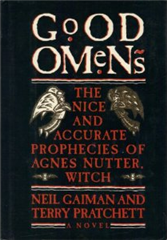
Day 99: Good Omens: The Nice and Accurate Prophecies of Agnes Nutter, Witch

Cover of Good OmensAnd now for something completely different. Good Omens: The Nice and Accurate Prophecies of Agnes Nutter, Witch is an absolutely wacky spoof by Terry Pratchett and Neil Gaiman. In the planning for Armageddon, a demon gives the Antichrist to a Satanist nun to swap with the baby of an American diplomat. But she mixes up the babies, and the Antichrist goes home with an ordinary British family.

Eleven years pass, and the powers, both of light and darkness, gear up for the end of the world. But one angel (Aziraphale) and one demon (Crowley) have decided they like the human race and life on earth too much to want the war between Heaven and Hell. They go off together to find the Antichrist and avert Armageddon. And then there are Agnes Nutter’s “nice and accurate” predictions.

A review on the book cover says it is like a combination of The Omen and Monty Python, and that gets it about right. It contains lots of digs at sources of apocalyptic literature. This book is not for everyone, but many of you will find it hilariously funny.

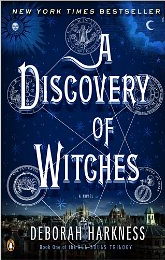
Day 43: A Discovery of Witches

Cover for A Discovery of WitchesBest Book of Week 9!

A Discovery of Witches by Deborah Harkness is like Twilight for adults. A couple of years ago I decided to try the wildly popular Twilight series and found the first book terribly juvenile. But recently, I picked up A Discovery of Witches, also extremely popular and with similar themes. I just finished reading it and had a lot of fun.

Diana Bishop is a Yale science historian visiting at Oxford to study alchemy. She is also a witch, from a long line of witches. But ever since her parents were murdered in Africa when she was seven, she has refused to learn about and tries not to use witchcraft.

She is working in the Bodleian Library when among the manuscripts she calls up is one called Ashmole 782. As soon as she touches it, she can tell it is powerfully enchanted. To keep true to her vow not to use witchcraft, she refers to it as she would any other manuscript and then sends it back.

Not long after, she meets a mysterious vampire named Matthew Clairmont, a well-known but reclusive genetic scientist. He is interested in the book but disturbingly warns her to beware of other witches. As she has been brought up to fear vampires, she is appalled at his warning and tries to avoid him. But she soon figures out he is actually trying to protect her from the other vampires, witches, and daemons who have suddenly appeared in the library, despite the dictum that the three species are not supposed to draw attention to themselves from humans. Matthew explains that they all want Ashmole 782.

Soon Diana and Matthew have formed a strong bond of attraction, but because Diana has neglected her education in her heritage, she is unaware that relationships between the species are strictly forbidden.

This is a lively and engrossing book, sometimes light and comic but other times fraught with romance, danger, action, and suspense. You care about Diana and Matthew and are interested to see where their story is leading. The book also introduces other fascinating characters, such as Diana’s aunts, Matthew’s family, and Diana’s aunt’s house. Yes, it is a character. Matthew–overly protective, quick to anger, not always under control–makes a much more convincing vampire than does the sulky, languishing Edward from Twilight, and Diana is a lot smarter and more interesting than Bella. This book is the first of a series of three, and I’ll be looking forward to the second book.

Day Twenty: Game of Thrones

Cover for Game of ThronesBest Book of Week 4!

Game of Thrones is the first book in the Song of Ice and Fire series by George R. R. Martin and also the name of a successful TV series based upon the books. I did not at first think this series would appeal to me, because I have not read much in the fantasy genre since my 20’s. However, I have to say that this has been one of the most exciting series of books I have ever read.

I have known a couple of people to turn up their noses when I told them it was a fantasy series, but really, the first few books only fit loosely into this genre. Except for a few scenes, Game of Thrones stays firmly in the historical novel category–except that the world is fictional. OK, the dead are coming back to life, and there used to be dragons. Minor details. Like Gavriel Kay, Martin seems to be using the genre to tell the story of events in an actual medieval country, in this case possibly England or Scotland–I have read reviews that suggested he was telling the story of the Wars of the Roses. In the succeeding books, we slide slowly into the fantasy genre.

The series is set in a world where winters and summers can last decades. It has been summer for a long time, but the Starks of Winterfell know that winter is coming. In fact, that is their family motto, and when they say it, you know they are talking about more than snow. Eddard Stark is summoned to court by his friend Robert Baratheon, the King of the Seven Kingdoms. Eddard helped Robert overthrow the previous king, “Mad King” Aerys Targaryen, years ago to give the kingdom to Robert’s older brother. But Robert’s brother died in the revolt.

Robert wants Eddard to take the position of The Hand, the king’s enforcer, after the death of the previous Hand, Eddard’s brother-in-law Lord Jon Arryn. A hard but honest man, Eddard does not seek or want the honor, but he feels it is his duty to accept. He goes to court, taking along his young daughters, eleven-year-old Sansa and eight-year-old Arya (my personal favorite character). He leaves his wife Catelyn and oldest son Rob to take care of the estate. His bastard son Jon Snow decides to become a protector of The Wall, a huge structure of ice in the north that protects the Seven Kingdoms, but from something more dangerous than Picts. This commitment is for a lifetime, and Eddard is reluctant to have him take it but Jon sees no future for himself in Winterfell. Shortly after Eddard leaves, one of his younger sons, Bran, sees something he shouldn’t have and is thrown off a tower as a result, to awaken paralyzed from the waist down.

Robert has affianced his oldest son Prince Joffrey to Eddard’s daughter Sansa. Back in court, it becomes clear almost immediately to Eddard that Queen Cersei Lannister is running the kingdom while Robert plays and that both Joffrey and his mother Cersei are cruel and vicious. Cersei is also conniving, and Joffrey would be if he wasn’t so stupid. The court is full of secrets and spies, and people are out for what they can get. In the midst of finding all kinds of skullduggery, Eddard discovers a secret about Cersei, much to his peril and that of his family.

In the meantime, Viserys Targaryen, the only remaining heir of the mad king, is across the sea, prepared to sell his little sister Daenerys to the Dothraki war lord Khal Drogo in return for an army and an attempt to restore the Targaryen throne.

And up in the north, bad things seem to be happening beyond The Wall.

These are only a few of the many characters in the first volume, and as the series continues, more are introduced. Martin provides an appendix for you to keep track of them. Even the minor characters seem like real people. You will have your favorites, and you will never know what is going to happen to them next. The complex world—buildings, costumes, scenery—Martin envisages is vividly described, so you can picture exactly what he has imagined.

If this all sounds intimidating, I suggest you get a copy of the book and give it a try. If you’re like me, you’ll be grabbing the next one off the shelf as soon as you finish. Eventually, you will realize the series isn’t finished and you will have to wait for the final book to come out. At least, the sixth book is supposed to be the last one. I have read five, and I can’t imagine how Martin is going to wrap everything up in one book. With any luck, he’ll have to write another one!

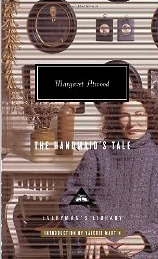
Day Thirteen: The Handmaid’s Tale

Cover for The Handmaid's TaleWhen I first read Margaret Atwood’s The Handmaid’s Tale back in the 80s, I believe my reaction was that the Canadian author might be over-reacting to the rise in American religious fundamentalism, although that also made it fairly scary reading. Not only does the novel translate well into this century, it is even more effective and foreboding in a time when hard-won civil and reproductive rights are being abrogated, education is being dumbed down and tampered with (as we know who have to fight the “intelligent design” battle every two years), and fundamentalism of all kinds is on the rise. Everyone should read or re-read this book.

Atwood presents the story skillfully. It is from the point of view of one person, the handmaid, as she struggles with her everyday life but remembers her previous one–one that we would consider normal. Instead of explaining what happened, she muses about her life as her thoughts come to her and as things happen, so it takes us awhile to understand what is going on. More than 20 years later, I still remember my horror when I realized the handmaid’s function in this dystopian society.

All we understand at first is that the handmaid lives in a rigid, stratified society in what used to be the U.S. in the not-too-distant future. It is a time of war, and there are terrifying checkpoints everywhere. All women are forced to wear uniforms in specific colors that indicate their station and function, and hers is red. She is treated as an outcast, and almost her every action is supervised. It takes us awhile to figure out that she lives in a theocracy, the laws of which were made as an apparent backlash against the successes in the late 19th century of women’s rights. In a foreword to the version I read, Atwood says that she purposefully didn’t include anything in the book that people have not already done to each other, which makes a statement in itself.

The novel is beautifully written. Although education for women is against the law, the handmaid was educated in her previous life, and constantly plays with language as she muses.

Read in the current climate, some of the themes and statements in this book will send a chill down your spine.