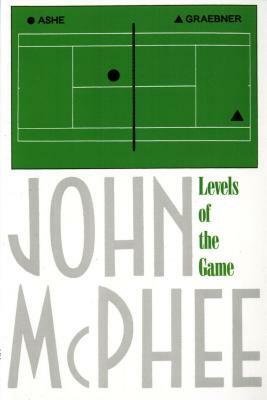
Review 2537: Levels of the Game

Although John McPhee is best known for his work in the 1960s through 1990s, he is still going at 93. He is known for being a pioneer in a style of writing called “creative nonfiction” or “literary journalism.” Years ago, I read his four-volume work Annals of the Former World, about the geology of the United States, basically the formation through time of various areas of the country, which was absolutely fascinating. Later I picked up a copy of his Coming into the Country, about homesteaders in the wilds of Alaska in the 1970s. So, when I saw he had written a book that could fill a hole in my A Century of Books project, I got it.

Levels of the Game is not really my subject matter. It cleverly combines a play-by-play description of a tennis game at Forest Hills in 1968 with profiles of the players. This is an amateur game between Arthur Ashe and Clark Graebner. Although I used to watch tennis a bit when Ashe was further along in his career, I couldn’t really follow the subtleties of the play-by-play that well. I’m sure for tennis lovers it might have been climactic.

Ashe at the time was the only Black player of the U. S. circuit, and there were no others following behind. A lot of what McPhee says in his profile is interesting and a lot is dated. Coming up, Ashe ran into situations where he was barred from clubs. Yes, it was still like that.

If you’re a sports fan, particularly of tennis, you’ll probably get more out of this book than I did. Still, I didn’t really understand the important place Ashe holds in the game until I read this book.

P. S. The description of Ashe, who at the time was a lieutenant at West Point, putting on love beads to go on a date, cracked me up.

Related Posts

Open: An Autobiography

Coming into the Country

Annals of the Former World: Basin and Range

Day 245: Unbroken: A World War II Story of Survival, Resilience, and Redemption

Cover for UnbrokenUnbroken is the incredible story of Louis Zamperini, an Olympic runner whose plane went down in the Pacific during World War II. He and his pilot Phil (Russell Allen Phillips) survived many days on a small raft only to be captured by the Japanese and interred in a series of brutal POW camps.

The book begins with Zamperini’s childhood in California as an almost feral creature who was always in trouble for stealing and other mischief. His unconquerable spirit served him well through his travails in adulthood but caused problems for his parents and himself when he was a child. His unruly years were ended, or at least subdued, by his brother Pete’s interest in training him as a runner, as he had always been the kid who ran away from his pranks the fastest. Once Louie began to take the sport seriously, he became a very fast runner and began winning medals. Although he only finished 8th at the 1936 Olympics, he ran his last lap in 56 seconds, and his dream was to return to the Olympics and medal.

After Pearl Harbor Louie became a bombadier and made many flights in dangerous and ill-equipped planes until his B-24, known as a lemon, went down during a search for another missing plane. I was particularly surprised at how unsafe the planes were and how ill-equipped the men were when their plane went down. Their raft contained only some chocolate and a few flares, and its repair kit pieces were ruined because they weren’t kept in a waterproof envelope. The three men who survived the crash had no equipment to make drinking water from sea water and were reduced to attempting to catch rain water. They had no food except the chocolate (which one of the men ate the first night). Braving strafing by a Japanese plane, shark attacks, dehydration, starvation, and a typhoon, Louie and Phil survived more than 40 days at sea. The other man died.

Their raft landed on an atoll in the Marshall Islands, where they were immediately captured by the Japanese. At first treated kindly, once they were transferred to POW camps, they encountered unbelievable brutality. Aside from being routinely starved–while Red Cross shipments intended for them were stolen by the Japanese–they were forced into hard labor and regularly beaten. Louie in particular because of his ungovernable nature became the scapegoat of an insane, brutal guard named Mutsuhiro Watanabe.

About half of this book is devoted to the men’s experiences in the camps, with the focus on Louie after he and Phil were separated. Eventually, though, the men were saved with the end of the war. The rest of the book related Louie’s trials with PTSD and alcoholism and how he overcame those problems to live a productive life. The book ends with his accomplishments even in an active old age, including carrying the torch at the 1988 Olympics in Nagano on his 81st birthday.

Overall, this is an interesting book, but I found the descriptions of the brutality at the camps overwhelming. Although I am not squeamish by any means, I kept reading a few sentences only to have to put the book down. I read it for a book club, and the other members reported having the same difficulty, even skipping over complete sections. The writing was excellent–Laura Hillenbrand’s Seabiscuit is a favorite–and the story compelling, but the details difficult to absorb.

Day 190: Open: An Autobiography

Cover for OpenBest Book of the Week!

Those of you who know me will probably be surprised to see the review of a sports biography on my blog. I will freely admit that this is not a book I would have chosen for myself; instead, it was a choice of my book club. That being said, I found Open: An Autobiography by Andre Agassi to be extremely interesting and even touching.

In making notes for my review, though, I came across another problem–how to review a biography of a living, well-known figure except by relating some of its disclosures. For some assistance on this, I took a peek at the review in the New York Times, but they obviously had the same problem. However, a phrase in that review caught my attention. The reviewer remarked that from the first time Agassi first appeared in the sport, he looked like a deer in the headlights. Now, look at the picture of him from the cover of the book.

This expression is a lead-in to a story about a sad, sad boy who seems to have finally grown up into a mostly happy, contented man. His big secret, which by now everyone knows, is that this athlete, who is considered one of the best tennis players in the world, ever, has always hated tennis. He was forced into the game as a young boy by his fiercely competitive (and I would say, although he never does, abusive) father, a former Olympic boxer who never succeeded professionally but was trying to live his life through his son.

His fate was so predetermined that his father gave him a tennis racket to hold in his cradle, and when as a boy he found he preferred soccer because of the camraderie (he frequently remarks on how lonely a sport tennis is), his father made him quit so he could spend more time on tennis. The vision of Agassi as a small boy facing the machine his father had rigged to fire thousands of tennis balls at him at an unbelievable speed is a chilling one.

I was particularly outraged by the attitude of his father and other adults toward his schooling. Agassi is clearly an intelligent person. He can remember, literally, everything, but as he explains in the book, except in English class he had difficulty grasping concepts. He had to have them explained to him a few times, and then he could remember them. When you watch his farewell speech at the 2009 U.S. Open or any of his speeches about his charter schools, you can see that he is a thoughtful, reasoned, even eloquent speaker who does not need notes. I am guessing that he may have had some sort of learning disability.

I feel so sorry for a boy who needed help with his lessons instead of a father who regularly had him skip school to play more tennis. Later he was sent to a tennis training school at the age of 14 (a school that sometimes sounds like something from Dickens and other times like Lord of the Flies), from which he was allowed to drop out of school to pursue, you guessed it, more tennis. This “preparation” gave him no other recourse–he was forced to follow a career in tennis because he had no other prospects and couldn’t do anything else.

Open is about Agassi learning to grow up and make peace with himself. It is terrifically engrossing, and his descriptions of some of the games made me wish that I had seen them. (Actually, I watched some of them on YouTube.) He avoids any kind of self-aggrandisement. In fact, as the title says, he is open for the first time in his life. Although he expresses himself honestly, he does not use the occasion of writing this memoir to slam other people or tell anyone’s secrets but his own. His depiction of certain other well-known figures (for example, his marriage to Brooke Shields and his rivalry with Pete Sampras) is balanced, and it seems, fair. Finally, I found it touching to see how a person who grew up in such a harsh environment would turn out to be so caring of others.