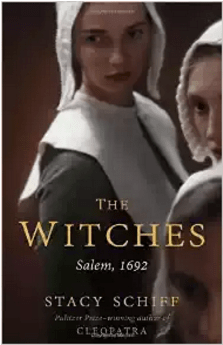
Day 861: The Witches: Salem, 1692

Cover for The WitchesIn The Witches, Pulitzer-winning nonfiction writer Stacy Schiff takes another look at 1692 Salem and its witch hunt. She explores the climate of New England at the time, particularly its paranoia and excessive religiosity, and why it was open to such an over-reaction. The book also explores the ramifications for the region for years to come.

Schiff quickly points out that much of what is “known” about the witch trials is apocryphal. There was no black slave, for example, but an Indian servant. Schiff reconstructs the events from what she can find, many of the official documents having been destroyed at later times, and the accounts, even of the official note takers, varying considerably from one another and interjecting opinion and descriptive wording that should not have been permitted.

The incident began with one household, where some of the children were subject to screams and contortions. This household was that of Samuel Parris, the minister of Salem Village. The girls were a niece, daughters, and a servant, all teens or pre-teens. Schiff is fairly charitable in ascribing the state of these children to a condition that was later diagnosed as hysteria (a condition itself fraught with controversy), which generally affected young women leading restricted lives with little hope of change. Later, we hear of another householder who handled a similar condition severely and eliminated it. But Parris soon established it as witchcraft, and an even larger group of girls and other people who became afraid of being accused themselves were on their way to a lot of attention. As one of them put it (whose remark was ignored), “We must have some sport.”

They had their sport all right. By the end, 19 people and 2 dogs were hanged for witchcraft. Some of the girls would have gone on from there, but the colony finally declared there would be no more prosecutions and the behavior eventually stopped.

This is a fascinating book that explores such topics as permissible evidence, assumption of guilt, the treatment of people who protested their innocence versus that of those who admitted guilt, and the behavior of certain of the principal leaders of society. It finds parallels to other events much more recently in our past.

Related Posts

Cleopatra, A Life

Véra (Mrs. Vladimir Nabokov)

Mayflower: A Story of Courage, Community, and War


Day 522: Véra (Mrs. Vladimir Nabokov)

Cover for VeraBefore I start on my review of Véra, I just wanted to comment on the death of Mary Stewart, which I just heard about. I have been reading and re-reading Mary Stewart’s books since I was a young girl. Not only did she write some of the best romantic suspense stories ever, but she also wrote a much-praised historical-fantasy series about Merlin. Her works were well grounded in their settings and beautifully evoked places (some of which we will never see again, such as 60’s Damascus and Beirut). To my surprise, my post about her book This Rough Magic continues to be one of the most visited on my site. We are going to miss Mary Stewart. I have re-read Stewart’s books so many times that I can write reviews of them from memory. I’ll post another one soon.
***

I’ve read two biographies now by Stacy Schiff, and both of them are about elusive women. Cleopatra was elusive because most of the information about her life is available only from prejudiced sources. Véra Evseevna Nabokov was elusive because she wanted to be.

Véra considered Nabokov to be a genius and his work to be of sole importance. She never publicly acknowledged her own contribution to it. Even the subtitle of this biography reflects the way she presented herself, always as Mrs. Vladimir Nabokov.

I don’t know a lot about Nabokov. I have read only one of his books, Lolita, but I found it astounding. Despite my dislike of the subject matter, reading it was an amazing experience, and I found the use of language astonishingly beautiful. But you do not need to be familiar with Nabokov’s oeuvre to find this biography, which won the Pulitzer, fascinating.

The Nabokovs had a truly collaborative relationship even though they never publicly acknowledged it. Although Véra denied helping him write, he often called her his first reader. Visitors heard her tell him to reword phrases or even remark, “You can’t say that!” For years, she typed up his manuscripts from his note cards or his dictation. She oversaw the translations of his work into different languages, even laboriously correcting them in the several languages she spoke. She was exacting about the use of words. She took care of all Nabokov’s correspondence, even to friends and family, as well as his business and financial affairs. She was the gatekeeper for interviews and visitors. She also drove him everywhere (and carried the luggage). Her entire married life was dedicated to providing him time and peace to write.

In areas even more directly affecting the success of his literary career, it was at Véra’s suggestion that Nabokov begin to write fiction in addition to poetry. Once the Nabokovs emigrated to America, Véra convinced Vladimir to begin writing in English. She pulled the manuscript of Lolita out of the fire on three different occasions, and it became his most famous work. Students taking his classes at Cornell were bemused by his “assistant,” who provided quotations or page references just when he needed them, drew complex diagrams on the blackboard, and erased it after class. Véra also taught his literature and language classes for him on many occasions and was acknowledged as a better, more systematic Russian language teacher than her husband.

Véra never seemed to resent this role she had taken on; she fostered it. But she was in no sense a nonentity. In correspondence she was much more direct than her husband. Although they tended to share correspondence—he would start a letter, perhaps; she would finish it; he would sign it—she was always left to impart the hard news—the refusal of contracts, the dictation of terms, the correction of translations. Many people believed that she was a dragon who was screening Nabokov’s mail or keeping people away from him, but she was doing what he wanted.

The couple was seldom seen apart. Although Nabokov had an affair early in their marriage and liked to flirt with women, he dedicated almost all his books to Véra. They had an extraordinary marriage, and this is an extraordinary, surprisingly entertaining book.

Day 22: Cleopatra: A Life

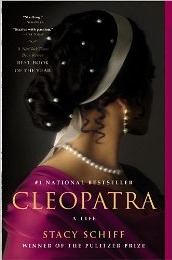
Cover for Cleopatra: A LifeWhen my grandmother traveled to Egypt in the 1960s, she wanted to buy a bust of Cleopatra. She was surprised to find out that the Egyptians consider Cleopatra a traitor. No images of her were available, so Granny Billie came back with a bust of Nefertiti instead.

When you think about Cleopatra, maybe you imagine the beautiful seductress played by Elizabeth Taylor in the movie. Maybe you think about the scheming whore in Antony and Cleopatra. Maybe you even think Cleopatra was Egyptian. (The Ptolemys were Greek.) Stacy Schiff, whose book Cleopatra: A Life was selected by the New York Times for its best books of 2011 list, would point out to you that Cleopatra’s history was written by the victors, her defeaters.

Schiff tells us the engrossing story of what is known of Cleopatra’s true life. Certainly she married her brother. So too did most of the Ptolemaic rulers marry their own siblings. Certainly her brother was executed when he revolted against her. The Ptolemys were noted for lopping off the extra branches of the family tree.

What you may not know is probably more to the point. Schiff shows us a picture of Egypt, the wealthiest country in the ancient world when Cleopatra gained the throne, but already on the wane. And there is its powerful ruler, Cleopatra, not beautiful but cultured and intelligent, reportedly fascinating in conversation, educated. Not the type of woman the patriarchal Romans are used to dealing with.

A clever strategist and negotiator and witness to Rome’s attempt to gobble up the known world, Cleopatra early realized that she needed to carefully pick her allies in Rome’s continuous battles for control of the empire. First she picked Pompey over Julius Caesar—not ultimately the wisest decision, but her family had ties to him, and her brother’s betrayal of him was one of the horror stories of the age. Then she negotiated a partnership with Julius Caesar, but unfortunately he was soon assassinated. Her next choice was not as percipient, but Marc Antony seemed to be the greatest soldier of his time.

There are few unbiased records of Cleopatra’s life, and none that are biased for her, but Schiff does an excellent job of examining the various allegations made in the existing records and judging their likelihood. Rather than the ruthless vixen reviled through the ages, Schiff depicts Cleopatra as a strong woman who was doing her best for her country.

Although some have criticized the book as heavy going (one actually commented that it “lacked dialogue”—I don’t know what source that person thought the dialogue would come from), I didn’t find it so. It was written for the general public but reflects serious scholarship, and Schiff has found an elegant balance between that and entertainment.