
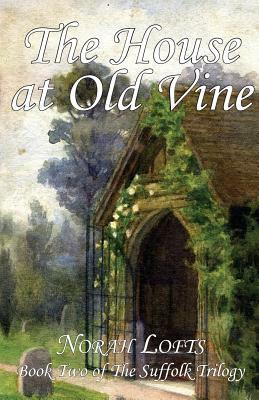
The House at Old Vine is the second book in Norah Lofts’ Suffolk trilogy. Like the first book, it changes narrators, but as each section is considerably shorter than the first section of the first book, the effect is of linked short stories.
The novels follow a house and a family through time, beginning in the Middle Ages. This one begins sometime before 1496 and ends in 1679 and has half a dozen narrators. Each section is separated by an Interlude, which briefly tells more about what happened next.
In 1496, Josiana Greenwood tells the story of her life and her doomed love. Some of the characters from the previous book are still in the periphery. Josiana is a bastard child whose mother refused to tell her parents the identity of her child’s father. Her grandparents have treated both her and her mother like the lowest of laborers, but when she is 13, her grandfather wants to sell her off to a much older man who disgusts her. To protect her, her mother takes her to the nuns at Clevely, where she is educated and meets her true love. We know from the beginning that her love, Walter Rancon, is going to be burned by the church as a Lollard, but the story goes back in time to divulge other facts and secrets, including the connection to the family of the original serf who accumulated the property, Martin Reed.
In 1565, the background of the story is the reign of Elizabeth and a Catholic priest in hiding. Elizabeth Kentwoode is a child who has been thoroughly spoiled by her grandfather. She is quite a vicious child, and she shows what she will do to keep her string of blue beads.
In 1620, Elizabeth Kentwoode, now a redoubtable woman sometimes called Madam, selects Barbara Hatton to be the wife of her nephew John. Barbara is in love, but shortly after the wedding, Elizabeth lets her know that John has a long-time lover, a bar maid, who looks a lot like Barbara.
In 1645 during the English Civil War, Anthony Flowerdew is a spy for Parliament trying to find Royalist supporters when he comes to stay at the Old Vine, now a respectable inn which had first been run by Madam and now by Mrs. Kentwoode (Barbara). Anthony falls in love with Barbara, now a widow with a son, and decides to quit being a spy.
In 1670, Ethelreda Benedict is a girl from an island in the fens who has barely ever met anyone besides her father when he dies. She has to leave the island and eventually gets a position at Old Vine, now a boys’ school run by Anthony Flowerdew and his stepson Chris Kentwoode. A sort of leech on the place is Barbara’s relative Canon Hatton, who while everyone has plain fare, sits in his room and eats only the best food. Yet the others think he has nothing.
In 1679, Oliver Stanton, one of Anthony Flowerdew’s old students, breaks with his father and returns to Old Vine hoping to get Flowerdew’s help in finding work. There he finds Flowerdew as an old man struggling to support the school by himself with Ethelreda Hatton now doing all the work and the Cannon still hulking by his fire. Chris Kentwoode has died, and the number of students has dropped off. Oliver takes a job as a teacher there and soon begins to feel sorry for Ethelreda, who is overworked and mistreated by her husband.
Some readers may find this format keeps them from being involved in the characters, but I felt some interest in some of them. Although it would have spoiled some surprises, I would have liked to see a chart tracing the characters’ relationships, at least the ones from the last book, as sometimes it was difficult to follow how they connected to the original characters.

