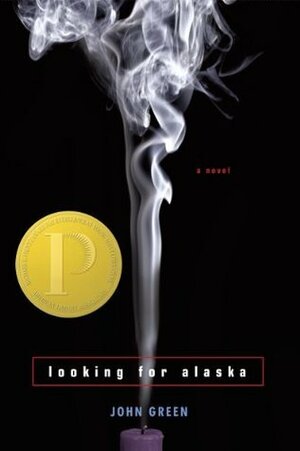
Review 2566: Looking for Alaska

The few John Green books I’ve read are aimed at teenagers (although some are excellent adult reading) and address, fairly subtly, an issue. For Looking for Alaska, it’s death and grief.

Sixteen-year-old Miles is miserable in his school. He has no friends, and the level of education is fairly low, so he convinces his parents to send him to a boarding school in Alabama that his father attended. He is hoping this change will initiate what he calls the Great Perhaps.

He is lucky enough to pull as his roommate a stocky kid named Chip (aka The Colonel). The Colonel is at first dubious of him until some other students overdo it with the initiation for new students. The custom is to haul Miles off in the middle of the night and drop him into the lake, but because The Colonel and his friends have lately pranked them, one of them wraps Miles up in duct tape and then they drop him in the lake. He is in danger of drowning, but he manages to float himself to shore and then get the tape off.

The Colonel is outraged by this prank because it was so dangerous. He has a running feud with the Weekday Warriors, rich kids who board there but return home every weekend to their parents’ homes in Birmingham. It was some of those kids who duct-taped Miles because of his association with The Colonel.

The Colonel nicknames Miles “Pudge” because he’s so skinny and introduces him to his friends, a Japanese boy named Takumi and a girl named Alaska. Miles is immediately smitten by Alaska, a cool girl but with an unstable temperament, usually out-going and dare-devilish but sometimes hysterically unhappy.

The group pals around, teaches Miles to smoke and drink and get into trouble, but they also take studying and grades seriously, especially The Colonel, who is on a scholarship and comes from a very poor home.

Then one of the friends dies.

For once, I thought Green got a little of this wrong. Some of the friends’ reactions didn’t read true, or maybe they did and I just don’t know teenagers. For example, throughout the novel, Miles is fascinated by the last words of famous people, so much so that he reads a lot of biographies. When the friend dies, he is upset, but he regrets he didn’t get to hear the friend’s last words. He is supposedly devastated by the death and blaming himself, so that seems like a flippant reaction, but Green mentions it twice.

Otherwise, Green does his usual masterly job of gaining your sympathy for his characters and presenting them with a difficult situation. He writes well, avoiding that stereotypical “teenage voice” that so many adult authors use; has a good sense of humor; and is good at depicting believable teenagers.
Related Posts

The Fault in Our Stars

Turtles All the Way Down

Tell the Wolves I’m Home

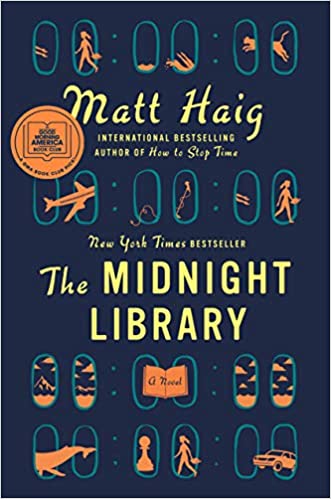
Review 1800: The Midnight Library

I am usually fairly good at spotting books I’m just not going to like without reading them, but I try to keep an open mind. Sometimes I am surprised if I do read one, as I was when I read Eleanor Oliphant Is Completely Fine. Sometimes I am not.

Nora Seed’s life started out with a lot of promise, but for one reason or other she quit doing all the things she’s good at. Haig begins with a countdown of days and hours before she decides to commit suicide. Having taken an overdose, she ends up in a library of all the lives she could have had, free to try some of them out.

I kept my patience and read through the first alternative life, about a quarter of the book. Then I quit.

Why didn’t I like it? Let me count the ways:

  1. The horrible sprightly tone with which it discusses a character who is so miserable she is suicidal
  2. The choppy rhythm of its writing. Almost every sentence begins subject verb subject verb, more like a children’s book than an adults’.
  3. The lack of character depth, or really any personality at all
  4. The lack of any kind of depth or subtlety
  5. The confused and poorly thought out working of the library
  6. Pretty much everything else about the book

Eleanor Oliphant Is Completely Fine

A Man Called Ove

The Virgin Suicides

Day 984: A Tale for the Time Being

Cover for A Tale for the Time BeingMonths after the Japanese tsunami, Ruth, of Japanese descent, finds a barnacle-covered package on the beach of the island in British Columbia where she lives. The package contains a Hello Kitty box with the diary of a young Japanese girl.

Ruth gets involved in reading this diary. The girl, Nao, tells a difficult story of having been raised in Sunnyvale, California, until her father lost his job at a technology company. The family was forced to return to Japan, where her father has been unable to find work and is suicidal. Nao, seen as an outsider by her classmates, is viciously bullied. Nao, too, is considering suicide.

The only bright spot in the girl’s life seems to be Jiko, her 104-year-old great grandmother, a Zen Buddhist nun. Jiko has taught Nao a few of the fundamentals of Zen Buddhism, which help support her. Nao has stated an intention of writing about Jiko’s life, but she actually writes about whatever occurs to her, including the story of her uncle, a World War II kamikaze pilot.

This story is punctuated with scenes from Ruth’s quiet life on a small island with her husband Oliver, a biologist. Both stories dip into philosophy, Buddhist beliefs, and even a little magical realism. Ruth and Oliver become involved in Nao’s story and wonder if she committed suicide, if she survived the tsunami, and where she is.

At first I resisted this novel a bit. I probably wouldn’t have read it if it was not on my Man Booker Prize list. I wasn’t completely convinced by Nao’s voice, and I felt that the story was a way to sneak in lessons about Buddhist teachings. Eventually, though, I got sucked in and became just as interested in Nao’s fate as Ruth was.

However, in tackling its many subjects—suicide, bullying, the trash in the ocean, the nature of time, the tsunami, World War II, just to name a few—I sometimes felt this novel was all over the place. It is entertaining but kind of mind boggling.

Related Posts

The Brief Wondrous Life of Oscar Wao

We Need New Names

The Life and Death of Sophie Stark