Review 1385: The Miniaturist

Best of Ten!
I so enjoyed The Miniaturist that I was only disappointed at knowing all its secrets, since I had first seen it televised on Masterpiece. Jessie Burton’s novel is set in the 17th century, and what a difference from the previous novel I read (Widdershins) also set in the 17th century. Burton’s novel evokes the bustling city of Amsterdam, ruled by commerce but also by a harsh Calvinism, a city where people are constantly watched for misbehavior.

Nella arrives from the country to take up residence with her new husband, Johannes Brandt, a wealthy merchant. Although she brings a good family name to the marriage, she brings nothing else, for her father was a poor businessman.

Nella isn’t warmly received. Johannes’s sister Marin is cold, and Johannes hasn’t bothered to be home. When, after a few days, Johannes hasn’t consummated the marriage and Marin continues with the housekeeping, Nella fears that she has no role in her new life.

Johannes’s marriage gift to her is a miniature copy of their house that she can furnish. Although Nella thinks he is treating her like a child, she eventually sends a note to a miniaturist asking for three items: a lute, because Marin will not allow her to play the ones in the house; a block of marzipan, because Marin disapproves of sugar; and a marriage cup, which Nella should have received from Johannes but did not. When the items arrive, they are exquisite, but she also receives things she did not order. And more arrive. They so closely match what is going on in the house that Nella first thinks the family is being spied upon, later that the items foretell the future.

This novel is really good. The story and characters are compelling. Life both within the claustrophobic household and the city is evocatively evoked. It has a delicate touch that reminds me very much of Tracy Chevalier’s The Girl with a Pearl Earring. And there is that tantalizing touch of the supernatural.

Related Posts

The Last Painting of Sara de Vos

Corrag

The Weight of Ink


Review 1375: Melmoth

Helen Franklin is an Englishwoman living in Prague who leads a willfully colorless and drab existence. She dresses and behaves as if she wants no one to notice her and makes a living translating brochures. In nine years in Prague, she has made only two friends, Karel and Thea, a couple.

Helen encounters Karel one night, looking ill. Thea was recently stricken by multiple sclerosis, and Helen assumes he is worried about her. He tells her the story of a manuscript he’s been given that documents sightings of Melmoth. In the legend of the novel, Melmoth (who seems in actuality to be based on a male character in an Irish Gothic novel) witnessed Christ arisen from the grave but denied it. In this novel, Melmoth is an evocatively described woman, a suggestion of tattered sheer silks, who is fated to witness man’s inhumanity. She appears to those who have entered the depths of despair and asks them to keep her company.

Through the manuscripts, we learn the stories of several people who have caused the sufferings of others and who have met Melmoth. Both Karel and Helen are immediately obsessed with this vision and imagine Melmoth stalking them.

The novel is tied together by the gradual exposure of Helen’s own crime, but the themes of the novel center around the history of man’s inhumanity and the importance and difficulty of witness.

This novel was certainly a departure from Perry’s The Essex Serpent, and I wasn’t sure how much I liked it. It has a deeply Gothic atmosphere, suitable for its setting in Prague, but I didn’t understand its characters’ fascination with Melmoth. Also, I had little sympathy for most of the characters whose crimes are related in the manuscript, even though I was sympathetic to Helen. Although this novel has more serious intentions, I have to say I preferred The Essex Serpent.

Related Posts

The Essex Serpent

Wylding Hall

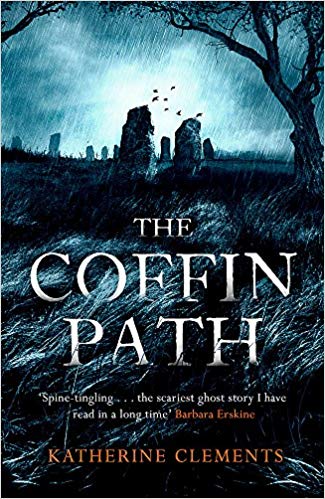
The Coffin Path


Review 1326: The Coffin Path

Cover for The Coffin PathIt’s 1674, and Mercy Booth helps her aging father work a sheep farm in remote northern England. She feels that at 28, she is beyond marriage, but she really only cares about the farm.

In early spring, she is out on the moor when she feels that someone is watching her with enmity. After that, strange things begin happening in the house. Three old coins disappear from her father’s drawer. She hears noises upstairs when no one seems to be there. She catches glimpses of a pale face. The home is believed to be cursed after the three prior inhabitants were all murdered, their mouths covered with those missing coins.

Early in spring the head shepherd hired Ellis Ferreby, a wandering shepherd. The novel is narrated by him in alternate chapters as he observes what is going on. He, too, has seen and heard strange things.

Also key to the story is Sam, the young son of Ambrose, the head shepherd, who lately lost his twin brother after a fall. He is a favorite of the house but begins to behave strangely.

This novel is truly atmospheric, and although I had glimpses of its secrets, I could not figure everything out. I found myself interested in the characters and involved in what was happening to them. This is a real page-turner.

Related Posts

Corrag

The Haunting of Maddy Clare

All the Birds, Singing


Day 1227: Miss Seeton Flies High

Cover for Miss Seton Flies HighAgain, I requested Miss Seeton Flies High from Netgalley without realizing it is part of a series. In fact, “Hamilton Crane” is the pseudonym for the second writer of the series, the first being Heron Carvic. Miss Seeton Flies High is the 23rd book in the series.

If you are expecting a traditional mystery from this series, you’ll be surprised. Miss Seeton is a sort of cross between Miss Marple and a medium. Her forte is drawing surrealistic pictures that give the police clues about the crime in question, if they can figure them out.

Miss Seeton is asked about the kidnapping of a rich playboy and draws a picture of crazed sheep that leads the police instead to a pot-growing enterprise. Later, the retired art teacher receives a much-appreciated windfall. She uses it to take a short vacation in Glasonbury to research King Arthur for a local play. In Glastonbury, she meets a man who later becomes a victim.

This novel is set in the 1970’s and has a little bit of the 70’s atmosphere, especially with hippies and other New Agers in Glastonbury.

link to NetgalleyOf course, even the notion that the police would take Miss Seeton’s drawings seriously is ridiculous, let alone treat them as evidence. The reader has no hope of interpreting the drawings and guessing the perpetrator of the crime, since they are full of puns and not enough information about them is provided. Essentially, these novels are meant as spoofs of whodunnits. I’m sure they’re fun to write. I didn’t find the novel as much fun to read.

Related Posts

Coffin, Scarcely Used

The Red House Mystery

The Iron Clew

Day 1217: A Footman for the Peacock

Cover for A Foot man for the PeacockA Footman for the Peacock is a strange little novel. The novel was controversial when it was first published during World War II, because it depicts an upper-class family that tries to avoid its civic duty during the war. But that activity seems almost incidental to the rest of the plot.

What is the plot? The narration flits around in time but centers on the Roundelay family. Their current configuration consists of Sir Edmund and Lady Evelyn and their household of two daughters, three elderly aunts, and three or four servants, including the retired and senile Nursie. When we finally seem to be settling somewhere, on the new Lady Evelyn’s growing acquaintance with the village and regional customs, we stay only long enough for her to hear an old running song, which Evelyn in her innocence takes to be about hunting. then we skip over to her daughter, Angela.

Angela seems to have a sensitivity to an upper-floor servant’s bedroom where the words “Heryn I dye, Thomas Picocke, 1792” are etched on a window pane. She makes an odd connection between this room and an unfriendly peacock in the grounds of the estate, which seems to be signalling Nazi bombers to destroy the house.

I guess I found this novel, which has a supernatural element, peculiar enough to be amusing, but it certainly has an unusual premise. I had more of a problem with the scattered narrative style, which took a long time to get somewhere. Ultimately, the novel becomes a story of class abuse and cruelty in the 18th century.

Related Posts

Harvest

Longbourn

His Bloody Project

Day 1070: Burntown

Cover for BurntownThe previous two books I’ve read by Jennifer McMahon were a weird combination of unusual but realistic life and the supernatural. Burntown features the supernatural less, but in some ways is more bizarre and in others verges on the precious.

When Miles Sandeski is a little boy, he sees a man wearing a chicken mask murder his mother. Despite his assurances to the police that the man was not his father, the police think his father did it. Later, his father takes his own life.

Miles’s father handed down an invention taken from Edison’s lab that allows people to talk to the dead. Miles uses it to talk to his mother and find out who killed her. Then he goes off to do something about it.

Years later, something dreadful happens at Miles’s house. His daughter Eve, now calling herself Necco, ends up living on the streets in their industrial home town of Ashford, Vermont. She doesn’t remember what happened, but her mother has told her that a flood washed away their home and killed her father. Her mother became a Fire Eater, ingesting a drug that brings visions of the future. But her mother has died, apparently jumping off a bridge.

Necco is camping out in a car with her boyfriend when her boyfriend is murdered. He has been looking into her past and promised to show her something the next day. The police think she murdered her boyfriend and are trying to find her. However, they don’t know who she is.

Theo is also running from someone. Her girlfriend Hannah talked her into selling drugs to the high school students. Theo did a big deal and then left her sachel at Necco’s place when some kids took her there to watch Necco breathe fire. The drug dealer is after her for his money, but in going back for her sachel, Theo may have seen the murderer.

link to NetgalleyAs Necco and Theo try to figure out what’s happening, they get help from unexpected places and make new friends. Although there is a certain amount of danger in this novel, it is far less eerie than the previous two novels. It depends more on strange characters and desolate urban settings than on its supernatural elements. I liked it well enough but felt it verged oddly toward being a feel-good novel full of eccentric characters at the conclusion.

Related Posts

The Night Sister

The Winter People

The Night Strangers


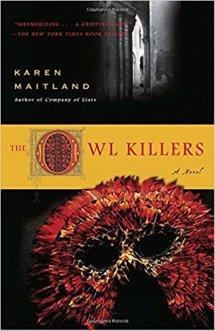
Day 1056: The Owl Killers

Cover for The Owl KillersIn the 1321 village of Ulewic, England, a group of women have settled into a beguinage, a community of women who are committed to a life of celibacy and service but not one sanctified by the church. Some of them are from Belgium, and they are led by Servant Martha.

The village is experiencing dark days and some of the villagers are returning to a pre-Christian cult called the Owl Killers. When the beguinage takes in a leper and then the daughter of a lord, who has been raped, the villagers and the Owl Killers begin to turn against them.

Although this novel is atmospherically dark and seems well researched, I had a hard time sticking with it. This problem may have more to do with the fact that we were moving cross-country while I was reading it than with the book itself. But I frankly found few of the characters sympathetic. The village priest is so terrified that the truth of his affair with a man will come out that he is led into dastardly acts. Servant Martha seems completely blind to what is going on with some of the members of the beguinage. Beatrice is jealous and bitter. Osmana is sympathetic but one-dimensional.

I may try another Maitland novel at a better time. The novel blends a bit of the supernatural with a fairly straight historical narrative, which combination is interesting.

Related Posts

The Daylight Gate

Harvest

The Chalice


Day 968: Lost Among the Living

Cover for Lost Among the LivingIt is three years after World War I. Jo Manders is working as a paid companion to her husband’s aunt, Dottie Forsyth, after her husband Alex disappeared during the war. Jo has been in a limbo of grief and practical concerns. Although he is assumed dead, Alex has not been declared dead, so Jo cannot receive a pension. Penniless, she was forced to take the job with Dottie, who is often unpleasant or rude.

Jo has been traveling with Dottie through Europe buying art from newly impoverished nobility. But now they are on their way to Dottie’s home, Wych Elm House, which has been closed for some time. Dottie’s son Martin is returning home from a hospital where he’s been treated since the war, and Dottie has summoned home her husband with the plan of finding Martin a wife.

On the first day at the house, Jo walks into a room and sees a young girl in gray and pearls. It takes her some time to realize she’s seen a ghost—Dottie’s mentally ill daughter Franny who died during the war by falling off the roof. Franny had hallucinations and claimed that a demon dog named Princer protected her. In the village, Jo hears that children claimed to have met Franny and Princer in the woods. On the same day that Franny died, the body of a man was found in the woods, torn to pieces.

As Franny keeps appearing to Jo, sometimes leaving things for her to find, Jo begins to believe that Franny was murdered. She also wonders about one of Dottie’s clients, a  mysterious Colonel Mabry, who seems to know something about Alex.

St. James just keeps getting better and better at her chosen combination of suspense, the supernatural, and romance. In this case, a little of the mystery was lessened because there was only one plausible romantic partner for Jo, but still, this is a very suspenseful, eerie novel.

Related Posts

The Haunting of Maddy Clare

An Inquiry into Love and Death

Silence for the Dead

Day 960: Silence for the Dead

Cover for Silence for the DeadKitty Weekes has been living a catch-as-catch-can life ever since she fled from her abusive father four years before. To support herself and hide from her father, she has taken on several different identities the past years. Now she has forged credentials as a nurse to get herself a job at Portis House, an asylum on the coast of England.

When Kitty arrives at the isolated mansion, separated from the village by a bridge, Matron sees through her right away. But the hospital is understaffed, so Matron keeps Kitty on probation. The mansion was once beautiful but now it is forbidding, with sealed off areas that are crumbling. The patients are all ex-servicemen suffering from shell shock, depression, and other conditions related to the war. The routines of the place seem unnecessarily severe and the budget too limited. Then there is the mysterious Patient 16, whom only a few people are allowed to see.

Kitty soon finds herself working harder and longer hours than she was contracted for. But she also feels something is wrong. There are certain places around the house that don’t feel right. One night she sees a bare-chested man walking around when all the patients are accounted for. Another time when she is outside the house, she sees a unknown woman and when she goes to investigate, is knocked down.

Then she meets Patient 16 and is shocked to find he is Jack Yates, a hero of the war. Some information she gains from a previous nurse makes her wonder what happened to the family that owned the house, who simply vanished. When she and Jack begin exchanging information, they realize something strange is going on.

Silence for the Dead is another supernatural suspense novel from Simone St. James. It is quite good at developing an atmosphere of foreboding. Kitty is a plucky heroine, and this is another enjoyable light read from St. James.

Related Posts

The Haunting of Maddy Clare

The Other Side of Midnight

An Inquiry into Love and Death

Day 898: An Adventure

Cover for An AdventureAn Adventure is the account by two English woman academics of a couple of supernatural events during a visit to Versailles, published under pseudonyms. The women had the first experience on August 10, 1901, and the second was experienced by one of the women alone the following year. The two women claimed not to have spoken together about the first event until three months later, when they agreed that the Petit Trianon, where the first event occurred, must be haunted. At that time, they decided to write down separate accounts of the incident.

The first section of the book is each woman’s account of the incident. On a visit to Paris, they went to Versailles and decided to stroll the grounds looking for the Petit Trianon, which was a favored place of Marie Antoinette. Although their accounts disagree in some respects, both women reported seeing the same landscape and layout of buildings and some of the same people dressed in antique costumes. One of the women saw a lady painting in a white dress. They also reported an oppressive atmosphere.

On a subsequent visit, “Frances Lamont” heard people speaking as if they were walking on a path nearby and music from the 18th century. Later, the women were unable to locate many of the places they had visited on the previous visits. These events led them to decide they had observed supernatural visits of Marie Antoinette and some of her servants and courtiers. They also learned that Petit Trianon was rumored to be haunted on August 10, which is the anniversary of a pivotal date in French revolutionary history.

The second section of the novel relates the discoveries that the women made. It describes the differences between the landscape of the area at the time of the event and in the 1780’s. It details the women’s research to explain the costumes of the people they saw and the events witnessed.

The final section of the book contains the women’s explanations of the events as a combination of memories in the mind of Marie Antoinette as she and her family were cooped up in a small room on the day of August 10, 1789.

The most interesting part of the book is the first section, containing the women’s accounts of the events. The section about their investigation is harder to follow and difficult to visualize. Subsequent reading I’ve done on the notorious event contained allegations that their sources validating some of the information they researched were questionable.

The final section seems much too suppositional for easy belief (if you can believe any of it) as well as repetitive, revisiting much of the information from the second section. Whether you believe something supernatural happened to these women or whether their memories were influenced in the time that elapsed after the event or even that they invented the whole (which does not seem to be a general assumption), this is a mildly interesting account that was controversial when published, even during a time that was credulous about the supernatural.

Related Posts

Giving Up the Ghost

The Séance

The Sun King