Review 1617: The Western Wind

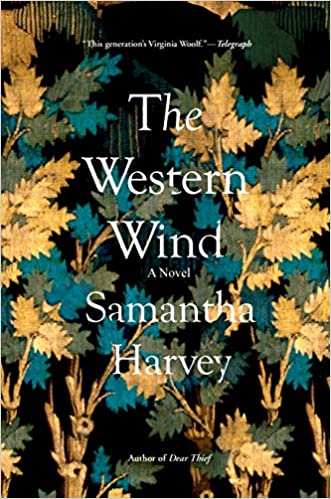
On Shrove Tuesday 1491, Henry Carter awakens the local priest of the village of Oakham, John Reve, to tell him he’s seen a body floating in the river. For four days, Tom Newman has been known to be drowned, but the villagers have not been able to recover the body. When John and Henry return to the river, however, the body is gone.

Although there is no evidence to suggest that Newman’s death was other than an accident or suicide, the dean, who has taken it upon himself to investigate, is convinced that Newman was murdered. His reasoning is that Newman, as the wealthiest, most productive man in town, is unlikely to have committed suicide and that there was no reason for him to be by the broken village bridge so early in the morning unless he was meeting someone. Before the day is out, the dean has selected two possible murderers and is trying to force Reve to pick one, even though Reve believes neither is guilty.

The novel moves backward in time to the day of the drowning, during which time the villagers’ secrets are revealed—John Reve’s among them. The novel is deeply interesting for its view into the thinking and superstitions of the Medieval mind. I read this absorbing novel for my Walter Scott project.

Related Posts

Fair Helen

The Owl Killers

The Chalice

Review 1590: The Burning of Bridget Cleary

In 1895, a rural Irish woman, a milliner, was burnt to death by her husband and relatives. Their explanation was that the ailing woman had been taken away by the fairies and that they had burnt a changeling trying to get it to say it was not Bridget Cleary.

Historian Angela Bourke examines this crime in detail, not only the events as reported by the witnesses and the trial but the meaning of it. She interprets fairy legends and their place in rural Irish society, and she also explains the meaning of comments and actions the night of the crime and the night preceding it in terms of these legends. She looks at the crime from a feminist point of view as well.

I found this book interesting, although at times I felt Bourke got carried away with her interpretations. Most of the time the writing style and her analysis are interesting, but the book is occasionally a little dry.

Related Posts

The Good People

Religion and the Decline of Magic

The Witches: Salem, 1692

Review 1556: Dark Enchantment

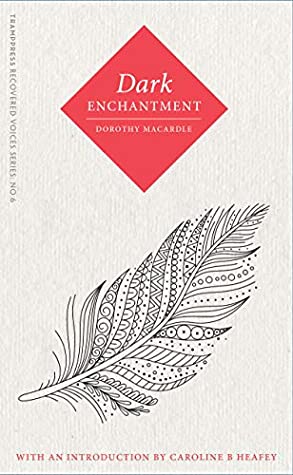
I was delighted to receive a review copy of Dark Enchantment from Tramp Press from their Recovered Voices series and decided to time my review for the season. This is especially felicitous because the movie from another Dorothy Macardle book, The Uninvited, has been my family’s go-to Halloween movie for years. This is another entry for RIPXV.

After three years of teaching, an occupation that Juliet Frith likens to drudgery, she is exhausted and unwell. Her employers, eager for her to leave because of newspaper stories about her mother, have summoned her father to take her away. Frith is an actor who can’t afford to support Juliet and doesn’t know what to do with her, but for now they are vacationing on the Côte d’Azur.

On a day trip to visit villages in the Alps Maritimes, Juliet is taken ill at an inn, so Frith makes arrangements for them to stay the entire week. Juliet improves rapidly and befriends the pregnant wife of the innkeeper, Martine, so Frith arranges for Juliet to stay there when he has to leave for a job. Juliet will be working half-time at the inn for the length of Martine’s pregnancy. It helps that Juliet has met Michael, studying trees in the nearby forest.

The lives of all the villagers are soon wrapped up in drama because of Terka, a beautiful Romany woman who is missing an eye. She has a reputation as a sorceress, and the villagers are terrified of her. Although Juliet thinks Terka is being treated unfairly, Martine’s husband René is foremost at trying to drive her out of the area, so she has turned her attentions to poor Martine as well as others. Things begin to get ugly.

This novel develops slowly at first, but it has appealing characters and kept my interest. Although the threat foretold for Juliet doesn’t really pan out, she becomes deeply involved in the fortunes of Martine and René. I enjoyed this light read very much.

Related Posts

The Uninhabited House

The Good People

House of Glass


Day 1206: The Good People

Cover for The Good PeopleBest of Five!
Hannah Kent seems to be fascinated with historical true crime cases. Her Burial Rites was about a woman found guilty of murder in Iceland. The Good People is about the inhabitants of a poor, superstitious valley in Ireland in 1825.

Nóra Leahy has had a year of misfortune. Not long ago, her son-in-law arrived to tell her and her husband, Martin, that their only daughter had died. He brought with him their grandson, Micheál, to care for.

Unfortunately, Micheál at four is not the bright, babbling toddler he was the only other time they saw him. He does not seem to be able to use his limbs and does not talk. Instead, he screams all the time to be fed.

Martin cares for Micheál and gives him affection, but Nóra hides him away from the neighbors. Then Martin dies, falling down suddenly at a crossroads.

The manner of Martin’s death provokes comment but so does the hidden child.

Even after Nóra brings home a hired girl to help with the work of caring for the child, Micheál seems an unbearable burden. Nóra begins to believe that her grandson was “swept away” by the fairies, the Good People, and that she has a fairy child in his place. She consults Nance Roche, an old wise woman who treats the villagers’ ailments.

Nance herself has enemies in the valley. In particular is Kate Lynch, because Nance refuses to help her with a piseóg, or curse, against Kate’s husband, who beats her. Although Nance refuses to deal in curses, Kate leads others to talk of strange dealings when things begin to go wrong for the valley. Also, the new priest, Father Healy, has begun speaking against Nance at mass.

All of this builds a feeling of dread. Kent has beautifully evoked the way that superstition plays a part in the people’s everyday lives. We know something bad will happen; we’re just not sure what.

Although I would have read The Good People anyway, it is a novel for my Walter Scott Prize project. I found it mesmerizing.

Related Posts

Burial Rites

The Wonder

Harvest