Day 640: The Enchantment of Lily Dahl

Cover for The Enchantment of Lily DahlBest Book of the Week!
Lily Dahl is a 19-year-old making a living as a waitress in a small-town cafe and living in an apartment above it. Although she is saving for college, what she really wants to be is an actress.

Lately she has been fascinated by Ed Shapiro, an artist living in a room across the street. He is in his thirties, recently deserted by his wife. At night she can’t keep herself from watching as he paints in his underwear.

Lily’s next-door neighbor, an old lady named Mabel, is helping Lily with her part of Hermia in a local production of A Midsummer Night’s Dream. Lily has also made friendly overtures to Martin Petersen, even though he seems very odd, because she remembers they used to play together as children. Martin stares at her and stutters, but he becomes a different person when acting his part of Cobweb in the play.

As Lily gets to know Ed Shapiro, she becomes aware that someone is watching her apartment and has even entered it when she wasn’t home. She suspects Hank, the boyfriend she broke up with when she realized she liked Ed.

Odd things begin to happen around town. Martin has left her some bewildering gifts and told her things that don’t make sense. She has heard rumors of someone seen near the river carrying a body and people seeing something that looks like an angel. Lily begins to fear that someone may have been killed.

This novel is an eerie one, and Lily, although at times naive, makes a strong and daring heroine. Occasionally, the novel seem almost dreamlike as it explores the differences between appearance and reality. You may find it hard to put down the novel, which in its look at the underbelly of a small town in Minnesota, reminded me a bit of the movie Blue Velvet, although the novel is gentler.

Day 637: The Quick

Cover for The QuickAt first, The Quick seems like a straightforward historical novel about a young writer in 19th century London. But it has a twist. To be honest, if I’d known what the twist was beforehand, I probably wouldn’t have chosen this novel to read, because frankly, I’m tired of this subject. That said, I’m glad I read the book, because it is absorbing, well written, and quite suspenseful.

James and Charlotte Norbury grow up neglected in a rambling house in Yorkshire. Their father rarely comes near them after their mother dies and seems to forget they might need attention or tutors or governesses. So, while the two children run wild, it is the older Charlotte who takes care of James and teaches him to read.

After their father’s death, James goes away to school while Charlotte stays in the care of Mrs. Chickering, an elderly relative. James eventually moves to London to try being a writer, but he is not wealthy and has difficulties finding acceptable lodgings he can afford. An acquaintance introduces him to Christopher Paige, a young aristocrat looking for someone to share his rooms. Although the more austere and shy James does not envy Paige’s life of frivolity, he slowly begins to realize that Paige is his first friend—then that he is more than a friend.

One night, though, a terrible event takes place. Christopher Paige is killed and James disappears. When James does not appear at Mrs. Chickering’s funeral, Charlotte travels to London to find him.

In London, Charlotte’s inquiries attract the attention of the members of a powerful and mysterious club, the Aegolius. There has been an unexpected event at the club, and other people are looking for James. Soon, Charlotte finds herself involved with a secret substrata of the city.

Owen depicts a wonderfully atmospheric London. Although I was at first disappointed with the direction the story took, I still was unable to put this book down.

Day 634: The Never List

Cover for The Never ListThe Never List is one of several books that were published last year to capitalize on the huge popularity of Gone Girl. Unfortunately, The Never List never comes close to reaching the tension and suspense of Gillian Flynn’s work.

Caroline has managed to arrange her life so that she has not left her New York apartment for years. She was once Sarah, held captive with three other women for years and subjected to torture by a crazed psychology professor named Jack Derber. Derber’s parole hearing is coming up, and Agent McCordy is trying to prepare her to testify. That would mean she would have to leave her apartment.

Of course, Sarah doesn’t want Derber out of jail, but she is more concerned about whatever happened to her best friend Jennifer, with whom she was kidnapped. After a car accident in their teens in which Jennifer’s mother was killed, Sarah and Jennifer constructed the Never List, things they would not do that would put them in danger. One of those things was to never walk back to their college dormitory at night after a party. It was after they got into the car they thought was their cab that they were kidnapped. The last time Sarah saw Jennifer alive was in that car. After that, Jennifer was kept in a box in Derber’s basement.

Sarah begins to believe that letters she receives from Derber hold coded clues for her fellow victims Tracy and Christine, and that theirs may hold clues for her. In hopes of finding Jennifer’s body, she tries to get them to help. She believes that Jack’s wife Amelia, the member of a religious cult, might know something. But when she travels to Oregon to see her, she can’t find her.

Eventually, Sarah begins traipsing all over the country looking for clues, later helped by Tracy.

The first thing that struck me was the novel’s narrative style, a certain flavor of first person that reminds me of the style adopted for many young adult novels. I find it irritating, used to provoke a false intimacy.

I also found it completely unlikely that an agoraphobic who hasn’t left her apartment in years and is full of terror could put it aside and suddenly begin flying and driving all over the country. I had this same complaint about Louise Millar’s Accidents Happen, and that character was only traveling around the city.

Zan doesn’t successfully build suspense in this novel. At one point, Tracy and Sarah are captive in a van with a bunch of women and you wonder how they are ever going to get out, when before it can get too scary, they are miraculously released. Not only does she make this happen too quickly to build the suspense, but the character who releases the women has somehow managed to fly straight across the country from New York to Oregon in a few hours, just in time to witness them being kidnapped. (I only have to travel halfway across the country to Oregon, and it takes me almost all day.) Other scenes that could be terrifying are not.

I won’t go into much more detail about the plot, which mixes serial killing and torture, S & M clubs, human trafficking, and cults. Did I miss the kitchen sink? Suffice it to say, I did not believe this book for a minute.

Day 622: Under the Harrow

Cover for Under the HarrowBest Book of the Week!
Under the Harrow is an unusual and imaginative novel. It is described in some write-ups as if Charles Dickens had written a modern thriller, and that description does give a sense of the novel.

Dingley Dell is a hidden valley occupied by about 11,000 people who have never been out of it. Their history relates that their ancestors were deserted as children in an orphanage during a terrible plague in 1890. With the only books available to them an old encyclopedia, the Bible, and the complete works of Charles Dickens, they have invented for themselves a very Dickensian environment, not omitting some of its evils, like a workhouse, a huge separation between classes, and a government by a privileged few. Only a few people have ever left the valley to see what is outside, and only a very few of them ever returned. Those few were promptly clapped into the madhouse, victims of a terrible mental illness.

Frederick Trimmers has lately suffered from some misgivings about the state of the dell. He is a writer for a muck-raking newspaper who sees much to improve in the dell. Lately, though, he has more personal problems. His troublesome nephew Newton, sent off by his parents to school, has run off from the dell. Newton’s father Gus soon goes after him. While they are having unexpected adventures outside, Frederick is learning disturbing things about the existence and history of the dell. Soon he begins to believe that the entire valley is in danger.

Dunn is having some fun with us while building up a fair amount of suspense. The novel is narrated in a sort of über-Victorian English. The inhabitants of the dell have almost all taken some of the silliest names from Dickens, and many of them remind us of his oddest characters. And in a moment of major action, he offhandedly remarks that the farmer in the dell purposefully left the cheese standing alone. That will give you a little idea of what you have in store, although he doesn’t overdo it. It’s about what you must expect from an author known for a novel where letters disappear one at a time from the text or another written entirely in footnotes.

There is a conspiracy, of course, and if I have a complaint, it’s about the unbelievable extent of the conspiracy and the unlikelihood, given how big Dunn makes it, that everything would come out okay. Still, I give this novel high marks for its originality and its ability to capture and hold my attention.

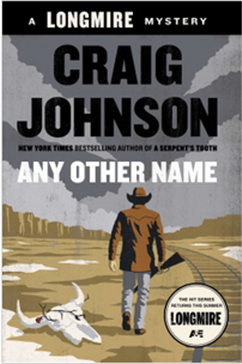
Day 536: Any Other Name

Cover for Any Other NameSheriff Walt Longmire is supposed to be on his way to Philadelphia for the birth of his first grandchild, but he’s been sidetracked. Old Lucian, the former sheriff, has asked his help for a friend. The two travel to a neighboring county to call on Phyllis Holman, whose husband Gerald has been deemed a suicide. Phyllis does not believe he committed suicide and thinks the local police are covering something up. Connie Holman, the couple’s daughter, wants Walt to drop the investigation.

It seems from the investigation photos that Holman must have shot himself. But Walt would like to find out why, and why he shot himself twice. Holman was on the Cold Case squad investigating the disappearance of an exotic dancer named Jone Urrecha. But Walt learns there have been three disappearances of local women within the last three months.

Despite his daughter Cady’s repeated summonses, Walt finds himself caught up in the case. Soon he’s involved in several shoot-outs, a close encounter with a herd of buffalo in a snowstorm, a chase through an abandoned lodge, a short visit with his dead friend Virgil White Buffalo, a bar fight, and the pursuit of a coal train. He also finds out someone has hired a hit man to kill him.

http://www.netgalley.comAssisted by his best friend Henry Standing Bear and his deputy and lover Vic Moretti, Walt tries to wrap up the complicated case and make his plane flight. As usual with Johnson’s mysteries, the characters are interesting, the writing is excellent and the dialogue witty, and there is plenty of action.

Day 531: Midnight in Europe

Cover for Midnight in EuropeChristián Ferrar is a lawyer and Spanish émigré who lives in Paris during the time of the Spanish Civil War. He wants to do what he can for the Spanish Republic against the fascists. The Republican government contacts him to help with the occasional arms deal. Getting arms is difficult, because the fascist governments of Europe are on the other side. Besides, the US and other countries have banned sales of weapons to the Republic because of atrocities committed by the communists.

Working with Ferrar on these dangerous transactions is a Swiss citizen named Max de Lyon who used to be an arms dealer. The two of them get into some sticky situations during missions to Poland and Odessa.

For someone doing secret work, Ferrar is oddly unsuspicious of a Spanish marquesa who comes to his office to consult him and seems open to his advances. It was so obvious to me that she was a spy that I’m giving away a plot point.

I occasionally enjoy a good spy thriller and had heard good things about Furst, but I did not find Midnight in Europe involving. None of the characters have much depth, and Furst doesn’t successfully build any tension. I remember enjoying an earlier book of Furst’s years ago, so perhaps my problem is that I have lately been reading the master, John Le Carré.

http://www.netgalley.comThis period is a fascinating one, and I would have hoped Furst would do more with it. For one thing, he explains very little about the war, seeming to assume that everyone will automatically know the Republic is the good guys. Perhaps he thought that explanations would slow down the action, but the action never really gets going. Interestingly, he only mentions atrocities committed by the side we’re supposed to favor, although there were plenty on the other side. He does a better job evoking the growing threat from Nazi Germany.

Day 525: Nine Coaches Waiting

Cover for Nine Coaches WaitingIn honor of Mary Stewart’s death earlier this month, here’s a review of another of her classic romantic suspense novels. She was really the master of this genre, writing literate novels with intelligent, plucky heroines and lots of excitement.

Linda Martin arrives in 1950’s France to take up a post as governess to a little boy, Comte Philippe de Valmy. Although Linda has been living in England since her poet father’s death, she has grasped this chance to return to France, where she was born. When the de Valmy’s stress that they want a governess who speaks only English, Linda decides to deceive them in a small way by pretending she does not speak French.

As Linda settles into her life at the Château Valmy, she occasionally feels some disquiet about events or comments she overhears. Philippe is an orphan whose parents died in an automobile accident. Until recently, he was living with his Uncle Thierry, an archaeologist, but Thierry went off to work on a dig. Philippe is a lovable boy, but he seems afraid of his aunt and uncle. Léon de Valmy is confined to a wheel chair. He was once a member of the international social scene, but since his polo accident he has focused his activities on the estate, which belongs by right to Philippe. Although he is a charismatic personality and Linda likes him, she thinks he treats Philippe with undue strictness. His wife Héloïse is beautiful but cool.

Linda has a dramatic meeting with Raoul, the de Valmy’s handsome and worldly son. He seems disposed to admire her, but she cannot believe he is serious. Despite herself, though, she finds herself falling in love.

A couple of disturbing near-accidents happen to Philippe. During a walk in the woods, he is almost shot, apparently by a careless hunter. Later, Linda notices a weakness in the railing of Philippe’s balcony and shoves something across it. This action keeps him from falling to his death when he runs out to the balcony to see who is arriving. Soon she becomes afraid that someone is trying to kill the little boy she has been hired to protect.

Photo of Mary Stewart
Mary Stewart

Stewart knows how to set a scene and build suspense. She is also an extremely good writer who is able to make you care about her characters. Because of its setting in the château, this is one of the more gothic of her suspense novels. It is also one of the most romantic. Nine Coaches Waiting is the first Stewart novel I read, and it has remained one of my favorites.

Day 514: The Vanishing Point

Cover for The Vanishing PointI’ve found the last few Val McDermid novels I’ve read disappointing, and The Vanishing Point is no exception. First, it begins by using a contrivance that is not at all successful.

Stephanie Harker’s adoptive son Jimmy is kidnapped from the secure area of O’Hare Airport while she is in the full body scanner. After an initial frantic period of activity, she sits down with FBI agent Vivian McKuras to tell the long tale of how she became Jimmy’s guardian.

Even though this story is necessary to understand the novel, its context within a police interview during a search for a missing child is not at all convincing. I doubt very many police interviews consist of one person talking for hours without any questions from the police. Then there is the issue of how McKuras can lead the investigation if she is interviewing Stephanie all night long. Presenting this information as a series of flashbacks would have taken care of the problem. This is an unusual misjudgment for McDermid.

The bulk of the novel centers around Stephanie’s relationship with Scarlett Higgins, a reality TV star who hires Stephanie to ghostwrite a memoir for her. Although Scarlett maintains a persona of a dumb blonde, Stephanie quickly realizes that Scarlett is a lot smarter than she seems and grows to like her. Stephanie becomes involved in Scarlett’s life, her marriage to a popular D.J., and all the difficulties of her celebrity.

When Scarlett dies of cancer, she leaves her young son Jimmy to Stephanie’s care. The story is long and complicated but doesn’t turn up many suspects in the kidnapping except Stephanie’s own stalker ex-boyfriend Pete. In fact, the novel gets fairly involving and does a good job of leading its readers down the garden path for quite some time.

I won’t give away the ending, but it is so completely far-fetched that it left me gasping. Despite its rough beginning, McDermid as ever writes a gripping novel, but this one ends up in the stratosphere.

Day 501: Waiting for Wednesday

Cover for Waiting for WednesdayThe writing duo Nicci French has come out with another powerful Frieda Klein mystery with Waiting for Wednesday. Although it deals mostly with another case, there is still the threat of a serial killer from the first book in the background.

DCI Karlsson and his team are trying to solve the murder of Ruth Lennox, a housewife whose face was smashed by a heavy object. Although her death appears to be part of an interrupted robbery, when the police find the thief, he has an alibi for the actual time of the murder. Soon Karlsson and his team find evidence that Ruth was leading a secret life.

Frieda is recovering from injuries incurred at the end of Tuesday’s Gone, and she is on leave from her practice. Her absence from the case does not prevent another psychoanalyst who is working with the police, Hal Bradshaw, from seeing her as a threat and attempting to professionally humiliate her.

Bradshaw has set a trap for Frieda and some other analysts he dislikes by sending in graduate students for consultation who pretend to have sociopathic thoughts and ask for treatment. Frieda immediately realizes her subject is pretending and sends him away, but something he says captures her attention and she begins trying to track down the source of the story. In doing so, she meets Jim Feary, a retired journalist who is sure he has happened upon traces of a serial killer. When Frieda takes Jim and his evidence to see Karlsson, though, Karlsson believes that her judgment is impaired because she is still traumatized by her experiences and that Jim is a nutcase.

http://www.netgalley.comFrench presents a complex set of mysteries in this novel, which is really gripping and ultimately suspenseful. While Frieda flounders with too much going on in her usually quiet life to allow her to make her recovery, Karlsson, Yvette, and Riley struggle with a case that gets more and more complicated. Even if you can figure out a piece of one puzzle, as I did, there is still a lot more going on in this intelligent mystery novel.


Day 495: Just One Evil Act

Cover for Just One Evil ActI can chart my changing attitude toward Elizabeth George’s Inspector Lynley mystery/thrillers simply by how I treat the new books. I used to get them as soon as they were available and read them immediately. This one I had for a couple of months before reading it. They are still page turners, don’t misunderstand me, but George has put her characters, and fans, through a lot.

George is not a proponent of the idea of keeping her characters’ private lives out of her mystery novels—very much the opposite. At first their absorbing lives made these novels stand out. But by now she has put Lynley through a brother accused of murder, a fiancée marrying his best friend, a seemingly hopeless romance, a murdered wife, and an ill-judged affair with his alcoholic boss. Heretofore, Sergeant Barbara Havers, although sometimes rebellious and unruly, has been a rock of good judgment, often better at finding the criminal than Lynley is. So, now it’s her turn to go off the deep end.

At the end of the previous novel, Believing the Lie, Barbara’s neighbor Taymullah Azhar had his sweet young daughter Hadiyyah kidnapped by the girl’s mother Angelina, who returned to Azhar pretending a reconciliation in order to get an opportunity to take the child. The situation is complicated because the parents never married and Azhar’s name is not on Hadiyyah’s birth certification, so for now he has no legal right to her (although, if that is so, since Angelina abandoned them, British law must be really weird). In addition, he has no idea where they have gone.

The Met can’t apparently help him, so Barbara takes Azhar to a private investigator, Dwayne Doughty, and they hire him to find Angelina and Hadiyyah. Eventually, though, Doughty reports back that there is no trace of the two to be found.

The tables turn quickly, though, when Angelina returns with her lover Lorenzo Mura, claiming that Hadiyyah has been kidnapped from them, so Azhar must have taken her. When it appears that Azhar is just as alarmed as Angelina and that he has an alibi for the time of the kidnapping, they all return to Lucca, Italy, where Angelina and Mura have been living. Inspector Lynley is assigned to go along as liaison between the parents and the Italian police. Isabelle Ardery, the boss, refuses to let Barbara come along.

Barbara absolutely refuses to believe that Azhar has had anything to do with the kidnapping. She has already given information to a tabloid journalist to create enough furor in Britain about the kidnapping for someone to be assigned to the case, and that liaison with Mitchell Corsico is not only a breach of trust but a major source of drama—and irritation—for the rest of the novel. The novel ends with Corsico assuming Barbara is in his debt. I certainly hope George doesn’t plan to pursue that subplot, because I found it to be too far over the top, with the journalist demanding more disclosures about every 15 minutes (an exaggeration, admittedly) and always when Barbara urgently needs to be doing something else.

Unfortunately for Barbara, as she breaks all the rules set by her new boss, John Stewart, to investigate the case from her end, it begins to look as though Azhar did indeed plan the kidnapping and execute it with the help of some of Doughty’s contacts in Italy. We readers actually know where Hadiyyah is, although we don’t know the identity of her kidnapper. But we also soon learn that her kidnapper has died, leaving Lynley and the excellent Italian detective Salvatore Lo Bianco to figure out who he was and where he put the child. Lo Bianco’s efforts are hindered by the actions of his incompetent boss.

In the midst of all this, Angelina dies, and it becomes obvious that she was murdered. Soon, it looks as though Azhar could be implicated in that, too.

My problem with this novel is Barbara’s behavior, as she goes overboard to protect Azhar. First, there are the leaks to Corsico which, after the first one, seem totally unnecessary. Then she begins concealing and attempting to alter evidence. I won’t go on. Even worse is how this trouble is wrapped up at the end of the novel, either by a cheat or a completely unlikely act on the part of Ardery.

You can tell I had a mixed reaction to this novel. On the one hand, it is extremely gripping. On the other hand, especially if you have been following the series and care about Barbara, you occasionally want to throw the book across the room. For the last four or five books, I’ve been wondering whether to quit the series, but I always end up picking up the next one.

Finally, I was upset by how the novel ends for Azhar and Hadiyyah, who for a large part of the series have been two of the most likable characters.