Day 404: Swamplandia!

Cover for SwamplandiaBest Book of the Week!

Swamplandia! is the third book I’ve read in the past few months that has a strong young female voice (with Tell the Wolves I’m Home and Where’d You Go, Bernadette). All of them were very good.

Before I start, though, a comment on the cover for the hardcover copy of the book, which is not the one I read or the one shown here. I was not really clear about whether this book is considered appropriate for young adults or not (probably), but the hardcopy cover makes Swamplandia! look like a children’s book, showing a very young girl piggyback on a character who looks somewhat like the Mad Hatter, both watching an alligator. Let me warn you that Swamplandia! is definitely not for young children.

Thirteen-year-old Ava Bigtree and her family live on an island in a hokey-sounding amusement park in the Florida Everglades called Swamplandia! There, they dress up as Native Americans (their grandfather, who founded the park, was a German-American farmer from Ohio) and breed and wrestle alligators. Ava’s mother Hilola was the main attraction until she became ill with cancer and eventually died.

Since then the family has tried to cope with its grief while also attempting to save the floundering park. Homeschooled and with little contact with the mainland, the Bigtree kids have been raised in a sort of dream land. They all possess a thorough and subversive knowledge of the history of Florida and of its flora and fauna but not many skills for dealing with the outside world. Kiwi spends almost all his time reading, Osceola believes she has a ghost lover, and Ava is aiming to become a world-famous alligator wrestler.

When tourists stop arriving on the ferry, Chief Bigtree, the children’s father, makes one of his mainland journeys to raise money to save the park, but not before Kiwi apparently abandons them to get a job with the park’s competitor, The World of Darkness. Sixteen-year-old Osceola and Ava are left alone on the island until Osceola floats away on an old barge to join her lover.

Frantic to save Osceola, young Ava joins up with a mysterious man named the Bird Man, who claims to know his way into hell, which is where Ava assumes she must go to bring Osceola back from her ghost lover. As our apprehension grows, we follow Ava’s journey while periodically cutting over to observe Kiwi’s serio-comic adventures at the hell-themed World of Darkness.

Russell creates a lush world in Swamplandia! and a compelling narrator in the innocent/wise Ava. The language of the novel is gorgeous, its heroine engaging. You will find yourself immersed in a damp world bursting with life, and you won’t want to leave it until you know what happens to Ava.

Day 398: The Strange Fate of Kitty Easton

Cover for The Strange Fate of Kitty EastonIf you prefer a book to leap immediately into action, this is probably not the mystery for you. The second in a series, it starts slowly, with Speller taking the time to develop the setting and characters.

Laurence Bartram is a young man damaged by World War I, during which his wife and child died and he was injured. Laurence is an expert on church architecture, and he is happy to be summoned to the estate of Easton Deadall by his friend, William Bolitho. William wants him to look over  a small but unusual church, for which William is designing and installing a window.

Laurence is soon pulled into the affairs of the Eastons, a family that is haunted by the war, but moreso by the disappearance in 1911 of the young daughter of Digby Easton, the oldest of the three Easton brothers. Digby died during the war, but Kitty still obsesses her mother Lydia, an invalid who sometimes speaks of her as if she is alive.

The middle Easton son, Julian, has been doing his best with the estate, which Laurence finds beautiful but slightly crumbling, while Lydia’s sister Frances takes care of her. Laurence finds the subject of Kitty lurking behind every conversation and wonders if they will discover her body in the course of their renovations. Soon, the third Easton brother, Patrick, returns to Easton Deadall after an absence of years, first at Oxford and then on an archaeological dig in Greece. It becomes obvious that there is tension between him and Julian.

The family decides to make up a party to visit the Empire Exhibition. William, who was left wheelchair bound by the war, does not feel he can handle it, and Lydia is too ill, but the rest of the family goes. The expedition includes Eleanor, William’s wife, and Laurence. They also bring along David, the estate’s man of all work, and the teenage maid Maggie to help care for William and Eleanor’s young son Nicholas. At the exhibition, Maggie and Nicholas go missing, and although the others find Nicholas, Maggie is nowhere to be seen.

Distressed by Maggie’s disappearance, which can’t but echo the earlier one of Kitty, the family begins falling apart and secrets emerge, especially about the charismatic Digby and his relationships to his family and to his troops during the war. A few days after the disastrous outing, Laurence and David are clearing an area in the church to prepare for the installation of William’s window when they discover a trap door in the floor under the altar. When they open it, they find the body of a woman. The police are able to quickly ascertain that the body is of a woman too old to be Maggie, but then, who can it be? Could it even be Kitty, grown up and returned from wherever she has been?

Laurence does not exactly detect so much as look into a few things the others haven’t thought of, and he eventually unearths a tangle of secrets. Although the novel takes awhile to get going, I soon found myself unable to put it down. It slowly and skillfully builds to suspense. I found it well worth my patience.

Day 385: Sweet Tooth

Cover for Sweet ToothBest Book of the Week!

I’m always suspicious of book blurbs that compare one writer’s books to another’s. On the cover of Sweet Tooth, a blurb says “Jane Austen meets John Le Carré meets John Barth.” To my shame, I can say nothing about John Barth (except that I attempted once without success to read The Sot-Weed Factor), but Sweet Tooth has nothing to do with Austen except that she is mentioned in it and has only a few similarities with Le Carré but none of the extreme tension. Generally speaking, I don’t really believe that the work of one writer is like that of another, and certainly no one is like Ian McEwan.

Serena Frome is a smart, beautiful young graduate from Cambridge in the early 1970’s when she takes a job as a very minor employee of MI5. She has been groomed for this position by her much older mentor and lover, Tony Canning, a don. She is a naive young woman from a relatively privileged background who loves literature in a fairly superficial way (speed reading through stacks of novels) but has been pushed into mathematics because her mother wants her to accomplish something “important.” Unfortunately, she finds her facility at mathematics to be superficial too, unequal to the level of her classmates, and only earns a third. Her only distinction at school is some breezy articles written for a student magazine about what she is reading, and they lose their audience as soon as she writes more seriously about political issues.

Really, her mother seems much more eager for her to accomplish something than she is. She is somewhat shallow and eager to please, more interested in her relationships with men than in a career. She also has a tendency to pretend she knows about things that she doesn’t.

After carrying on a fairly innocent flirtation with a coworker, Max Greatorix, and having him break it off, Serena gets her big break at work. MI5 is setting up an operation called Sweet Tooth, the intention of which is to quietly fund young writers who have political beliefs sympathetic with those of the government in a subtle propaganda war against communism. Serena is told that the money will simply give the chosen writers more freedom to work, and the operation will not interfere in any way with their work.

Serena, with her voluminous reading habits but flimsy background of the series of articles she wrote in college, is asked to pronounce on the work of Tom Haley. She loves his stories and is soon given the job of recruiting him, the only fiction writer in the operation. The project seems to go swimmingly, although Tom is soon writing about themes the government would not approve. But Serena tells herself that they were not to influence Tom’s work, and anyway she is having an affair with him.

Their relationship is born in deceit, though, since Tom has no idea that his grant is coming from MI5 or that Serena is his handler. As their affair grows more serious, Serena struggles with when to tell him. Soon something else is going on that Serena doesn’t understand. As with any good spy story, you don’t always know who is lying to whom.

Since this is McEwan, we know the story will not be straightforward, and again he presents us with a great example of an unreliable narrator and a foray into metafiction. We also get a light evocation of England during a difficult period of miners’ strikes, economic and political instability, IRA bombings, and the dawning hippy and drug cultures. Although by no means a Cold War spy thriller, the novel provides plenty of plot twists.

Day 382: Touch Not the Cat

Cover for Touch Not the CatI was surprised by how many people were interested in my review of Mary Stewart’s This Rough Magic, so I decided to post a review of another Stewart novel, one of my favorites of her later romantic suspense novels, about family secrets, published in 1976. Touch Not the Cat is the only Stewart book, aside from her Merlin novels, that includes a touch of the supernatural.

Bryony Ashley is awakened on Madeira, where she works, by a message from her father. She has always had a telepathic link with one of her cousins—she doesn’t know which one—but he unexpectedly relays a garbled message from her father. So, she is not altogether surprised when she learns that her father has been severely injured after a hit and run accident. Before she can go to him, he dies, leaving behind a warning of danger. She returns to England to settle his estate.

Bryony’s family owns Ashley Court, an ancient stately home that the family has not been able to afford for some time. It is entailed to her cousin Howard and after him to his sons, her identical twin cousins Emory and James.  Bryony has always assumed that her “lover,” as she calls her telepathic friend, is one of these two cousins, since telepathy is said to run in her family and she was never very close to her third cousin, Francis.

The only part of the estate that passes to Bryony is the small cottage where she lives on a patch of land surrounded by a system of canals. The rest of Ashley Court is currently being rented by a rich American family, the Underhills.

Almost as soon as Bryony gets home, odd things begin happening. Someone steals an old book of records from the church. She goes on the tour of Ashley Court and notices that small, valuable objects of art are missing, including some of her own possessions. Then Emory and James arrive on the scene and immediately begin pressuring her to wind up the estate affairs and sell her own property to them.

As she pokes around in the library, Bryony figures out that her father was worried about something he discovered about the ancient property and is reluctant to sell it until she determines just what his discovery was. Calmly helping around the estate is her childhood friend, Rob Granger. It was to Mrs. Granger and her son that Bryony always turned in times of trouble as a child, so she confides some of her concerns to him.

Interspersed with Bryony’s story are a few paragraphs in each chapter from the point of view of an ancestor, the black sheep of the family, Nick Ashley. It was Nick’s father who selected the puzzling family motto “Touch not the cat, but [without] a glove” (an actual motto of the Clan MacPherson). Eventually, the two stories converge to reveal the secrets of the house and the reason for Bryony’s father’s death.

From a more innocent time, Mary Stewart’s novels are among those I turn to periodically for a bit of light reading, and I find them unfailingly entertaining. As usual with Stewart, her heroine is appealing and she slowly builds a feeling of suspense. Her plotting in this novel is complicated and the mystery engrossing. Although we are accustomed these days to narratives that move back and forth between two periods of time, this was a more unusual technique for the 1970’s.

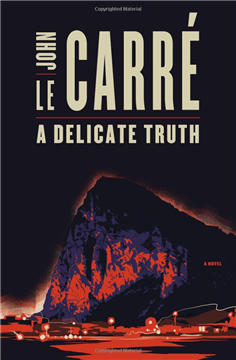
Day 379: A Delicate Truth

Cover for A Delicate TruthBest Book of the Week!

A mid-level diplomat called Paul is sent on a mission to Gibralter with an army detachment and some mercenaries to capture a terrorist about to do an arms deal. Paul’s role is to act as the “red telephone,” keeping the minister in charge, Quinn, appraised. The agreement is that no action will be taken on British soil without British approval.

A person is spotted in the houses that the teams are monitoring, and there is an argument about whether to go ahead. The British, lead by a Welshman named Jeb and backed by Paul, argue that there is not enough evidence to proceed, but the mercenaries start to move anyway, and Quinn then gives permission to go. During the actual mission, though, all the monitors in the command center where Paul is waiting go dead, and Paul has to take the word of Elliott, the head mercenary, that everything went as planned.

Returning to a few days before the mission, Tony Bell, Quinn’s private secretary, is looking for help. For months, Quinn has been going AWOL, leaving him out of meetings, and keeping documents from him.

Toby has unofficially been informed that Quinn was censured a few years ago for a mission that went wrong involving a mercenary company lead by Jay Crispin. Quinn was forgiven but told not to consort with Crispin. Now Toby finds that Quinn has been meeting with Crispin and even sneaking him into the Foreign Office on the weekend. However, Toby is not supposed to know about the prior incident, so he has nowhere to turn. Taking a drastic decision, he secretly tapes a meeting about the mission to Gibralter. But his mentor, who originally was the one to break confidentiality, fails him, and soon he is sent to another posting.

A few years later, Kit Probyn, lately known as Paul, has retired to his wife’s property in Cornwall when he runs into Jeb, no longer a soldier but a leather worker who makes the rounds of fairs. Jeb tells him that the Gibralter mission, which Kit thought was a success, actually went horribly wrong and that Jeb himself was used as the fall guy. When Kit decides to collect evidence and blow the whistle, he turns to Toby with what he has learned. Although Toby is more aware of the dangers of their task than Kit is, neither has any idea of what they are getting into.

This novel is another of Le Carré’s taut and cynical thrillers, now moving from espionage to the theme of mixing private enterprise with politics and the fight against terrorism. Although not quite up there with The Constant Gardener, which I think is one of the best and most touching of Le Carré’s post-Cold War thrillers, it is deeply involving and tense. With Le Carré, you are never sure of whether good or evil will win, which makes his novels that much more exciting. He is really the master of this genre.

Day 362: Finders Keepers

Cover for Finders KeepersBelinda Bauer returns us to Shipton, the setting on Exmoor of her first two chilling novels. Someone abducts a girl from her father’s car, leaving a note that says “You don’t love her.” At first the police assume the kidnapping is for money or revenge against the girl’s apparently wealthy father, but more abductions follow. The small town, which has been ravaged by serial killers twice, is horrified.

Constable Jonas Holly is still on leave following the murder of his wife Lucy the year before. He will soon be returned to duty, although Inspector Reynolds is skeptical of the help he can provide.

Steven Lamb, almost a victim in the first novel, thinks he knows who murdered Lucy Holly. As more children disappear, he becomes worried about his younger brother Davey, as well he might. Unknown to their mothers, Davey and his pal Shane have been running around the countryside while their families think they are at each other’s houses.

Reynolds and his team are at a loss. They hope the children are alive but can’t figure out where they’re being held, despite having covered the moor with heat-seeking technology from a helicopter.

Bauer’s thrillers keep me on the edge of my seat. Her novels are well written and suspenseful, her characters complex. If you like dark thrillers, you can’t do much better.

Day 344: Tuesday’s Gone

Cover for Tuesday's GoneTuesday’s Gone is the second mystery/thriller featuring psychotherapist Frieda Klein in a series that is turning out to be quite exciting. A social worker calls on a mentally ill client for a first visit at a grimy, squalid hostel. The client, Michelle Doyce, leads her in to her apartment and introduces her to her guest–a naked man who has been long dead.

The police, embattled with cost-cutting measures, are inclined to close the case even though the victim has not been identified, but DCI Karlsson wants to see what Frieda Klein makes of Michelle, who seems to be talking nonsense. Frieda soon concludes that, rather than having strangled the victim, Michelle suffers from a rare disorder that makes her unable to distinguish the animate from the inanimate and was trying to help him.

When the victim is finally identified, he turns out to be Robert Poole, an apparently charismatic and charming con man and identity thief. He seems to have several potential murderers, but none of them appears to bear him any ill will.

In the meantime, Frieda is slowly beginning to realize that the case from the first book, Blue Monday, is not closed, because the murderer is not dead, as believed. Frieda is sure he is lurking somewhere nearby. She is also involved with troubles with her family and among her friends, as well as the return of her ex-lover Sandy from the US.

Frieda is an interesting character–a loner who likes to walk the streets of London at night and prefers to keep her own counsel yet has several close friendships. The mysteries are involving and complex, and although I figured out who the murderer was before the secret was revealed, it was only a bit earlier. Although the married writing team who calls itself Nicci French builds suspense slowly, the final chapters of the novel are quite thrilling.

Day 342: The Tryst

Cover for The TrystThe Tryst is an odd book by Michael Dibdin, the author of the Aurelio Zen mysteries. Although billed as a crime novel, it takes some time to get around to the crime. In fact, it misleads us into thinking it is one type of novel when it is actually another.

The novel follows the actions of two characters, a homeless boy and the therapist who is trying to figure out why the boy is pretending to be insane. Gary Dunn has come to the psychiatric hospital where Aileen Macklin works as a psychiatrist requesting institutionalization and insisting that someone is trying to kill him.

We find out that Gary, a glue-sniffing boy who lives with a bunch of junkies, has befriended an old man. Although Gary’s mates would like to rob the man, Gary has become involved in the old man’s long, involved story about a former employer who sees a beautiful woman no one else sees. In the story, the employer follows the woman to his death. This story eventually connects the fates of Aileen and Gary.

Ultimately, the novel doesn’t work that well, because it starts out being a crime thriller and turns into more of a gothic novel/ghost story. It is too much one kind of novel to work successfully as the other kind. Although the novel is well written and interesting, it reads almost as if Dibdin started with an idea and changed his mind in midstream. For a better example of a book that combines a crime story with a ghost story, read Johan Theorin’s fantastic The Darkest Room.

Day 341: Nightwoods

Cover of NightwoodsBest Book of the Week!

Charles Frazier sets his novels in backwoods North Carolina. His first novel, Cold Mountain, was set during the Civil War. His second, Thirteen Moons, went further back to the treatment of the Cherokee in the earlier part of the 19th century. Nightwoods, his third, deals with more recent times, a small mountain town in the early 1960’s.

Luce is a troubled young woman with a traumatized past who has taken up a secluded life as a caretaker for an old disused lodge across the lake from town. She is unprepared when a social worker brings her the young twin children of her murdered sister Lily, an almost feral boy and girl who refuse to speak and like to start fires.

Stubblefield is lazing away his life on the coast of Florida when he learns his grandfather has died and left him, aside from a load of debt, the lodge and a road house and a considerable number of acres on the mountain. When he goes to inspect the lodge, he is immediately smitten by the skittish Luce.

Trouble is on the way, which we know from the beginning of the novel. Bud, the husband and murderer of Luce’s sister Lily has been released from prison because of a hung jury. He is on his way to town in search of the money he stole, which he gave to Lily one night when he was drunk and she refused to give back to him. He beat her to death trying to get her to tell him where it is, and now he thinks the children know.

This novel is at times tender, as Luce blindly copes with the two damaged children in the best way she can, instinctively treating them with delicacy and kindness. At the same time, the violent Bud resembles a character from a Carl Hiaasen or Elmore Leonard novel, almost comic at times in his psychopathic ineptitude.

The result is an enthralling novel that is both a love story, not just between its characters but with the beauty of nature, and a thriller with a true feeling of danger. As usual with Frazier, the novel is wonderfully well written, with entrancing descriptions of nature.

Day 326: Life After Life

Cover for Life After LifeBest Book of the Week! Year!

From the descriptions of this book, I wasn’t sure I would like it even though I usually enjoy Kate Atkinson, a very playful writer. But what a great book–completely engrossing, oddly funny, and immensely satisfying.

Ursula Todd is born on a snowy night in 1910, but the umbilical cord is wrapped around her throat, so she dies. On the same night, Ursula is born again, but this time she lives. As she gets older, she faces various hazards, some of which she does not survive. Each time she is born again, on the same snowy night.

Through vignettes during the course of Ursula’s life, Atkinson skillfully and compellingly weaves the story of how small decisions in life can affect larger issues. We know a very large issue is coming up from the beginning, because in the first scene of the novel, Ursula assassinates Adolf Hitler and is killed in turn by his men.

Life After Life is a stunningly inventive novel about choice, fate, free will, and the nature of time, which Ursula explains to her psychiatrist (who believes in reincarnation) is not a circle but a palimpsest–a manuscript that has been overwritten but on which you can still see some of the writing.

I found this novel amazing, having never read anything quite like it. It is fascinating, funny, touching, and thought-provoking. I personally am going to miss Jackson Brodie, but Atkinson has launched herself far beyond him.