Review 2425: Murder Road

If you like a good ghost story, there’s no one to beat Simone St. James. Her last two books were especially excellent.

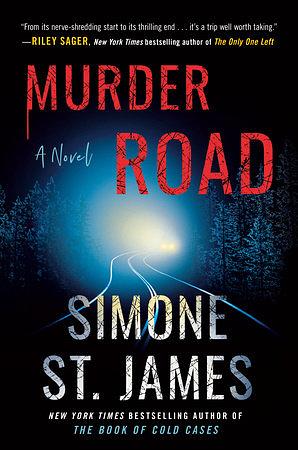
It’s July 1995. April and her new husband Eddie are on their honeymoon on the way to a motel on Lake Michigan when they get lost. Something about the road they are on, Atticus Line, feels wrong. April sees a light blinking in the woods and then they see a figure in the road, a girl who seems to have something wrong with her. Her name is Rhonda Jean, and once they realize she’s bleeding, they rush her to the hospital in Coldlake Falls.

Rhonda Jean has been stabbed, and she dies in the hospital. April and Eddie are covered with blood, as is their car, and they suddenly realize they look like murderers. And that’s how the cops see them.

April and Eddie soon realize that they need to try to solve the murder themselves. They learn that there had been a series of murders on the Atticus Line, mostly of hitchhikers on the way to a beach, starting in 1976 with an unidentified woman. There is also a story of a ghost who haunts the road. Once you see her, you die. April sees her when they return to the road, and the ghost tries to pull Eddie from the car, but they don’t die. What does the ghost want?

As far as the plot goes, and sympathy for the main characters, this one is right up there with St. James’s best. Unfortunately for me, Michigan native, it turned into What It Gets Wrong about Michigan, especially Midland, one of the novel’s settings and my home town.

Never mind me. If you like ghost stories, you’re going to love this one. No need to continue reading. However, if you like accuracy . . .

First, it was the weather. This is minor, but the characters experience a series of really hot days. Sure, it can be hot in Michigan, but in the northern lower peninsula, which is where the book is set, it’s usually not that hot in July. Mornings are usually cool and nights cold. There’s a bit about a flannel shirt that Eddie brought along in case it was cold. He would know it would be cold. Of course, weather in 2024 could be different, but I looked up the weather in that area in July 1995. They had one day in the 90s and a low in the 80s. Most days were in the 60s or 70s. But again, this is minor.

Then she shocked me by saying Midland was in the south, almost to the Indiana border, proving she never even looked at a map. Midland, as its name suggests, is smack dab in the middle of the lower peninsula, maybe a bit east of the middle. It’s a five-hour drive from Ohio. Indiana is further away. The main characters are from Ann Arbor, which is almost two hours further south than Midland, so they wouldn’t make that mistake.

I’m no Midland booster—I got out of there as soon as I could—but St. James depicts it as a sad little town. It’s actually quite prosperous as the home of Dow Chemical, which has pumped a lot of money into it, and it has a large percentage of people with PhDs. The characters think they are in a sad downtown area when they go to the library, but they are not, and in fact never get there. The downtown of MIdland was quite vibrant in the 90s, much more so than when I left in the 80s. The library is actually on a long main street that is commercial at both ends but middle- to upper-class residential in the middle where the library is, with the botanical gardens behind it and the performing arts center next to it. April is surprised that the library is surrounded by greenery, but most of Midland is quite green, although it gets a little seedy a few long blocks away, closer to downtown. Finally, there is no bank across the street from the library.

Just a little more research, even if she couldn’t make a visit, would have got these facts right. It’s kind of interesting that she didn’t do it or make up a different town, as she did with the setting farther north.

Related Posts

The Book of Cold Cases

The Sun Down Motel

The Broken Girls

Review 2339: The Quiet Tenant

For five years, the woman in the shed has been captive, padlocked in, handcuffed to a table, subject to repeated rape. Her captor lives in the house with his wife and child. But his wife has recently died, and his in-laws, who own the house, want to sell it. When he tells her he has to move, she knows it means her death. She knows when he has been out killing, but she has managed so far to talk him out of killing her, and now she convinces him to move her.

Emily is the owner of a restaurant and serves as its bartender. She is in love with handsome Adrian Thomas, who comes in regularly for a nonalcoholic drink. His wife has recently died, and she thinks he is showing interest in her.

In between short chapters from the women’s points of view are even shorter ones from the points of view of his victims.

This novel is certainly readable and suspenseful, but I had a few problems with it. First, the tone of the chapters by the victims is all wrong. These chapters make up a very small portion of the novel, however.

I had a bigger problem with the unlikelihood of the captive woman not taking several opportunities to escape. The first time, when Adrian absentmindedly doesn’t lock the handcuffs properly, is explained by her belief that the house has hidden cameras and Adrian’s omission may have even been a test. But I don’t know. I think most people would try. It’s less believable when she decides not to leave without the 13-year-old daughter, Cecilia, especially since as soon as she got to police, Cecilia would not be in danger. I found this really unlikely after Adrian leaves her free in the house during Christmas break while he is at work. She would have had all day to get away. She knows by the end that he has tricked her about the cameras, so she should be able to guess he’s tricking her about the so-called GPS tracker he put on her wrist.

Still, if you want to ignore such details, the novel is certainly a page-turner.

Related Posts

Room

Dark Places

Before I Go to Sleep

Review 2207: Birnam Wood

Well, this is quite a novel. Unfortunately, I don’t know how to explain what it is like without giving too much away. But I’ll try. Let me say that I don’t know whether I liked it, but it certainly is effective.

First of all, you’re not going to find a character in this novel to outright like. Catton has fully realized her characters as flawed people, and she keeps turning back to them and showing another side. There is definitely a villain, though.

Mira is the founder of Birnam Wood, a gardening collective that plants vegetables in unused spaces. Mira is not picky about whether they do this with permission from owners or even steal water or tools to do their work. However, most of the members believe their activities are legal.

Shelley is Mira’s roommate and best friend but also the person in Birnam Wood who does most of the management and publicity work. She is tired of not being listened to or having her contributions unacknowledged.

Mira reads that a landslide near Korowai National Park has cut off one of the accesses to the park, leaving only one road to a nearby town. A prominent businessman, Owen Darvish, who has property in the area that he had been planning to subdivide, took the property off the market because after the landslide it will not sell. Mira decides that this large, unoccupied property in a remote area would be perfect for a major planting operation, so she drives there to check it out.

On the property, though, she is apprehended by Robert Lemoine, an American billionaire who has been in the news because of a deal with Darvish. Eventually, he explains that he is buying the property from Darvish and is interested in donating a large sum of money to Birnam Wood to help ramp up their organization.

Tony, a radical Birnam Wood member who has been away teaching in Mexico, comes back to a meeting. When Mira presents Robert Lemoine’s proposition, he is very much against it but is outvoted. He walks out but decides to go to the area, thinking an article on what Lemoine is doing there would help his attempts to become a journalist.

Lemoine has a secret agenda that none of these characters know about. The novel moves from seeming to be a combination of a study of characters and somewhat of a sendup to a plot full of suspense.

Related Posts

The Rehearsal

The Luminaries

The Bone People

Review 2136: The Secret Guests

A while back, I tried reading a mystery by Benjamin Black, a pen name for the writer John Banville. It made me interested enough to try another book by him.

During the Blitz, the British government decides to send the two princesses, Elizabeth and Margaret, away for safe-keeping. Ireland is selected, presumably because it is neutral. Garda Detective Strafford, who is assigned to security, thinks the choice of Ireland is crazy, because there are still many people in the newly independent Ireland who hate the British, but the British involved don’t seem to know that. Celia Nashe, the MI5 agent assigned, just wants to break through the old boys club and get a decent mission.

So, Celia and the princesses are sent, otherwise unaccompanied, to join the household of the Duke of Edenmore with only Strafford for company, surrounded by a hidden detachment of incompetent Irish army men. Clonmillis Hall proves to be a castle—ramshackle, comfortless, cold, and poorly run.

No, this isn’t Cold Comfort Farm but a pretty good thriller, as the local IRA agent finds out who the girls are and notifies his contacts in Belfast. But first we see the discomfort of Nashe and Strafford, the homesickness and boredom of the girls.

Nothing much about this semi-literary thriller is predictable. The girls are lightly characterized—Elizabeth as reserved and priggish, Margaret as sly and mischievous, but still with sympathy. Although the novel changes point of view, it sticks mostly with Strafford. An interesting, engrossing read.

Related Posts

Christine Falls

Last September

The Fall of Light

Review 2123: The Murder Rule

Hannah has left her alcoholic, dependent mother in Maine for the University of Virginia. There she uses deceit and some dirty tricks to get onto the Innocence Project. In particular, she gets herself onto the case of Michael Dandridge.

Dandridge has been in jail for 11 years, found guilty of rape and murder. However, his sentence has recently been vacated. The original prosecutor is determined to retry him.

Hannah’s goal is to interfere with the project’s defense of Dandridge. We learn why slowly as passages from her mother’s diary are revealed, dated 25 years before.

I wasn’t sure what I thought about McTiernan’s change of locale, her other novels being set in Ireland, but her storytelling took over, and I found myself reading another page-turner. Although I was not sure that things could turn out the way they did, I found the novel thrilling.

Related Posts

The Ruin

The Scholar

The Good Turn

Review 2113: The Clockwork Girl

I liked Mazzola’s The Story Keeper well enough to try another book by her. This one looked interesting.

In 18th century Paris, Madeleine was forced into prostitution at a young age by her mother and so badly scarred by a customer that she now works in the brothel as a maid. She is determined to escape with her nephew, which is one reason she reluctantly agrees to spy for the police on the household of Dr. Reinhart. She is supposed to find out what he is working on, but once installed there, she finds it difficult to learn anything. Something about Reinhart seems off, but he locks up his secrets. However, his interest is in anatomy and he makes elaborate wind-up animals.

A second narrator, Véronique, is Reinhart’s daughter, newly returned from being raised in a convent. Her father has promised to train her in his work, but time passes and he works only with Doctor LeFevre on some project for the King.

Madeleine hears rumors that children are disappearing off the streets and worries about her nephew.

A third narrator is Madame de Pompadour, who is afraid she is losing the King’s affection and worried about what he is up to.

This novel is fast-paced and eventually gets very creepy, but there are some unlikely aspects about it, especially how neatly everything is resolved. Still, it certainly kept my attention.

Related Posts

The Story Keeper

Little

Pure

Review 2108: The Paris Apartment

Jess needs to leave London quickly, so she calls her brother Ben in Paris and announces she is coming for a visit. He tells her it’s not a good time but ends up giving her instructions to his apartment.

All doesn’t go well for her travel plans, and she ends up arriving late. However, she can’t get Ben to buzz her in or raise him on her phone. She ends up following someone in and picking the lock to his apartment.

When Ben doesn’t appear the next morning, Jess begins asking about him. The neighbors, though, are hostile and unhelpful. The building itself is old and unusual, surrounding a courtyard with each apartment occupying a single floor. It seems much more expensive than Ben, a journalist, can afford. Moreover, in the apartment Jess has found a spot smelling strongly of bleach and a cat with blood on its fur.

I think I’ve read enough Lucy Foley. Her plots are puzzling enough, but her style gets old. All the books I’ve read by her are narrated the same way—in short chapters moving back and forth in time and changing narrators. Her style seemed unusual at first but it doesn’t change from book to book.

Related Posts

The Guest List

The Hunting Party

In a Dark, Dark Wood

Review 2094: The Book of Cold Cases

I had to read The Book of Cold Cases as soon as I received it, because there’s no one better than Simone St. James when it comes to a combination of mystery and the supernatural. It did not disappoint.

Twenty years ago, nine-year-old Shea got into a serial killer’s car. She survived, but the experience left her with several phobias and a great deal of fear. It also left her with a fascination for true crime, which she feeds by keeping a true-crime blog called The Book of Cold Cases.

At work one morning, She recognizes Beth Greer, a wealthy woman who was tried but not convicted of the murders of two men in 1973. Most people in their small Oregon town think she’s the first woman serial killer. She has never agreed to an interview, but after she catches Shea following her, she agrees to one.

Shea meets her in Greer’s parents’ home, an ugly mansion above the town with the ocean a sheer drop beneath a small lawn. Oddly, it is still decorated as her parents left it. Before the murders, her father was found dead in the kitchen, having been shot in the face by an apparent burglar. The manner of death was the same as that of two men shot several years later with the same caliber bullet, which was some of the evidence used against Beth.

Beth begins to tell Shea part of what she knows about the case, and Shea decides that although she doesn’t think Beth murdered the men, she knows more than she is telling. Then during a break, a weird thing happens. Shea goes to the kitchen and bathroom. First, all the taps turn back on after she turns them off, then all the kitchen cupboard doors open when she has her back turned to them.

When Shea tells Michael, her private investigator, what happened, he thinks Beth could have rigged up some kind of mechanism. But Shea isn’t so sure. Then when she is playing back her recording of the interview, she hears in the background the faint voice of a woman repeating, “I’m still here.” After she’s heard the voice, her phone dies and the recording disappears.

As Shea investigates the case, the novel moves back in time to events of 1973 and further back to Beth’s childhood to show what happened.

This is a great combination—mystery, thriller, and ghost story. St. James has always been good at what she does, but this book and her last were excellent.

Related Posts

The Sun Down Motel

The Broken Girls

Lost Among the Living

Review 2036: A Slow Fire Burning

Laura Kilbride often has poor judgment, such as when she spent the night with Daniel Sutherland. That night turned ugly, and she was seen by the writer Theo Myerson leaving the area with blood on her face. She says she didn’t kill Daniel, but an accident in her youth has left her with a condition that causes her to react inappropriately, and the detectives think her behavior is odd.

Another odd witness is the woman who discovered the body, Miriam Lewis, whose narrowboat is next to Daniel’s. She hasn’t told the police that she bears a grudge against Theo Myerson, who stole significant portions of her memoir for his best-selling thriller. And Theo happens to be Daniel’s uncle.

Carla and Theo’s marriage did not survive the death of their young son when he was in the care of Angela Sutherland, Daniel’s mother. This accident happened many years ago, but Carla and Theo were never able to forgive Angela, and Angela has recently died.

There are more secrets to come out before the murder is solved. Hawkins does a good job of keeping the pace moving while keeping the readers on the edges of their seats.

Related Posts

The Girl on the Train

Into the Water

The Hunting Party

Review 1881: Death in Kashmir

A quote on the cover of Death in Kashmir compares M. M. Kaye to Agatha Christie. A more accurate comparison in terms of the type of novel it is—romantic suspense rather than mystery—is to Mary Stewart, although there is just something about a Mary Stewart book that this novel doesn’t quite have. Still, Death in Kashmir is entertaining enough.

The novel is set in 1947, the year before the British left India, and it provides an interesting look at the life of British upper-class people living there at the time, although the natives are mostly only in the book as servants.

Sarah Parrish goes to Kashmir to attend the last meeting of the India Ski Club at Gulmarg in a primitive hotel that is usually only open in the summer. The outing has already been shadowed by the death that day of Mrs. Matthews in an apparent skiing accident. In the middle of the night, Sarah awakens to a scraping noise and realizes someone is trying to break into the room next door, that of another young woman, Janet Rushton. Sarah quietly hurries to Janet’s door to warn her and is shocked to be greeted by a drawn gun. However, when Janet sees someone has tried to enter by the bathroom window, she confides in Sarah that she is an agent for the government. She and Mrs. Matthews discovered an important secret and were waiting for help from their superiors when Mrs. Matthews was murdered.

A few nights later, Sarah and Janet have joined an expedition farther up the mountain to ski and spend the night in a ski hut. Sarah catches Janet ready to ski off in the middle of the night because she has finally been contacted by her people. The next day, she too is found dead.

Returning to Peshawar after the trip, Sarah tries to forget what she has learned, but she receives a letter from Janet’s attorney enclosing the receipt for her houseboat in Srinagar and telling her the secret can be found there. So, she finds herself returning to Kashmir with her friends Hugo and Fudge Creed. There she encounters all of the people who were on the ski trip, with a few extras, like the attractive Captain Charles Mallory.

The Cold War plot seems a little silly when compared to those of some of the masters, like Le Carré (and may more fairly earn the comparison to Christie, who also has some silly Cold War plots), but it leads to plenty of suspense and an unguessable villain. A small criticism is that both sides seem to have so many helpers that it’s no wonder there was a leak. A bigger caveat is that the explanations at the end go on for quite a while longer than seemed necessary.

Related Posts

This Rough Magic

The Spy Who Came in from the Cold

Code to Zero