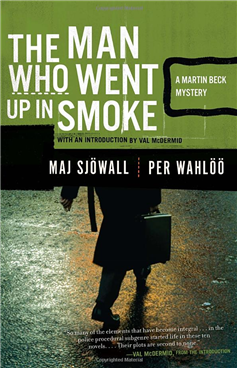
Day 350: The Man Who Went Up in Smoke

Cover for The Man Who Went Up in SmokeAt first, I thought this novel, written in 1966, was a little more dated than Roseanna, by the same authors. However, except for the formality in the characters’ dress, it stopped feeling dated after awhile.

Inspector Martin Beck has been on vacation with his family less than a day when he is called back to take charge of an unusual case. A Swedish journalist named Alf Mattson has been reported missing by his editor. The difficulty is that he disappeared in Budapest. There can be no official investigation because the Hungarian police have not received an official request for assistance, so Beck must travel to Budapest unofficially.

In Budapest Beck is able to retrace Mattson’s movements right up until he disappeared, one day after arriving. He visits a youth hostel where Mattson spent the first night and hears through his colleagues back in Sweden that Mattson claimed to have a girlfriend there. But when Beck finds her, she denies knowing Mattson.

Beck feels himself at a loss. His discussions with the Budapest police have not gone very far. The police can’t conduct a full-blown investigation until Mattson’s visa expires, but they have made some inquiries. It is not until Beck is viciously attacked that he understands he is getting somewhere.

Sjöwall and Wahlöö are known for having reinvented the police procedural, and many of its present-day conventions were first used in their novels. The novels are well written and deal with common people more often than with career criminals or gangsters.


Day 303: The Girl Who Kicked the Hornet’s Nest

Cover for The Girl Who Kicked the Hornet's NestI just realized that, having reviewed the other two books in Stieg Larsson’s Millennium Trilogy, I never reviewed The Girl Who Kicked the Hornet’s Nest. This final novel will be difficult to discuss without giving away what happened in the previous books.

As Lisbeth Salander recovers in the hospital from her injuries, journalist Mikael Blomkvist investigates Alexander Zalachenko, the Soviet defector she shot in self-defense at the end of the last novel. He begins to think there has been a massive cover-up on the part of Säpo, Sweden’s security police, to hide Zalachenko’s crimes while he was viewed of value to them. Among those crimes were the horrendous beatings he gave Lisbeth’s mother, for he is her father.

Some former members of Säpo are currently colluding with Dr. Peter Teleborian, the psychiatrist who supervised Salander’s institutionalization when she was a girl, to either have Salander re-institutionalized or to murder her, so that their activities do not become known. Salander is able to assist in her own way with preparations for her trial when a sympathetic doctor smuggles her laptop computer and a phone into the hospital for her.

The freakish Niedermann is still loose, having murdered a police officer and carjacked a woman during his escape.

All these subplots are wrapped up through an exciting trial and a subsequent pursuit of Niedermann.

I believe this series is so successful because of a strong message about violence toward women, interesting and believable characters, complex but careful plotting, thrilling action, and a strong, compelling, and unusual heroine. If you have not read the series already, I strongly recommend it. Start with The Girl with the Dragon Tattoo.

Day 288: The Return

Cover for The ReturnDuring a nursery school outing in a forest, a little girl finds a body. A corpse, headless, handless, and footless, is buried in the woods and has been there at least six months.

Inspector Van Veeteren has some difficulties even identifying the body. Any man the age of the corpse who has been reported missing does not fit the description.

Van Veeteren has already entered the hospital for colon surgery before a woman reports that the body may belong to her estranged brother–once a famous athlete who was accused of cheating and was later found guilty of murdering two of his ex-lovers. It appears that the victim, Leopold Verhaven, had been released from prison shortly before the murder.

The investigation of Verhaven’s murder naturally leads back to the murders for which he was imprisoned. Van Veeteren has plenty of time to read the trial transcripts in the hospital and finds that Verhaven was convicted on very little evidence. Eventually the team is lead to consider whether Verhaven was guilty of the murders at all.

As Van Veeteren follows up on his own while on leave, his team having been removed from the case, we get a lot of insight into his character, although not as much into that of his team members. This novel is interesting and dark, and in the course of it, a line is to be crossed.

Day 277: The Ice Princess

Cover for The Ice PrincessOn his weekly check of a weekend home in the fishing village of Fjällbacka, an old man discovers the furnace off and the house ice cold. In the bathtub, he finds the frozen and bloody body of the owner, Alex Wijkner, an apparent suicide. He goes for help to the first person he meets, Erica Falck, a writer on a brisk morning walk before beginning work on her book and her parents’ estate. Erica is shocked to find Alex, who was her best friend at school before she seemed to draw away from everyone and then left town with her parents.

The police soon find that the death was actually a murder. Erica is drawn into the investigation when Alex’s parents ask her to write a tribute piece about Alex. As she finds out more, Erica begins writing a book about her life.

Certainly Alex has some secrets. She was pregnant, although her business partner believes that Alex and her husband Henrik had not been intimate for some time. The partner further claims that Alex had been visiting Fjällbacka on weekends to meet someone.

As Erica pokes around in Alex’s life, she meets an old school friend, Patrik Hedström, a policeman on the case. Patrik has always had a crush on Erica, and now she begins to notice what a nice man he is. Not exactly working together, they both investigate Alex’s death.

I’m not sure why I liked this novel as much as I did. Alex’s biggest secret was obvious to me from the first, although it proved to be more complicated than I imagined. The actual reason for the murder I found unlikely. The writing is on the mediocre side, although it is difficult to tell whether this is due to the translation. Certainly, there are crudities–not just literal ones like unnecessary references to bladder infections and snot, but in behaviors that are almost on the slapstick side. A lot of forehead slapping goes on, although I have actually never seen anyone slap his or her forehead.

Nevertheless, I liked this novel. It makes much more of an attempt at characterization than many other Swedish mysteries I’ve read recently, which are all much more police procedurals. The main characters are likeable, and the novel is lively. The mystery is just complicated enough to have a few surprises. I believe that The Ice Princess is Läckberg’s first book, so maybe her writing will become more polished, or the translations better, as I continue reading.

Day 273: Sun and Shadow

Cover for Sun and ShadowTwo people are murdered in their apartments and their heads exchanged. Erik Winter and his team try to figure out what this means, fearing that a serial killer is at work. At the same time, Erik tries to cope with his father dying in Spain and his girlfriend’s pregnancy.

Edwardson, as with other Scandinavian mystery writers, tends to depict police work more as a grind than as food for a thriller. In this case, suspense was generated because, from almost the beginning, I was convinced the murderer would kidnap Erik’s girlfriend.

The novel was also clever enough to trick me. I was sure that the murderer was a certain character, but the book made me think that the killer was another person. It turned out I was right all along.

If you are interested in a slower-moving mystery that grows organically and is probably more realistic than our American mysteries/thrillers, you may enjoy reading Ǻke Edwardson.

Day 252: The Demon of Dakar

Cover for The Demon of DakarA theme of this mystery novel is how crime affects the lives of innocent people. Manuel Alavez’s two younger brothers were lured from rural Oaxaca with the promise of money made by a fat man and a tall thin man from Sweden. Manuel turned down the offer and continued his hard labor on the family farm. His brother Angel was killed in Germany, and Patricio was arrested at the Swedish border carrying drugs he thought were important letters. Now, Manuel has traveled to Sweden to visit Patricio in prison and collect the money that was promised to him even if he failed.

Slobadan Andersson is the fat man, the owner of a restaurant named Dakar in Uppsala. He and his partner Armas, the tall man, also import and sell drugs. But Armas soon goes missing.

Eva Willman is the single mother of two teenage sons. She has been unemployed for a long time, ever since the post office laid her off, but she has heard that there is a waitress position open at Dakar. Shortly after she starts work, feeling a new sense of self-worth, she learns her oldest son Patrik was reported at the scene of the stabbing of a local drug dealer.

Johnny Kvarnheder is a chef who has just left his old life behind to start work at Dakar.

These characters and others are affected by the activities of the drug smugglers and sellers who are trying to open up the drug market in Uppsala. Ann Lindell and a host of her colleagues from several agencies end up trying to find out who murdered Armas, who stabbed the drug seller, and who is responsible for selling drugs to teenagers. At the same time, Ann still misses her ex-lover Edvard and tries to cope with the serious illness of her mentor.

This novel is more of an interesting police procedural than a mystery, since readers know who murdered Armas but don’t understand how all the pieces fit together. The fates of the Mexican men were especially compelling. One caveat is that there were far too many police officers to keep track of, which may be realistic but somewhat impedes the story.

Day 212: Roseanna

Cover for RoseannaApparently Roseanna is a classic of Swedish crime fiction. Written in 1965 by the team of Maj Sjöwall and Per Wahlöö, it is a compelling police procedural that has sent me to the book stores looking for more.

Lake Vattern is being dredged on a July afternoon when up comes the naked body of a young woman. Autopsy results find she has been violently sexually assaulted and strangled. Detective Inspector Martin Beck and his colleagues Ahlberg, Kollberg, and Melander at first have difficulty even identifying the body.

After months of inquiries, they learn she is a librarian from Nebraska named Roseanna McGraw.  Once they know that, it takes awhile longer to deduce that she must have been killed on a canal boat named the Diana, during a trip when engine trouble delayed her passage through the lake until midnight.

As with other Scandinavian mysteries I have read, the pace is slower and probably more realistic than American procedurals until the police finally identify a suspect. Then, in that time when forensic evidence is so much more limited than at present, they find no evidence linking him to the murder except some hazy snapshots of the two together on the boat. Martin and his team must find some other way to prove he is the murderer.

It’s hard to define why I found this novel so much more enjoyable than some of the more recent Swedish mysteries. It is written in a spare, tight prose. The solution is plausible instead of too convoluted. The characters seem fully defined. The book drew me in, and I was not disappointed.

Day 204: Unspoken

Cover for UnspokenAs you have probably figured out by now if you have been following this blog, I have spent a lot of time trying mysteries written by Scandinavian authors. Unspoken by Mari Jungstedt is probably one of the less successful of them, although it has an interesting plot.

The novel is set in winter on the island of Gotland. Fourteen-year-old Fanny is missing. She seems to have no friends and only an unstable mother to care about her. She spends most of her time caring for the horses at the local racing stable.

Seemingly unconnected is the murder of an alcoholic photographer named Henry Dahlström. But Dahlström recently won a large sum of money at the race track. Inspector Anders Knutas and his team are investigating both incidents.

As I said, the plot for this novel is interesting, but the writing is so choppy as to be distracting, and the characters seem undefined. In addition, a love affair between Johan Berg, a reporter who gets involved in the investigation, and a married woman seems completely pointless, although I understand this is a continuing relationship from a previous book.

I noticed recently that there is a blog that evaluates book cover art, so I’ll just say this, sort of tongue in cheek. I was struck by how atmospheric the cover to this book was and just wish that half of that atmosphere spilled over into the novel.

Day 198: The Princess of Burundi

Cover for The Princess of BurundiJohn Jonsson, an unemployed welder, small-time crook, and expert on tropical fish, is found tortured and beaten to death at the beginning of The Princess of Burundi by Kjell Eriksson. A deranged man is roaming the town, his behavior escalating in violence. He has attacked one of his former classmates, and Jonsson is another. The attacks seem to be related.

Ann Lindell is on maternity leave while her colleage Ola Haver runs the investigation. But Ann is so interested, she returns from leave to help. Although the police think that the demented man, a victim of bullying years ago in school, is a likely suspect, they cannot find any proof that he is the murderer and begin wondering if they are off base. Does the murder have to do with Jonsson’s school days, the tangled relationships in the Jonsson family, or perhaps the tropical fish?

Although this was the second Ann Lindell mystery I read, I had the same difficulty I reported before in keeping the various police officers straight. However, I am still interested and want to get to know them better. The crime story was complex, and I was unable to tell where the novel was going until the very end.

Day 178: Borkmann’s Point

Cover for Borkmann's PointI don’t know what tipped me off about the murderer in Håkan Nesser’s Borkmann’s Point, but I guessed the result early on. I do not think the solution was obvious, though.

Inspector Van Veeteren interrupts his vacation to help find a murderer who has killed two people with an ax in the small coastal town of Kaalbringen. There don’t seem to be any links between the victims except that they recently moved to Kaalbringen, and the police aren’t finding any leads, so Van Veeteren occupies his time playing chess with the retiring police chief. Then, another man is murdered.

Some scenes in this police procedural are written from the murderer’s point of view, a technique that could be hackneyed but works fairly well here. The writing is taut, and the pace, although not rapid, keeps you engaged. I have commented before on the pace of some Swedish police procedurals, thinking it is more realistic than that employed in American mysteries but can flag. I did not have that complaint about this novel, however.

I thought the novel is more involving than some of the Swedish mysteries I have read but not as involving as others. I believe an opportunity was missed, though, in that more could have been done with the setting in a seaside town.