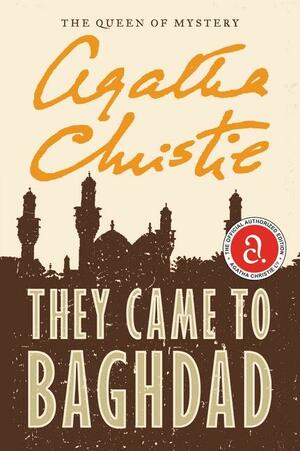
Review 2752: They Came to Baghdad

British officials are awaiting the arrival of their man Carmichael in Baghdad. He is being sought after everywhere as others try to capture him before he can pass on important information leading up to the summit meeting that includes the President of the United States and the Premier of the USSR.

But then we return to London and the activities of two women. The mysterious Anna Scheele is being followed, while Victoria Jones is being fired from her job as a stenographer/typist.

In Covent Garden Victoria meets a young man named Edward and is immediately smitten, but he says he is leaving for a job in Baghdad the next day. Victoria decides she must go to Baghdad, but she has no money. She ends up taking a job to help a woman on her way to Iraq who has broken her arm.

Once in Baghdad, Victoria realizes she doesn’t know how to find Edward. She doesn’t even know his last name. Then, in her hotel room at night, a bleeding man dressed as an Arab breaks in and asks her to hide him. She puts him behind her pillows in her bed while a policeman searches her room, but when she uncovers him, he is almost dead. He whispers some words and dies. This is Carmichael, who has made it all the way to Baghdad only to be ambushed.

Mr. Dakin, a British official, appears almost immediately but is dismayed when he learns Carmichael is dead. He is forced to explain a bit of what is going on. Since Victoria is going to a charity called The Olive Tree to find Edward, and this place seems to Dakin to be a focus of activity, he asks Victoria to keep her eyes open. He also asks her to look for evidence of Anna Scheele.

The big plot in this book is a silly one, but I found it otherwise a lot more entertaining than Christie’s other espionage-based novels. It includes exotic scenery, kidnapping, and murders, an engaging heroine, and some interesting descriptions of the area and of archaeological digs.

Related Posts

The Man in the Brown Suit

Passenger to Frankfurt

Destination Unknown

Day 884: Tales from the Queen of the Desert

Cover for Tales from the Queen of the DesertTales from the Queen of the Desert is a set of excerpts from two books by a remarkable woman, Gertrude Bell. Bell was a travel writer, diplomat, linguist, archaeologist, even a spy during World War I. She was widely regarded as an expert on the Near and Middle East and helped establish the country of Iraq.

She wrote the first book, Persian Pictures, after she visited her uncle in Persia (modern-day Iran) in 1892. She was very observant, and whether she is describing the landscape, the bazaar, or her impressions of Tehran, her descriptions are so vivid that it’s possible to imagine exactly what she saw.

In this book, she is sometimes a little snide, in a superior sort of way, although sometimes funnily so, as when she reports her impressions of the famous Peacock Throne of the Shah. At first she is astounded when she realizes that every inch of the room, including the carpet, is encrusted with jewels. But then she notices other objects among the jewels—patent medicine pills and toothbrushes, for example, which are also treated as treasures. As a final touch, she notes that the room is lined with boxes, which turn out to be music boxes. She understands that the Shah likes to turn them on all at the same time.

Some of her observations resound strongly even today. For example, at the beginning of the first chapter, she describes entering Tehran from the west gate. From that side, the city at the time was relatively unpopulated, the desert creeping in. But by the east gate, the town was vibrant and full of people. She concludes, “The East looks to itself, it knows nothing of the greater world of which you are a citizen, asks nothing of you and your civilization.”

Syria: The Desert and the Sown was published in 1907 after what was apparently Bell’s second trip to Syria, as she references a visit five years before. In this book, although she visits some of the area’s most important cities, the excerpts concentrate more on her travels in the hinterlands, where she meets many interesting people and examines archaeological sites. She also has another errand, which she does not discuss.

The excerpts from this book seem more fragmentary, for she begins chapters in different locations than she left off. Again, her descriptive powers are notable. By now, she gets by very well in Arabic and has studied the customs and courtesies of the area. Her attitude of slightly amused superiority is gone.

In both books, Bell’s writing is almost poetic at times. It’s easy to feel the romance and dangers of the East. There is nothing like some books for taking you to another place and time.

I received a copy of this book from the publisher in exchange for an honest review.

Related Posts

The Cruelest Journey: Six Hundred Miles to Timbuktu

The Great Game: On Secret Service in High Asia

Wild