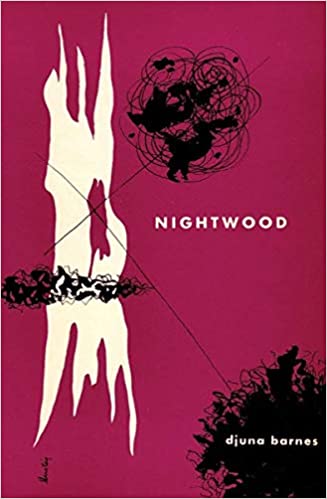
Review 1645: The 1936 Club! Nightwood

When I looked for books to read for the 1936 Club, I picked a couple of rereads, as I usually do, but also tried to find one I hadn’t read before. That novel was Nightwood, which I had heard of for years.

T. S. Eliot, who wrote the original Introduction and had a great deal to do with its publication, said that it would “appeal primarily to readers of poetry.” That comment struck dread into my heart, because I am not a big poetry reader. And indeed this is a difficult novel.

The plot is relatively slight. Felix, an Austrian Jew and pseudo-baron, marries Robin Vote because he wants a son to pass his heritage to. Robin is an enigma whom we only see through the eyes of those infatuated with her. She is boyish, and the Doctor, an intersex character who is also an enigma, implies that she is also intersex. Robin seems to view motherhood with horror, so she leaves Felix with his son and takes up with Nora, who is madly in love with her and spends most of her time dragging her, dead drunk, out of sleazy Parisian nightclubs. Then Robin dumps Nora for Jenny, a woman who always wants what other people have.

All the characters are distraught.

The novel is most known for its style and language. It is crammed with images and metaphor, but it is difficult to understand what the characters are talking about, especially the Doctor. I felt like I understood him less than half the time.

The novel seems filled with dread, as it might well in pre-World War II Europe, even though its characters’ preoccupations are not political. I found it disturbing, thought-provoking, and astonishing.
Related Posts

The True Heart

Fidelity

My Husband Simon

Day 418: Old Possum’s Book of Practical Cats

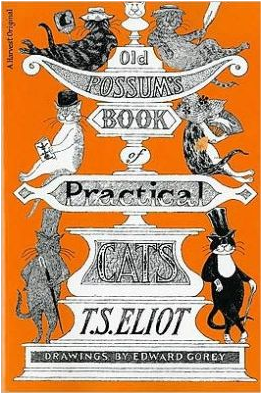
Cover of Old PossumIt took me longer to find this wonderful book than to read it. I came across it months ago in a used book store, bought it, and immediately opened it up. After I read the first poem, I got interrupted and put it down. Shortly thereafter, my husband, in a fit of tidiness, put it “somewhere safe.” He finally found it again, months later.

Some of you may know that T. S. Eliot’s Old Possum’s Book of Practical Cats is the source material for the musical Cats. Since the book is not as well known on this side of the pond as I assume it is on the other, I had not read it until lately and was frustrated during the musical at not being able to understand most of the words, much less which cat was which.

But these poems are delightful. They zip along with the kind of rhythm and rhyming that smaller children adore, and although I don’t think they’ll understand all the vocabulary, that can be explained to them. I was wondering whether modern children would understand or care about things like the clubs along St. James, but I decided that was unimportant. They would focus instead on Macavity, who isn’t there (I have a cat like that), on the names like Rum Tum Tugger that roll around in your mouth awhile, and on the proper way to address a cat (“O Cat”).

A comment on the cover I have shown here. This cover is not for the copy I bought, which was illustrated by Axel Scheffer. I thought Scheffer’s illustrations were cute, but it was hard to tell one cat from another. The reason I’ve attached the cover with Edward Gorey’s illustrations to my review is that Gorey’s version was the one I chose to buy for my young niece.