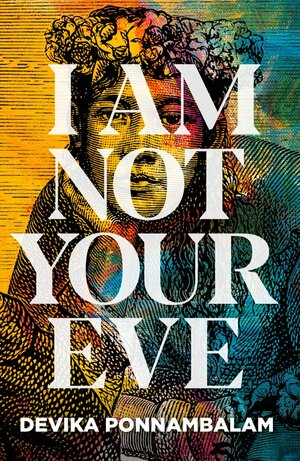
Review 2508: I Am Not Your Eve

This is an interesting yet difficult novel about one of Gauguin’s Polynesian “wives,” whom the blurb calls his muse. Although much of it is about her, Teha’amana, a very young girl, it is told with several voices—those of Gauguin’s daughter, his European wife (briefly), Teha’amana’s Foster Mother (called only that in the book), and very occasionally Gauguin himself.

The broad story is of Gauguin arranging a “marriage” on Tahiti with a very young girl. Their relationship is one-sided. She basically does what he tells her to do while he continues to talk about her as if she were free. Their relationship starts with rape and mostly consists of sex and posing for his paintings. She dislikes the food he eats. When she returns home after eight days to her mother as custom dictates, she tries to stay there.

From Denmark, Gauguin’s daughter writes about him in her diary. She seems to be the only family member who misses him. When his painting of Teha’amana arrives, her mother shoves it into the attic instead of taking it to Paris to sell, and she goes up to commune with it.

Interleaved with these stories are Polynesian creation tales and other myths.

This novel is poetically written, but it was sometimes difficult to know which narrator was speaking. There were a few times, for example, when I thought I was reading a myth but it was actually part of Teha’amana’s story. Also, I was occasionally startled by Gauguin’s point of view of Teha’amana’s behavior that seemed radically different from how she was feeling. Teha’amana’s expression of her point of view is very different from a Western way of telling things, so I didn’t always feel I understood what was going on.

The book only briefly mentions other girls, but apparently Gauguin had three very young Polynesian “wives,” hopefully one after another rather than at once. I couldn’t tell. Much of the content within the mythology sections and in Teha’amana’s story are very sexual in nature, although not graphic.

I read this book for my Walter Scott project.

Related Posts

Moloka’i

Under the Wide and Starry Sky

Euphoria

Day 449: The Signature of All Things

Cover for The Signature of All ThingsBest Book of the Week!

I was not really eager to read Elizabeth Gilbert’s memoir Eat, Pray, Love a few years ago for my book club, especially the pray part. But I discovered writing that was comic and intelligent and a story that was much more interesting than I expected.

In The Signature of All Things, Gilbert turns to fiction to tell the story of the life of a remarkable woman. Alma Whittaker is the daughter of a man born in poverty, the son of a frutier for Kew Gardens. Determined to become a wealthy gentleman, Henry Whittaker as a boy steals cuttings from the gardens to sell, and after he is caught, is dispatched by Sir Joseph Banks to gather plants on several voyages of discovery, including Captain Cook’s last.

Eventually, Henry breaks from Banks to start a pharmaceutical industry in Philadelphia. He marries a Dutch wife from a family of botanists and builds a series of greenhouses filled with plants from around the world.

Alma spends her childhood roaming the woods around her house and becomes a brilliant botanist but an unattractive girl and woman, tall and ungainly. She is much better with plants than with people, and when her mother Beatrix decides to adopt the beautiful orphaned daughter of a local prostitute, Alma is never able to develop a sisterly feeling for Prudence.

Although Alma spends much of her life there on her father’s estate, it is nonetheless an exceptional one, as she develops her own professional reputation, and eventually she ends up traveling farther than she ever expected she might. Gilbert takes time with her—time to develop her into a complex personality.

The course of her life takes a fateful turn when she encounters Ambrose Pike, an artist who has been living in South America and has painted the most beautiful pictures of orchids she has ever seen. Ambrose is of a spiritual turn of mind. He believes in the “signature of all things,” an old idea that god has left his imprint on everything on earth so that man will know its use. Although Alma, as a scientist, understands the fallacies in this notion, she finds she loves the man. But he has ideas about the pursuit of human perfection that she doesn’t comprehend.

This novel is beautifully written, completely different from Gilbert’s first book except for being a voyage through a human heart. I became fully engaged with Alma’s story. I grieved with her over her romantic disappointments and was impressed by how she snapped herself back into a productive life. This novel is an enthralling and satisfying story of an early woman scientist, about how a lonely but determined woman makes her own place in the world. Although Alma is not really a lovable person, Gilbert is able to make readers understand and care about her.

Day 424: Mutiny on the Bounty

Cover for Mutiny on the BountyMutiny on the Bounty did not seem like the type of book I would normally pick to read, but when my friend Karen learned I had never read it, she sent me a copy. Now that I have read it, I’m glad she did, for it is a true adventure story, extremely interesting and well written.

The story of the famous mutiny is told by Roger Byam, the only fictional character on the ship. At the beginning of the novel Lieutenant Bligh (not, apparently, a captain at the time) meets the young man socially and invites him along on the journey because of Roger’s facility with languages. One of Bligh’s directives for the voyage besides its mission to collect breadfruit trees is to draft a dictionary of the Tahitian language, a task for which Bligh does not feel competent.

Once aboard, Byam soon learns how ill-fitted Bligh is to command men. Byam commends him as an excellent navigator, but Bligh has no control over his temper and abuses all his men verbally, no matter their station. He is prone to order the most vicious punishments for slight or even imagined offenses. As time goes on, the men also come to believe that Bligh is cheating them out of their due rations with the connivance of Mr. Samuel, his clerk. Bligh even accuses his officers of the theft of cheeses that he himself had delivered to his own house before departure.

Bligh’s clash with Fletcher Christian is perhaps inevitable. Christian is one whom Bligh first views as a friend and promotes to second-in-command over the head of the ship’s master. However, Christian is an upright man whose attempts to soften Bligh’s behavior and whose rebukes in the name of fairness are not well received. And Christian is victim to his own passions. Nordhoff and Hall build slowly to the famous mutiny, which takes place shortly after the ship has departed Tahiti for home.

Although Christian is depicted more positively than Bligh, his fault lies in taking actions that affect the lives of the men who are innocent of the mutiny. Fully half the novel deals with the aftermath of the mutiny, culminating in the trial of eight men, three of whom are innocent.

The novel is carefully researched and the tale told is enthralling, from the details about shipboard life in the 18th century to the customs and culture of Tahiti. Even though the first chapter makes you aware of Byam’s fate, as he is tried for mutiny although entirely innocent, the suspense at the end of the novel still holds you to the page.

I was surprised to learn that this novel is the first of a trilogy. Men Against the Sea, which I had not heard of, tells the story of Bligh and the other men set adrift in a small boat, and Pitcairn’s Island, which I had heard of, relates what happened to the men who left with Fletcher Christian on the Bounty after they departed Tahiti for the second time. I will certainly read these other two novels.