
Review 2254: #1962 Club! The Reivers

The Reivers is William Faulkner’s last novel, written in 1962, which I chose as my last selection for the 1962 Club. Unlike some of his more famous novels, it is told straightforwardly by its main character, Lucius Priest, as a grandfather telling a yarn about his childhood to his grandson. I believe Faulkner wrote this novel, which reminded me of Huck Finn, for pure fun.

Key to the story, which is set in 1904 when Lucius is 11, is Boon Hoggenbeck, an overgrown man-child who works for Lucius’s grandfather, referred to as Boss. Lucius’s grandparents and parents have no sooner departed for the funeral of Lucius’s other grandfather than Boon decides to take Boss’s brand new automobile and Lucius to Memphis, both sort of colluding in this misbehavior without actually discussing it. On the way there, they discover that Ned, Boss’s Black coachman, has hitched a ride with them by hiding under a tarpaulin.

In these early days of cars in Mississippi, the trip to Memphis is in itself an adventure, but things heat up when Boon delivers himself and Lucius to a whorehouse (although Lucius calls it a boarding house) where Boon has a favorite girl, Miss Corrie.

A bunch of colorful characters appear, including Otis, a boy described as having something wrong and who you don’t notice until it’s almost too late. But the story really kicks in when the miscreants learn that Ned has traded Boss’s automobile for a horse that he plans to race against another horse that already beat it twice.

I wasn’t sure this was going to be my kind of story, but mindful of the time (it is definitely not politically correct in so many ways), and I mean 1904 not 1962, it is funny and contains some philosophizing about right and wrong.

Related Posts

The Hamlet

The Town

The Mansion

Review 2103: Kill Me Tender

When I asked Dean Street Press to send me books for Dean Street Press in December, I felt that a mystery starring Elvis Presley might be clever and amusing. This was despite my usual dislike for mysteries using an actual person or someone else’s character as the detective. So, I asked for the first book in the series. Unfortunately, I wasn’t able to post my review until now, so I missed the event.

Elvis is feeling strange and unfocused since he returned from his army service. He keeps an eye on his correspondence and is distressed to learn that the president of one of his fan clubs, a young girl, died of a heart attack. Also, someone has sent him a record of an Elvis impersonator singing one of his songs, only with the lyrics horribly changed. Then, he learns that another fan club president has died unexpectedly—and both girls had a red spot on their tongues. After a third death, Elvis begins to suspect that someone is killing off his fans. Elvis feels he must get to the bottom of this.

His investigation leads him to meet colorful characters—an uncredentialed doctor serving the Black community and his beautiful nurse, a whole room of Elvis impersonators, an expert on criminology, and a hippy-like jail resident who seems to be psychic.

The humor of this novel seems to be based in strange encounters and outrageous behavior, and it didn’t really work for me. Far from the witty maybe sharp novel I expected, it comes off as a fanboy tribute.

What bothered me more, though, was that while Klein obviously researched Elvis, he didn’t spend the same amount of time checking the accuracy of his memory of 1965. For example, a 14-year-old Southern girl of the time would be very unlikely to even know the language that one character uses. Elvis’s affair with a black nurse is also unlikely. But there is at least one downright anacronism—the use of the term “serial killer” ten years before it was coined.

Characterization is mostly one-dimensional in this novel except for Elvis himself. The rest of the characters are just being put through their paces.

I received this book from the publisher in exchange for a free and fair review.

Related Posts

Scot Free

Eight Perfect Murders

Insomniacs, Inc.

Day 25: Shiloh

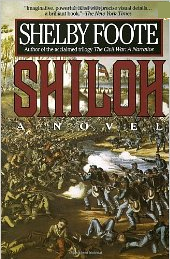
Cover to ShilohIn Shiloh, the historian and novelist Shelby Foote has written an interesting fictional account that describes the battle from the points of view of several different narrators, some on the Union side and some on the Confederate. Each narrator has his own chapter. In these brief narratives you get a sense of the character while being able to trace the larger movements of the battle.

Foote manages to work into the narratives the major events, such as the death of General Johnston; the surviving Confederate leadership’s failure to follow Forrest’s recommendation of attacking again at night, which probably would have ended in victory for the Confederates; the 10,000 Union “shirkers” who hid along the riverbank after they became dispirited from having to pull back time after time; and the river crossing by Buell’s troops, which turned the tables in the Union’s favor.

Lieutenant Palmer Metcalfe is marching with the Confederate army under Johnston as it prepares for a surprise attack on the Union troops. He thinks back with satisfaction to the complicated plan he helped draft, as he is a staff officer under Johnson. The noisy troops may have lost the element of surprise, but Johnston insists upon attacking.

Captain Walter Fountain is a Union soldier writing a letter to his wife Martha during a Tennessee evening when the Confederate troops burst out of the woods and charge the Union army.

Private Luther Dade is wounded in battle and is sent to a triage area to wait for a doctor. After hours pass and no doctor shows up, Dade begins to show signs of infection. He stumbles around across a large swathe of the battle area and finds himself witnessing the death of the Confederate commander Johnston.

So the novel proceeds in short chapters that culminate with a return to Lieutenant Metcalfe as he reviews the results of the battle. The characters are briefly drawn but have distinct personalities. Through following the peregrinations of the various characters and with the assistance of the maps in the book, you can get a good understanding of the complex battle and why the initially successful attack ultimately failed.