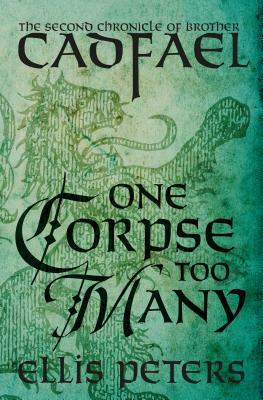
Review 2602: One Corpse Too Many

It’s 1138 during the war between King Stephen and Queen Maud, which became known as the Anarchy. King Stephen is besieging Shrewsbury, which is soon to fall. FitzAlan and Adenay, the castle defenders, wait until the last minute to flee with their men, but rumor has it that Adenay’s daughter and FitzAlan’s fortune are still inside the castle.

In the monastery, Cadfael is assigned a new helper, a boy named Godrik, who is a hard worker. It doesn’t take Cadfael long to figure out Godrik is a girl, Adenay’s daughter Godith, whom Stephen is searching for to use as leverage.

Stephen has the remaining defenders of the castle executed after he takes it, and Cadfael takes charge of identifying and burying the bodies. However, he finds there is one corpse too many. In looking more carefully at the corpses, he sees that one man has been garroted. So, he reports to the king the information that someone has tried to hide a murder by mixing the body with the executed and is given permission to try to identify the body.

A young lady of the town, Aline, identifies the body as Nicholas Faintree, a squire of FitzAlan. She has recently also identified one of the executed men as her brother.

Meanwhile, Godrik, whom Cadfael has sent reaping to escape the attentions of a mysterious man, Hugh Beringer, who has been following him, finds a wounded man. It turns out that the wounded man Godith finds is Torond Blunt. He was sent off with Nicholas Faintree to carry FitzAlan’s fortune into Wales. However, they were ambushed at night. Briefly separated, Torond returned to find Nicholas dead and then someone attacked him from behind, but he managed to get away and hide the fortune.

Now Cadfael is hiding Godith and Torond and trying to make arrangements to get them both to Wales along with the fortune. Meanwhile, it’s clear that Beringer is dogging his steps ever since he visited Godith’s old nurse to tell her she is safe. Incidentally, Beringer is engaged to Godith, although they haven’t seen each other for years. And she has fallen in love on sight with Torond.

Beringer seems to be playing a game with Cadfael, so he decides to play back. But is Beringer a friend or foe?

Although this mystery doesn’t really give clues to the murderer’s identity until the end, it does a good job of misdirection. This book is the second of the Cadfael series, which I would describe as Medieval cozy. It has likable characters and seems to be well grounded in its time period.

Related Posts

A Morbid Taste for Bones

A Murderous Procession

Grave Goods

Review 1347: A Place Beyond Courage

Cover for A Place Beyond CourageIn 12th century England, John FitzGilbert is the marshal for King Henry. He is an astute politician and a masterful organizer. FitzGilbert’s comfortable position is threatened, however, after Henry’s death. Henry has made all of his men pledge fealty to his daughter, Matilda, upon the event of his death, but he does not affirm his successor before his death. Many of Henry’s men prefer to follow Stephen, Henry’s likable nephew, after his death rather than recognize Matilda as queen or even as regent for her young son, Henry. The result is the period of English history called the Anarchy.

At first, John throws in his fortunes with Stephen, but he eventually recognizes that Stephen is a weak ruler, too swayed by his closest advisers. In particular, Stephen fails to reward John for his successes in battle. So, John switches sides to Matilda, along with other discontented men.

John is also unhappy in his marriage. He married Aline, his innocent young ward. Aline is painfully shy and seems totally unsuited for her position. She takes little interest in anything but the church.

A Place Beyond Courage is moderately interesting, but I feel it suffers from a trait common to historical fiction about actual characters. It tries to follow too faithfully the events of FitzGilbert’s life, resulting in a series of brief scenes instead of a more integrated novel.

Chadwick has also taken a character historically reviled because he gave his son over as a hostage with a famous speech that boils down to “There can be more where that came from” and depicted him sympathetically. Whether he deserves this treatment is questionable. Chadwick says he is know to have been gentle with women and children, but he sets aside Aline, his wife of many years and mother of his son, a woman he married for her fortune, for Sybilla, a young, beautiful woman the marriage with whom brings peace and useful connections. To justify this, Chadwick makes Aline unfit for her position and Sybilla so eminently more suitable that in the book this relationship is telegraphed for years before they even meet. Do any of these people actually deserve how Chadwick treats them? I’m not sure. Certainly, FitzGilbert seems mostly driven by ambition to me.

Making interpretations like this is the purview of a historical novelist, certainly, but most are more cautious than this. In any case, these doubts of mine are just thoughts that occurred to me as I was reading. My main objection is how Chadwick crams 20 years of events into a long series of short, staccato scenes. Few of the characters are very fleshed out because of this approach.

Related Posts

King Hereafter

The Siege Winter

The Winter Isles