
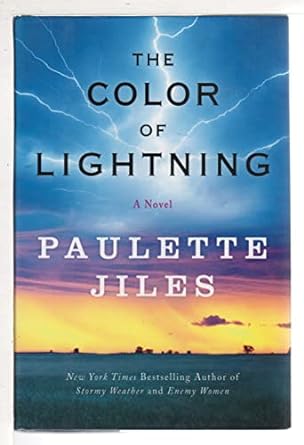
I have read several of Paulette Jiles’s books that are set in post-Civil War Texas and depict a countryside that’s dangerous and beautiful at the same time. Another characteristic of these books is that they feature brief appearances by the main characters of her other books. I believe that The Color of Lightning is the first of these books. Unlike the others, though, it is about a person who really existed.
Britt Johnson is a black freedman who travels with his wife and children along with his ex-master and a group of fellow Kentuckians to Texas to get away from the war in 1863. They all live in a small community called Elm Creek in Young County, Texas, at the edge of the area occupied by settlers. Although they are living in the traditional raiding lands of the Kiowa and the Comanche, the older residents of the settlement say they haven’t seen a native since they moved there.
Britt has been rounding up cattle, but his real ambition is to buy teams of horses and freight wagons so he can start a freight service for the area. While the men of the settlement are on a trip to Weatherford to get supplies, a force of 700 Kiowa and Comanche attack the white and black settlers of Young County. Britt’s oldest son Jim is killed and his wife Mary and children Cherry and Jube are captured. Elizabeth Fitzgerald’s daughter Susan is killed, and Elizabeth and her granddaughter Minnie are taken.
The United States government has removed its corrupt Indian agents from Indian Territory and for a few years makes an experiment of turning the various reservations over to the administration of religious organizations. Samuel Hammond is a Quaker who reluctantly agrees to take over the Kiowa-Comanche reservation. He hopes to manage the reservation without using force or violence, but he goes to work with no understanding of these native peoples, trying to contain them on the reservation when they have always been wanderers, stop the raiding (which he didn’t even know about when he took the job), and make the natives into farmers when they consider that women’s work.
In the meantime, Britt begins a long trip north to the winter territory of the Kiowa and Comanche to trade for his wife and children. He is given unexpected help from a young Comanche brave named Tissoyo whom he befriends on his trip. While he’s on his way, the story shifts to the lives of Mary, Cherry, and Jube in the Kiowa camp.
I think this novel did a really good job of representing the viewpoints of all of its characters—the settlers, the native people, the captives, and the Indian agency administrator. The novel is exciting at times and deeply interesting. Jiles is getting to be one of my favorite writers.
 What? Me Read?