
 Best Book of the Week!
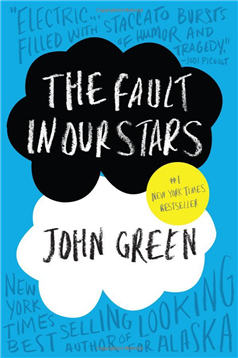
It seems as if I have read more books lately from which I do not get a sense of the characters’ personalities. I don’t feel as if they could be real people but just projections of the author’s plot. But that is not the case with The Fault in Our Stars, which creates for us some unforgettable personalities.
Hazel Lancaster is a sixteen-year-old with thyroid cancer that has spread to her lungs. Unlike the other kids in the support group her mom has talked her into attending, she doesn’t have any hope of survival. She just wants to live as long as she can. At the group, she meets Augustus Waters, a seventeen-year-old ex-basketball player who has lost one leg to osteosarcoma but has a generally good prognosis.
Hazel is witty, smart, and well read. She is obsessed with a novel called An Imperial Affliction by Peter Van Houten, which is about a young girl suffering from a fatal illness, and literally ends in the middle of a sentence. As she and Augustus discuss their favorite books, Hazel explains that she just wants to know what happened to everyone else in the novel. Augustus decides to use his wish from the Genie Foundation to take Hazel to Amsterdam, where she can meet Peter Van Houten and find out what happened after the novel ended.
This novel is about teenagers falling in love, and rarely has fiction depicted two more appealing people. My one very small criticism is that they are scarily smart and funny, in intelligence reminding me more of Salinger’s Glass family than of normal kids. But Green has got the juvenile speech patterns down.
Frightfully well written, touching, funny, and ultimately sad, this novel has much to offer teens, young adults, and adults. Hazel and Augustus are affectingly human, and even Hazel’s parents, those cumbersome quantities so often ignored or eliminated in children’s or young adult fiction (note, for example, how much we see of Bella’s father in Twilight), are deftly characterized by their affectionate jokey interactions with Hazel.
Again, I feel that my capabilities are stretched here in my inability to adequately express how good this novel is. When I first started reading it, I was afraid of manipulation, as there seem to be a lot of “affliction of the month” children’s books out there right now, but that feeling left me almost immediately.
 What? Me Read?