
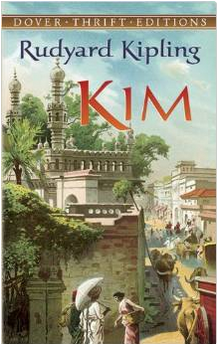
 Best Book of the Week!
Up until now, the only book I read by Rudyard Kipling was Puck of Pook’s Hill, which is definitely a children’s book. I always assumed that Kim was a children’s book, too, or at most a boy’s adventure story, but I don’t think I would describe it that way.
Kim is the son of an Irish soldier in India, but both of his parents died impoverished when he was young. He has been brought up by a Eurasian woman who leaves him to himself most of the time, only insisting that he wear European clothing. But he keeps some native clothing hidden away, and when he is wearing it, he cannot be discerned from any other street urchin. He knows everyone in Lahore, and they call him Friend of All the World.
One day he is playing outside the Lahore museum when a holy old lama comes to look at the wonders inside. Kim sees that he is a truly guileless man with no one to help him in a foreign country. The lama explains that he is searching for a holy river that will wash clean all his sins. Kim decides that he will go with the lama as his chela, his disciple who begs for him and takes care of him. Before leaving Lahore, though, Kim goes to see Mahbub Ali, an Afghani horse dealer for whom he has run some errands. Mahbub gives him a dispatch to take to a British Colonel Creighton.
The description of the journey of Kim and the lama is very colorful and interesting, reflecting Kim’s joy in the bustle of the road and a love of the country on the part of the author. But Kim’s father told him long ago that he would be saved by a red bull on a green field, so when he sees a regimental flag flying the device, he goes nearer to look and is suspected of being a thief.
He has always carried his papers in an amulet, and when he is captured, his identity as Kimball O’Hara is established. The priests in the regiment, of which Kim’s father was a member, plan to send him away to a Masonic orphanage. Kept a watch on and forbidden to see his lama, Kim writes to Mahbub for help. Mahbub makes sure that Colonel Creighton understands how valuable a boy like Kim would be as part of the Great Game, of spies and explorers in the far regions of the area.
So, Kim’s fate is taken out of his own hands and he is sent to school to learn to take his part in the Raj. But the lama pays for his schooling and makes sure he goes to a better school than originally intended.
This is really a great novel. I came to it prepared for perhaps some outmoded racism or hints of British superiority but found a novel that reflects a deep love of India and of all its peoples. Of course, there is an implicit assumption that the Raj is a good thing, but the British characters in the novel are as varied as any, and there are comments about mismanagement and misplaced airs of superiority on the part of the British. Kim is rich in colors and smells, in the flavors of language and the stories of the orient, and in this complex tale of a boy with loyalties both to the soldiers who raised him and to his beloved lama.
 What? Me Read?