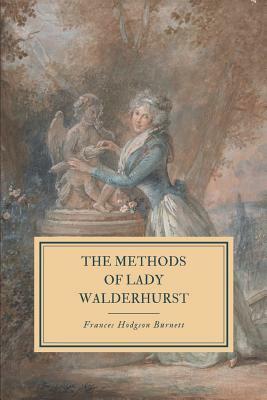
Review 2768: #RIPXXI! The Methods of Lady Walderhurst

It took me a while to find information on R.eaders I.mbibing P.eril (RIPXXI) for this year, since they are now only active on Instagram and Threads, where I am barely active or not at all, respectively. But here is my first book for this challenge, which runs from September 1 until the end of October.

When I was looking for an adult book by Frances Hodgson Burnett for my Classics Club list, I read that The Methods of Lady Walderhurst was a sequel to The Making of a Marchioness, which I enjoyed very much. When I finally began reading it, though, I became confused because it begins before Emily Fox-Seton’s marriage, and The Making of a Marchioness ends quite some time after it. Furthermore, it had been years since read TMofaM, but the book seemed very familiar.

As it turns out, this book was written as a sequel to the original Marchioness, which apparently ended with the betrothal. Later, the books were combined, and the Persephone copy that I read years ago must have been a combined edition. That explained to me why when I originally read the first book, it felt as if I was reading two—one a romance and one a dramatic suspense novel.

The Methods of Lady Walderhurst begins shortly before the wedding of the naïve, open Emily Seton-Fox, a well-born but poor errand runner for rich women, to Lord Walderhurst, a middle-aged marquis. Almost immediately, the subject of Alec Osborne comes up. Osborne is a distant relative who has considered himself Walderhurst’s heir. He has a disgraceful past, and Walderhurst dislikes him. He has married a Eurasian girl named Hester, and eventually they come to England on a visit from India.

Emily, now installed as Lady Walderhurst, is a friendly, guileless creature, and as she knows they are not well off, she talks her husband into letting them live in a vacant house on the estate. She does not realize how much Alec Osborne hates her.

Then Walderhurst has to travel to India on business, and Emily invites the Osbornes to move into the big house. She finds she is pregnant, and from that point Osborne begins plotting to kill her, working with Hester’s Indian maid. Hester herself is aware of his feelings but feels more ambiguous because of Emily’s kindness, which alternaturely infuriates her and softens her.

Where will it end?

From a romance novel in the first book, this story moves right into sensation novel territory. Although it describes Emily as childish and almost stupid, it really invokes the reader’s sympathy toward her. I enjoyed it just as much the second time. Warning: it does not portray its Asian characters in a positive light, but then again, there’s Alec.

Related Posts

The Making of a Marchioness

The Shuttle

Dolly: A Love Story

Day 818: The Making of a Marchioness

Cover for The Making of a MarchionessBest book of the week!
Although The Secret Garden was one of my favorite childhood books, I had no idea that Frances Hodgson Burnett also wrote novels for adults until I read a review of The Making of a Marchioness. The Preface points out that Polly references it in Love in a Cold Climate, but there Burnett’s name isn’t mentioned. In any case, I’m happy to report that it is a delightful novel.

The Making of a Marchioness combines a Cinderella story with a realistic description of an evolving marriage. It has been called “a romance between two unromantic people.” It also has a bit of peril mixed in.

Emily Fox-Seton is a woman in her 30’s of good birth but very poor. When her parents died, her more fortunate relatives made it clear they couldn’t be bothered with her. So, she has created a business of doing small tasks and running errands for her wealthy clients. She has the happy characteristic, though, of being a positive person who perceives kindness everywhere.

Lady Maria Bayne enjoys both Emily’s company and her utility, so she invites her to Mallowe for a house party in August, thinking Emily can help with the arrangements for her annual féte. Emily is delighted to leave the city in summer and soon becomes interested in the competition among three guests to snare Lord Walderhurst, a 50-year-old widower who is also a marquis. She finds herself rooting for Lady Agatha, a beautiful girl from a poor family that has several daughters to marry off.

Lord Walderhurst, though, likes the open expression in Emily’s eyes and her happy, busy ways. To Emily’s astonishment, he proposes, and she gladly accepts.

But that is only the beginning of the novel, about how gratitude and love can provoke love in its turn. Some piquancy is added by a plot development that puts Emily in danger from her husband’s heir, who has always considered Walderhurst’s vast estates as almost his.

This is a lovely novel that brought tears to my eyes. Its characters are prosaic but nice (except the heir). Even selfish Lady Maria is quite lovable. The writing is beautiful, and Emily’s story is touching.

By the way, a recent television adaptation of this novel, titled The Making of a Lady, follows the plot with some changes, but it wildly miscasts the two main characters, making them both younger and more attractive than they’re supposed to be in the novel. Still, I marginally enjoyed it.

Related Posts

Persuasion

Love in a Cold Climate

Major Pettigrew’s Last Stand