
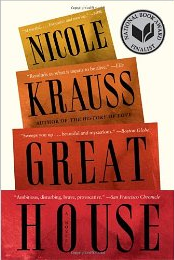
 The tale this collection tells is so complex that my book club members asked me to send them an email explaining the sequence of events, once I had figured it out. Great House by Nicole Krauss is written as a series of interleaved stories without regard to sequence, almost as if she wrote the stories in order as a novel and then cut it up into pieces and rearranged it. The effect is interesting, but it is difficult for readers to understand where they are in time as they go from one story to another.
A labyrinthine tangle of people’s stories is written around the migration of a desk from one person to another. Nadia, a writer, tells the story of how she accepted the loan of furniture from Daniel, a Chilean poet, who was soon after murdered by Pinochet’s regime. Years later, a woman comes to her claiming to be Daniel’s daughter and asking for the desk, so Nadia gives it to her.
Arthur, the husband of Lotte, the writer who gave Daniel the desk, finds a secret while he is going through his dying wife’s things. This secret may be the clue to where Lotte got the desk.
Nadia goes looking for the desk to ask for it back because she finds she cannot write without it. She eventually finds herself in Israel. Other characters encounter the desk, are affected by the search, or meet Nadia or each other. We find out that the woman who claimed the desk was not the daughter of Daniel after all, but the daughter of someone who has an even better claim to it, as his family lost it in the holocaust.
Most of the members of my book club were perplexed, and many of them did not like any of the characters. I had a more neutral reaction. The desk eventually comes to represent all of the things that were lost in the holocaust. The stories as a whole are demanding and interesting, and Krauss purposefully leaves you with unanswered questions.

 What? Me Read?