
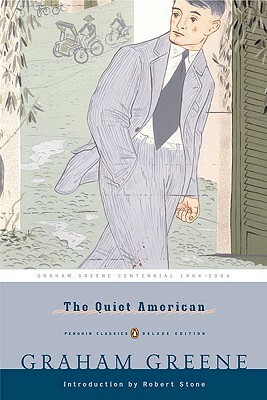
I long ago saw the movie version of The Quiet American starring Michael Caine and Brendan Frasier, but I couldn’t remember the details. I need to read more Greene, so when this book filled a hole in my A Century of Books project, I found a copy.
The narrator, Thomas Fowler, is an aging British reporter in Saigon, a cynical, world-weary man. The time setting is the early 1950s, when it was the French fighting the Communists in Vietnam. Fowler has lived a long time in Vietnam and has a young mistress named Phuong whom he cares for more than he admits.
At the beginning of the novel, he learns that an American, Alden Pyle, is dead. Then the story backtracks to his meeting with Pyle, a young naïve man who has just arrived in the country. Fowler catches on fairly quickly that Pyle has no real understanding of the country or its people but some half-baked ideas about Vietnam based on a book by an author who spent one week in the country. However, Pyle is not receptive to other ideas (until it’s too late).
Fowler invites Pyle to his home, where he meets Phuong. Very quickly, Pyle decides that he is in love with Phuong and tells Fowler he can make a better life for her, so he will court her but not behind Fowler’s back. He seems to have no conception that this may be painful for Fowler.
Fowler is married, so he cannot marry Phuong, but he writes a letter to his wife asking for a divorce—a request he’s fairly sure will be denied. At about the same time, he receives notice that he has been promoted and should return to London, but all he wants is to stay in Saigon with Phuong. He writes asking to stay.
He knows, though, that Phuong, although she cares for him, is probably ultimately going to be practical and take the young man who can marry her—egged on by her older sister, who has always thought Phuong could do better.
With this situation between them, Fowler begins hearing rumors about Pyle’s activities in Vietnam.
There are some suspenseful passages in this story, but what Greene does even better is get into the motivations of his characters. Of course, all the Americans in the novel are clueless oafs (except Pyle, who is clueless but not an oaf), and the women are disregarded. Phuong’s sister has more of a personality than Phuong does, and in one passage, Greene has Fowler basically say to Pyle that Phuong doesn’t think. (All she does in her own time is dance, visit her sister, and read movie magazines.)
If you can get past these caveats, this is a really good, suspenseful and psychological novel. None of the characters are particularly likable, but at some points you feel a lot of sympathy for Fowler.
 What? Me Read?