Review 2192: Act of Oblivion

It’s hard to know where sympathies might lie in this historical novel set right after the Restoration, in 1665. On the one hand, there is Richard Nayler (a fictional character), tasked with finding and taking to trial (or later, just plain executing) those deemed responsible for killing Charles I. A mighty task, but he performs it so zealously, not minding a dirty trick or two.

On the other hand, there are Colonel Edward Whalley and his son-in-law Colonel Will Goffe (historical characters), on the list because they signed the King’s death warrant after an illegal trial. They have escaped to America, but Nayler blames them for the death of his wife (in premature labor after they broke in on a religious service on Christmas Day, deemed illegal under Cromwell, and arrested people) and is determined to catch them.

Robert Harris states that this hunt for the regicides was the greatest manhunt of the 17th century so we may assume that’s his motivation for the book. Although I’m not particularly interested in the Puritan period of New England history, certainly there are interesting things I didn’t know disclosed in this novel, like the history of New Haven. In addition, Harris depicts the wildness of New England at this time more vividly than anything else I’ve read.

Harris manages to raise the tension of the novel at the end, when Nayler, long after everyone else has lost interest, finally locates Goffe, but overall, I was too turned off by the deeds on both sides of the English Civil War (usually I favor the Royalists, but he shows just how brutal both sides were) to care much about these antagonists. I read this book for my Walter Scott Prize Project.
Related Posts

Beheld

The Witches: Salem, 1692

An Officer and a Spy

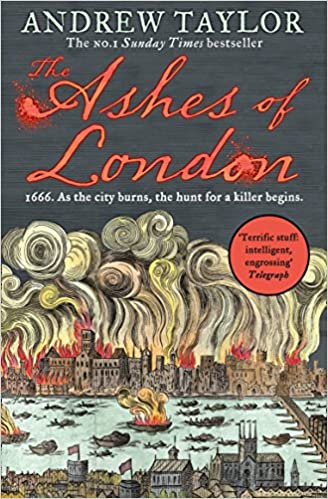
Review 1837: The Ashes of London

London is in the midst of the Great Fire of 1666. James Marwood is on an errand for his master when he stops to watch St. Paul’s burn. He is barely able to stop what he thinks is a boy from running right into the fire. When clothes begin to burn, the resulting dishevelment reveals a young woman rather than a boy. James puts his cloak around her, and she runs off still wearing it.

The girl is Cat Lovett, whose father is an attainted traitor as a result of the Restoration. She was supposed to meet him next to St. Paul’s. She has been living with her uncle’s family, the Alderleys, but they are trying to force her to marry Sir Denzil Croughton, a man she dislikes. She is hoping her father can help her. That night, though, her cousin Edward rapes her, and she stabs him in the eye, so she runs away with the help of her servant Jem to Jem’s sister.

James is also the son of a man who was on the wrong side of the Restoration. His father is a member of a sect called the Fifth Monarchists, who believed that after the King was put aside, Christ would be King. Now frail and senile, he keeps saying things that are deemed traitorous.

James works for the publisher Williamson, but soon he is asked to meet Mistress Alderley. She wants James to find her niece, and later he is asked by government officials to try to find Lovett.

There is also the matter of two bodies that have turned up. They both have their thumbs tied together behind their backs and have been stabbed in the neck.

I decided to read this series after the strong recommendation by Helen of She Reads Novels. I found it to be engrossing and entertaining. The atmosphere of burning London is well done as is the general paranoia following the Restoration. James and Cat are both appealing characters. Although it is quite a long novel at 400+ pages, it went very quickly. I’ll just have to look for the next one.

Related Posts

Merivel: A Man of His Time

The Devil in the Marshalsea

The Last Confession of Thomas Hawkins