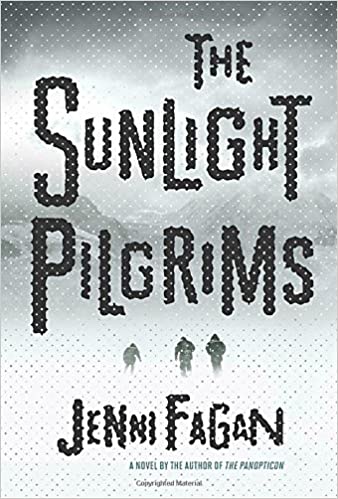
Review 1812: The Sunlight Pilgrims

Dylan MacRae has had a tough few months. Both his mother and grandmother have died, and he has been unable to save the family business, a small art cinema in London. That’s not all, because the melting of the polar icecaps is causing a new Ice Age, and the upcoming winter is forecast to be brutal.

Dylan has discovered that his mother purchased a small caravan in Scotland off the books before she died, so that he would have a place to live. On the eve before the cinema and his flat above it are repossessed, Dylan packs a suitcase containing a few things as well as the ashes of his mother and grandmother and takes a bus to the Clachen Fells in the Highlands of Scotland.

Upon his arrival, Dylan falls in love at first sight with Constance, another resident of the caravan park. She is an independent survivalist with a teenage trans daughter named Stella and two lovers. Temperatures continue to fall.

Dystopian novels aren’t usually my thing, but I became so involved in the lives of Dylan, Constance, and Stella that I enjoyed this novel of life doing its best to prevail in brutal conditions. Fagan has a talent for creating appealing characters. This is another winner from the author of The Panopticon.
The Panopticon

Greenwood

The Year of the Flood

Day 972: The Scottish Highlands

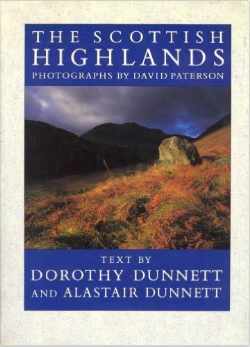
Cover for The Scottish HighlandsI will frankly admit here that I am a massive Dorothy Dunnett fan, and as such, I am eager to read anything she wrote. In this case, it’s an homage to the Scottish Highlands that she wrote with her husband Alastair, illustrated by photographer David Paterson. Alastair Dunnett was a journalist, novelist, and man of many talents. Dorothy Dunnett was an internationally known historical novelist and portrait painter.

This book is beautifully written and has gorgeous photographs. It is oddly organized for this type of work, though. The photographs and the text are presented independently, even though some overlap occurs. First, there is a section of text by Dorothy Dunnett, divided into areas of the Highlands. After that, the rest of the book is divided into the same areas, with Alastair’s text followed by Paterson’s photos. No attempt has been made to integrate the two Dunnetts’ text with each other, and little attempt has been made to integrate Alastair’s text with the photos.

A contrast to this book’s approach is James Herriot’s Yorkshire, where Herriot’s text and photos about the same places appear together. It’s almost as if the editors of The Scottish Highlands were putting together three different books. Still, it does make me want to visit the Highlands. Of course, I already wanted to.

Related Posts

King Hereafter

The Game of Kings

The Disorderly Knights