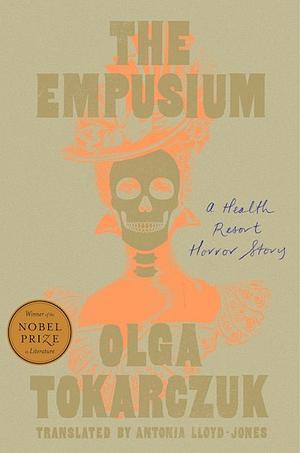
Review 2687: The Empusium: A Health Resort Horror Story

In terms of the horror story it’s labeled as, The Empusium may end like one, but it spends more time building up to its climax than on the horrible part. Or maybe horror is the attitudes toward women expressed by the men.

Mieczyslaw Woznicz is a very young Polish engineering student who arrives in a remote mountainous town in Silesia for treatment for tuberculosis in the early 20th century. He is staying in the guesthouse for gentlemen until he gets a place in the sanatorium. The guesthouse is run by Willi Opitz and his wife, but his wife dies almost immediately on Woznicz’s arrival.

I don’t know if it’s helpful from the beginning to understand what empusa are or not. I had to look it up. but from the beginning we are occasionally reminded that someone is watching everything. Still, this is something I tended to forget.

A lot of the novel deals with Woznicz’s sense of unfitness and inferiority, which has been enforced by his father’s constant expression of disappointment in him. But we also get to read lots of philosophical discussions among the men, which always end in misogyny.

Occasionally, readers are told a lot of bizarre folklore or visit some unusual site in the forest, and these incidents are leading up an annual fall event. Woznicz feels he has a shameful secret, but he’s going to learn more about himself by the end of the novel.

Tokarczuk is a writer whose books are totally different from each other. This one isn’t my favorite, but it is atmospheric and full of irony. It is said to share some characteristics, including plot points, with The Magic Mountain by Thomas Mann, a book I haven’t read.

Related Posts

Drive Your Plow Over the Bones of the Dead

Flights

The Books of Jacob

Review 1895: The Magician

Although I’ve only read one work by Thomas Mann, I still found The Magician, based on Mann’s life and writings, interesting. Although Mann himself often seems inert in this novel, he lived in interesting times, during both world wars.

The novel covers Mann’s life from a young man who is dispossessed by his father to his relocation from California to Switzerland in his 70’s. It examines the thinking behind his greatest works and although fairly meditative in tone, has some excitement during the Mann’s flight from Nazi Germany.

In some ways The Magician is reminiscent of The Master, Tóibín’s novel about Henry James, with Mann fantasizing about young men but never acting on those fantasies after a couple of abortive encounters. The difference is that James seemed almost unaware of his own proclivities. Mann still managed to have a long, successful marriage with his wife Katia.

Tóibín’s biographical fiction always seems intuitive and thoughtful to me. I enjoyed this one despite my lack of knowledge about its subject. I read this novel for my Walter Scott Prize project.

Related Posts

The Master

Nora Webster

Lady Gregory’s Toothbrush

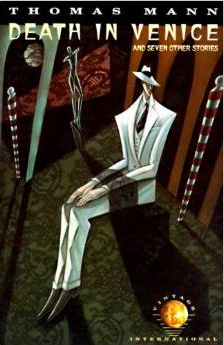
Day 544: Death in Venice

Cover for Death in VeniceGustave Aschenbach is a renowned author who has devoted his life to intellectual pursuits and his art. He leads an orderly life, conscientiously applying himself to his work.

One day when he is feeling over-taxed, he goes out for a walk and spots a red-haired man dressed as a traveler. Although the man appears to view him with disdain, at the sight of him Aschenbach is suddenly possessed with the desire to travel.

After stopping a few days on an island in the Adriatic, he decides to go to Venice. The city is gray and unwelcoming. The air is miasmic, and he wonders if he should have come. Then at the hotel he sees a beautiful boy. At first he simply enjoys looking at him, but eventually he becomes erotically fixated.

In writing this novella, Mann wanted to examine the relationship between art and the mind, a life of the senses and a life of intellect. At first, Aschenbach tries to rationalize his obsession by philosophizing about it. Mann makes many allusions to Greek mythology and calls the boy’s beauty godlike. But Aschenbach is lead inexorably into mental degradation. On the boat to Venice he was repelled by an older man, hair dyed and face rouged, who was traveling with a bunch of students. By the end of the novella, he has become that man.

While respecting the merits of the novella, I found Aschenbach’s obsessions and rationalizations repulsive, but I believe that is what Mann intended. In many ways, the story has similarities to Nabokov’s Lolita. However, while Nabokov’s language was beautiful enough to make me somehow grasp what Humbert Humbert felt, Mann’s was written with a different intent, I think.