Day 495: Just One Evil Act

Cover for Just One Evil ActI can chart my changing attitude toward Elizabeth George’s Inspector Lynley mystery/thrillers simply by how I treat the new books. I used to get them as soon as they were available and read them immediately. This one I had for a couple of months before reading it. They are still page turners, don’t misunderstand me, but George has put her characters, and fans, through a lot.

George is not a proponent of the idea of keeping her characters’ private lives out of her mystery novels—very much the opposite. At first their absorbing lives made these novels stand out. But by now she has put Lynley through a brother accused of murder, a fiancée marrying his best friend, a seemingly hopeless romance, a murdered wife, and an ill-judged affair with his alcoholic boss. Heretofore, Sergeant Barbara Havers, although sometimes rebellious and unruly, has been a rock of good judgment, often better at finding the criminal than Lynley is. So, now it’s her turn to go off the deep end.

At the end of the previous novel, Believing the Lie, Barbara’s neighbor Taymullah Azhar had his sweet young daughter Hadiyyah kidnapped by the girl’s mother Angelina, who returned to Azhar pretending a reconciliation in order to get an opportunity to take the child. The situation is complicated because the parents never married and Azhar’s name is not on Hadiyyah’s birth certification, so for now he has no legal right to her (although, if that is so, since Angelina abandoned them, British law must be really weird). In addition, he has no idea where they have gone.

The Met can’t apparently help him, so Barbara takes Azhar to a private investigator, Dwayne Doughty, and they hire him to find Angelina and Hadiyyah. Eventually, though, Doughty reports back that there is no trace of the two to be found.

The tables turn quickly, though, when Angelina returns with her lover Lorenzo Mura, claiming that Hadiyyah has been kidnapped from them, so Azhar must have taken her. When it appears that Azhar is just as alarmed as Angelina and that he has an alibi for the time of the kidnapping, they all return to Lucca, Italy, where Angelina and Mura have been living. Inspector Lynley is assigned to go along as liaison between the parents and the Italian police. Isabelle Ardery, the boss, refuses to let Barbara come along.

Barbara absolutely refuses to believe that Azhar has had anything to do with the kidnapping. She has already given information to a tabloid journalist to create enough furor in Britain about the kidnapping for someone to be assigned to the case, and that liaison with Mitchell Corsico is not only a breach of trust but a major source of drama—and irritation—for the rest of the novel. The novel ends with Corsico assuming Barbara is in his debt. I certainly hope George doesn’t plan to pursue that subplot, because I found it to be too far over the top, with the journalist demanding more disclosures about every 15 minutes (an exaggeration, admittedly) and always when Barbara urgently needs to be doing something else.

Unfortunately for Barbara, as she breaks all the rules set by her new boss, John Stewart, to investigate the case from her end, it begins to look as though Azhar did indeed plan the kidnapping and execute it with the help of some of Doughty’s contacts in Italy. We readers actually know where Hadiyyah is, although we don’t know the identity of her kidnapper. But we also soon learn that her kidnapper has died, leaving Lynley and the excellent Italian detective Salvatore Lo Bianco to figure out who he was and where he put the child. Lo Bianco’s efforts are hindered by the actions of his incompetent boss.

In the midst of all this, Angelina dies, and it becomes obvious that she was murdered. Soon, it looks as though Azhar could be implicated in that, too.

My problem with this novel is Barbara’s behavior, as she goes overboard to protect Azhar. First, there are the leaks to Corsico which, after the first one, seem totally unnecessary. Then she begins concealing and attempting to alter evidence. I won’t go on. Even worse is how this trouble is wrapped up at the end of the novel, either by a cheat or a completely unlikely act on the part of Ardery.

You can tell I had a mixed reaction to this novel. On the one hand, it is extremely gripping. On the other hand, especially if you have been following the series and care about Barbara, you occasionally want to throw the book across the room. For the last four or five books, I’ve been wondering whether to quit the series, but I always end up picking up the next one.

Finally, I was upset by how the novel ends for Azhar and Hadiyyah, who for a large part of the series have been two of the most likable characters.
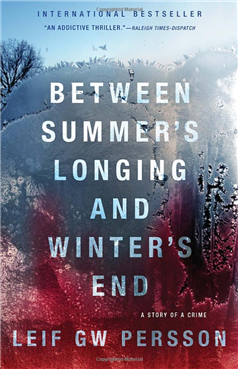
Day 493: Between Summer’s Longing and Winter’s End

Cover for Between Summer's Longing and Winter's EndBest Book of the Week!
Between Summer’s Longing and Winter’s End is difficult to place in genre because while it is about the investigation of a crime and its repercussions, it is also reminiscent of the more cerebral of John Le Carré’s political thrillers without so much being a thriller as a record of law enforcement incompetence. The novel is crammed with characters who are mostly concerned with pursuing their own agendas, whether it be the chief constable of Sweden with his ridiculous intellectual exercises or a member of the secret police who is more concerned with pursing graft and sexual exploits than doing his job.

The novel is a fictional dissection of the possible scenario behind the true-life assassination of the Swedish prime minister Olof Palme in 1986. It is the first of a trilogy of which only two novels have been published in English, but it stands fairly well on its own.

Between Summer’s Longing begins with an apparent suicide. A man living in a student apartment in Stockholm plunges to his death from his window. The apartment door is locked from the inside, and there does not appear to be any other explanation for the incident, even though the man’s shoe fell shortly after the body, killing the small dog that had just saved his master’s life from the falling body. The dead man is identified as John Krassner, an American journalist.

There are a few odd things about the crime scene, including the unusual message the man apparently left as a suicide note and the lack of a manuscript he had supposedly been writing. Still, everyone appears to be ready to wrap things up when police Superintendent Lars M. Johansson discovers that his own name and address are on a slip of paper inside a hollow heel of the man’s shoe.

In a separate time stream, the novel returns to several months earlier when the Swedish secret police get a tip to keep an eye on John Krassner. Chief Operations Officer Berg is informed by his people that they are having difficulty finding out what Krassner is up to because he seldom leaves his room, which is close by that of several students. He puts police Superintendent Waltin in charge of an operation to lure Krassner out of the house at a time when it will be empty and send an independent operative in to search his apartment. That operation takes place the night Krassner is killed, but Waltin’s operative assures him he was finished and out before the death.

Persson takes us down some labyrinthine trails before finally getting to the assassination and also before we find out exactly what happened to Krassner. In the meantime we encounter espionage agents, secret societies, sexual deviants, drunks, and incompetents, almost all of whom work for the regular or secret police or the government. If there is any hero of the novel, it is Superintendent Johansson, who figures almost everything out.

The novel is gripping and well written except for a couple of murky passages, but I wasn’t sure if I found them murky because of my own lack of understanding of Swedish politics of the 80’s or if they were perhaps even purposefully murky. Persson himself was a whistle blower in the Swedish police, so it should not be a surprise to learn that the novel is cynical, sly, and full of intrigue.

Day 485: Into the Darkest Corner

Cover for Into the Darkest CornerAlthough I can’t say I found this thriller terrifying, it was certainly difficult to put down. First-time novelist Elizabeth Haynes effectively evokes suspense by telling her story in two parallel time periods—the earlier one where we have a good idea of what happens and the present where we do not.

In the present, Catherine Bailey is a terrified woman suffering from OCD and PTSD. Three years before, her abusive boyfriend Lee Brightman nearly killed her. Since he managed to discredit her with her friends before that and she had a breakdown during the trial, his punishment was light. Although Cathy has moved away from London to Lancaster and obsessively performs her security checks, she is certain that he will come for her when he gets out of jail.

Five years earlier, Cathy is a care-free young woman who likes picking up men at bars. She meets Lee, who is mysterious about his work but stunningly handsome. We readers have seen him murder his previous girlfriend at the beginning of the book, though, and Lee is soon manipulating Cathy to try to separate her from her friends.

In response to suggestions from her new neighbor, the post-trauma Cathy finally begins getting help for herself, but she is wise enough to know that there is a difference between an unfounded fear and a real fear. Of her new contacts and medical professionals, only a female police officer seems to understand that she may actually be in danger.

Haynes is good at keeping up the suspense, even for the earlier plot for which we already understand the basic outlines. Awhile back I reviewed Accidents Happen, featuring a heroine in a similar condition facing a similar threat. Into the Darkest Corner seems much more realistic in its portrayal of a person suffering from OCD and depicts its characters’ behavior more believably.

Day 459: The Orphan Choir

Cover for The Orphan ChoirThe Orphan Choir is a departure from Sophie Hannah’s Simon Waterhouse and Charlie Zailer mystery/thriller series. It still is darkly atmospheric and features her trademark neurotic characters but goes off in another direction.

Louise Beeston’s neighbor on her Cambridge street regularly wakes her up playing loud rock music late at night. When she goes over to complain in the beginning of the novel, he ridicules her in front of his friends and refuses to turn the music down. Louise’s husband Stuart can sleep through anything and doesn’t want her to call the police, but she does anyway. They refer her to the Council.

The music stops as the representative from the Council, Patricia Jervis, arrives, but Patricia seems very sympathetic and takes the complaint. Louise also complains to Jervis that her neighbor mocked her for sending her son Joseph away to school at the age of seven. Louise is actually very unhappy about the decision, but Joseph was given a place at a school that requires him to board if he is in the choir, and Stuart insists that she would be ruining Joseph’s chances if they send him to a different school.

Louise continues to hear music, but the neighbor seems to have begun a more insidious program of sometimes quietly playing choir music of children singing. After Louise turns on some loud music of her own at 6 a.m., when she knows the neighbor is sleeping, the rock music stops but the choir music continues.

With the house being renovated, Louise talks Stuart into buying a second home in a gated community in the country. Peace is the rule there, and she is happy and calm for awhile until an argument with Stuart about removing Joseph from the school results in Stuart summoning Dr. Freeman, the director of the choir, whom Louise despises. Suddenly, she begins hearing the choir music again, but without her neighbor nearby, she fears she is going crazy.

http://www.netgalley.comAs I am familiar with Hannah’s other novels, I suspected someone was gaslighting Louise, possibly her husband, who seems genial but overrides and undercuts her at many points during the novel, including summoning Dr. Freeman without discussing it with her first. Another suspect is Dr. Freeman, who seems creepy and overly concerned with whether Joseph is in his choir or not. However, I won’t say whether I was right. I think I prefer Hannah’s mysteries, but if you like novels that are unusual and slightly macabre, you may enjoy this one.

Day 454: Ripley Under Ground

Cover for Ripley Under GroundIn the second novel of Highsmith’s Ripley series, Tom Ripley seems much more of a bumbler than in The Talented Mr. Ripley and the plot unnecessarily convoluted. In the first book, Highsmith succeeded in making us care about Ripley’s fate almost despite ourselves, but in Ripley Under Ground, Ripley’s troubles seem to be caused by hubris.

Ripley is living in France in his beautiful house with his wealthy wife Heloise at the beginning of the novel. He has done well from the death of Dicky Greenleaf but occasionally finds ways to raise a little extra cash.

One recurring source of money has been some businesses built around the work of a famous artist named Derwatt. The businesses are completely fraudulent, however, because Derwatt has been dead for five years. He committed suicide in Greece, and Buckmaster Gallery was originally opened to sell his paintings as an homage by his friends. His paintings were soon all sold, however, and it was Tom’s idea to “resurrect” him, as a recluse living in Mexico. Derwatt’s devoted friend Bernard Tufts has been painting forgeries ever since, to be sold by the gallery with a small token going to Ripley.

Gallery owner Jeff Constant contacts Ripley in a panic. Thomas Murchison, the American owner of a Derwatt, thinks his painting is a fake, and he is coming to the next Derwatt opening to speak to the gallery owners. In an attempt to bamboozle Murchison, who is planning on meeting with an art expert, Tom masquerades as Derwatt at the opening and assures Murchison that the painting in question is his. Murchison has some theory about the use of color in the painting, though, and is unconvinced, even ridiculously suggesting that Derwatt may not remember his own painting.

As himself, Tom meets Murchison in the lobby of his hotel and invites him to France to see his own Derwatts. Tom’s intention is simply to try to convince Murchison he is wrong about the painting, but of course he ends up having to murder him.

This starts us on a complicated series of events, where Tom buries the body then digs it up, confesses his murder to no less than four people, travels all over Europe looking for an errant Bernard, and is, of course, the number one suspect in Murchison’s disappearance. If this isn’t enough, while Tom is trying to cope with all these problems, people continually arrive on his doorstep and the phone rings at every inopportune moment. Ripley’s return is not an unqualified success from my point of view, as everything is over-complicated and the pace of the novel is too frenetic.

Day 441: The Talented Mr. Ripley

Cover for The Talented Mr. RipleyThe first Ripley novel, The Talented Mr. Ripley, is a re-read for me after I recently bought a set of three Ripley novels. If you are familiar with Tom Ripley only through the terrific movie starring Matt Damon, prepare to find the original Ripley a lot less likeable.

We first meet young Tom Ripley just eking out an existence in New York, but he is already engaged in a con—inept because he can’t even collect the proceeds of his mail fraud. Nevertheless, when a middle-aged man seems to be tailing him one night, he is afraid it is the police.

The man turns out to be a wealthy businessman named Herbert Greenleaf. He has been trying to get his son Dickie to come home from Italy and take up his responsibilities, but Dickie has shown no interest in returning. Apparently, some of Mr. Greenleaf’s friends have misunderstood the depth of Tom’s friendship with Dickie, whom he has only met once or twice, and have recommended he send Tom to Italy to try to convince Dickie to come home. Tom sees in this project a free trip to Europe, getting out of New York at a very good time, but he also intends to do his best for Mr. Greenleaf.

Tom is a man with a troubled past and a will to succeed with the right people. Except for his fastidiousness, he seems almost a blank slate, so eager to please that he constantly lies about himself, his work, his education. He wants to be liked but finds people shying away from him after awhile. He is a talented mimic. Tellingly, he only feels guilty when he tells the truth about himself.

Tom travels out to the small seaside village of Mongibello to find Dickie, who does not remember him. In an attempt to ingratiate himself, Tom confesses why he is there and how much Dickie’s father is paying him. Dickie is amused by this and invites him to stay, encouraging Tom to spend the money from Dickie’s father on the two of them even though Dickie has plenty of his own money.

Tom becomes enamored—it is unclear whether of Dickie or Dickie’s lifestyle—for Dickie is free to go wherever he wants, and his only serious endeavor is to try to paint, which he does badly. Dickie’s close friend Marge Sherwood poses a problem to their friendship, though. She is immediately jealous and suspicious of Tom, telling Dickie he is probably gay. Since Tom’s sadistic aunt, who raised him, used to taunt him with being a sissy, Tom has sought to deny this, even to himself.

None of these characters is particularly likable. Dickie is a spoiled rich kid who uses Tom but believes himself used, who thinks only of himself, and strings Marge along so he’ll have some company in the long winter months. Marge, although seen only through Tom’s eyes, is clinging and jealous. Tom is, of course, Tom, whom we only begin to understand slowly.

The situation is ripe for disaster, and Tom eventually commits a much more serious crime than mail fraud. This event happens only a third of the way through the book, and the fascination of the novel is in watching how Tom Ripley hides his crime, how he manages to profit by it, and what he is forced to do to avoid suspicion. He is surprised to find within himself an ability to coldly and analytically carry through his crimes with little notice—actually commit them almost without planning—although he is somewhat bumbling when it comes to the cover-up.

But Ripley learns, and we watch with fascination as he slowly develops his inner sociopath. This is an absolutely spellbinding novel by an author who was depicted in a recent biography as a sociopath herself. Another goal for my personal reading—pick up that biography!

Day 429: The Dark Rose

Cover for The Dark RoseThe Dark Rose is the story of how the lives of two troubled people intersect, with unfortunate results.

Louisa has had a secret for 20 years that changed her life. In flashbacks to 1989, she meets Adam, a singer and bassist in a local rock band, and falls immediately in love. For the first time, she is not the one in charge of her own love life, and he is in turn attentive and evasive, loving and impatient. Louisa is eaten up by jealousy, especially when his band mates make jokes about his relationships with other women. No good comes of this situation.

In the present time, 19-year-old Paul has been forced to testify against his friend Daniel. They have a long-standing friendship that Paul has been wanting to escape. As boys Daniel protected Paul from bullies while Paul kept others from finding out that Daniel was illiterate. But Daniel’s father is a criminal, and Daniel has begun involving Paul in illegal activities just as Paul is trying to begin a new life at university.

While he awaits Daniel’s trial, Paul is sent out of the area for his own protection to help with a project restoring a Tudor garden to its former glory. On site he meets Louisa, the head gardener, who is struck by Paul’s resemblance to her long lost love.

Kelly does a good job of keeping up the suspense, telling the interleaved stories of the young Louisa from 20 years before and of Paul’s more recent history. Although you become aware that each story involves some horrendous event, she spins out her tale so that events are revealed toward the end of the novel. Still, all is not over.

I found The Dark Rose less satisfying than The Poison Tree, Kelly’s debut. Paul and Louisa are definitely more flawed and less likable than the previous book’s heroine. Still, we want to find out what happens to them.

Erin Kelly has been likened to Gillian Flynn or Tana French. I am always skeptical of such comparisons (“If you like so-and-so, you’ll love . . .”), and I prefer the work of Flynn and French. However, Kelly does have a comparable dark sensibility. I just think Flynn and French are better at getting you to sympathize with their main characters, even though they are invariably flawed (except for Gone Girl, that is, where no characters are sympathetic).

A warning about this book if you shop in used book stores. I bought it a second time by accident because the British edition is under a different title, The Sick Rose.

Day 423: Accidents Happen

Cover for Accidents HappenKate Parker has lived the last five years in fear, not of something specific but of harm to herself or her son Jack. She believes she is cursed. First, her parents were killed in a freak accident on the night of her wedding, and then a few years later her beloved husband Hugo was viciously murdered by a gang of men who were trying to steal his car.

Since then, Kate has been obsessed with numbers, the odds of this or that happening that could hurt her or her son. She has gotten so fearful that her in-laws are threatening to sue for custody of her son, claiming she is harming his mental well-being.

Kate is not just being paranoid, though. Fairly early on, we learn that someone is regularly breaking into her house from the student rooming house that shares a wall.

Kate meets Jago Martin, a professor at Edinburg University who is visiting at Oxford. He has written a book that fascinates her on the statistics of events. Once he finds out her problem, he begins a series of unorthodox experiments with her to try to draw her out of her fears. Soon, she seems to be improving, and she is becoming attracted to Jago.

This novel does a fairly good job of building suspense. However, I feel the whole “treatment” idea to be unlikely, first that Kate would agree to do some of the experiments–actually any of them given how she was behaving before–and second that they would help her improve so quickly. There are other plot points I find unlikely, but I can’t discuss them without giving too much away. Let me just say that although the motivation for some actions may not be completely absurd, the chosen target makes no sense at all. Finally, after a villain comes into the open, given the time and effort expended on the tortuous plot, the manner of resolution seems too easy. With these mysterious comments, I will leave you to decide for yourself whether to read the book!

Day 409: The Secret in Their Eyes

Cover for The Secret in Their EyesBest Book of the Week!
I picked up this novel because I saw the excellent Oscar-winning movie from a few years ago. It had been long enough that, even though the movie stayed fairly close to the book, I didn’t remember some of the key plot points. The movie emphasized the crime-solving aspects of the novel, which is more about political corruption, Argentina’s violent history, and finally, a love story.

Written as a novel within a novel, the story spans more than 30 years. Benjamín Chaparro has retired after a long career as deputy clerk in an examining magistrate’s court, the court responsible for carrying on criminal investigations. As he wants to find something to occupy himself in his retirement, he decides to write about a case he worked on 30 years before, the ramifications of which seriously affected his life.

In this case from the 1970’s, a beautiful young woman, Liliana Colotto, has been found raped and murdered in her apartment. Although it is not a customary part of his duties, Chaparro’s judge sends him to the crime scene to observe the investigation. He is struck by the woman’s beauty and also by how the police are trampling all over the crime scene to get a look at her.

Her husband, Ricardo Morales, is in the clear, because a neighbor saw a man come to the woman’s door after her husband left for work. The investigation takes a false start when the other deputy clerk in Chaparro’s office decides that two workmen in the apartment building did it and has a confession beaten out of them. Chaparro figures out what is going on very quickly and files a complaint against the clerk, Pedro Romano. This incident has far-reaching effects on both the case and Chaparro’s life.

After this false start, the case goes nowhere. Chaparro has been meeting with Ricardo Morales periodically to keep him informed, but the investigators have been unable to find any clues to the identity of the mysterious man. The case is about to be closed when Morales shows Chaparro some snapshots of his wife, and Chaparro is able to discern the secret in the eyes of one man–that he was in love with Liliana Colotto and angry at her marriage. Chaparro sees the secret because he has his own–he has been in love with his married coworker, Irene Hornos, for years, since he first saw her. It is not revealing too much to say that Chaparro and Morales soon identify this man as Isidoro Gómez, because as I said, the focus is not on the solution of the crime but on the aftermath.

Several years go by before Gómez can be found. With the clever help of his friend and coworker Pablo Sandoval, Chaparro is able to get Gómez to confess to the murder, even though they have no evidence against him except the fact that he was late for work for the only time on the day of the murder. This should have been the end of the case, but because of corruption, political influence, and state-sponsored terrorism, the case and its ramifications follow Chaparro and Morales for more than 20 years.

The present-day story is concerned with the difficulties of writing and of Chaparro’s heart-yearning over Irene, who is now a judge. He has never spoken to her about his feelings, even though he left his first wife when he realized he loved Irene. He has been using his book as an excuse to meet with her to discuss it and the case.

This novel is wonderfully well written and absorbing. The conscientious, upright, deprecating Chaparro makes wry and cynical observations about the workings of the judicial system. The novel suspensefully shows how a state-sponsored reign of terror can affect the lives of even very ordinary citizens who are just trying to live their lives and how it can create injustice even in a case that has nothing to do with politics. The Secret in Their Eyes provides a fascinating look at a time in Argentina that many of us know little about.

Day 405: The Child’s Child

Cover for the Child's ChildEven though The Child’s Child is a relatively short novel, it seems to take a long time to get to the payoff. Although Barbara Vine’s novels are more character studies than thrillers, they always involve a certain amount of suspense.

This book uses a novel-within-a-novel structure, with the exterior novel taking place in 2011 while the interior one begins in 1929. The themes of unwed motherhood and homosexuality and the extent to which both are stigmatized are the same in both stories.

Grace Easton is a graduate student working on a thesis about the portrayal of unwed mothers in literature. She and her brother Andrew have inherited a house and impulsively decide to share it instead of selling it. However, they have not discussed issues such as how to deal with prospective mates, and soon enough Andrew, who is gay, has brought home James, a writer. Grace and James do not get on, and she begins to feel uncomfortable in her own home.

One evening Andrew and James witness a brutal crime against a gay friend, about which they will be called upon to testify. James is extremely upset by this event, and his reaction leads to unforeseen complications.

Grace has promised to read the manuscript (the interior novel) written by an acquaintance’s father with a view to telling the acquaintance whether it is publishable. She has been avoiding reading it while she works on her thesis but finally begins. We are led to understand that, while presented as a novel, it is actually a true story of the writer’s relative.

In the interior novel, Maud Goodwin becomes pregnant at fifteen and is immediately rebuffed by her family, with the exception of her brother John. John has recently taken a new job in a different county, and his solution to his sister’s problem is to set up housekeeping with her, the two of them posing as husband and wife to avoid her shame. John is homosexual, which of course was illegal in those days, and has vowed to remain celibate, so he knows he will never marry.

The interior novel takes up the bulk of the book, which I found unfortunate. I thought John was in some ways foolish, and Maud becomes a bitter, ungrateful woman. My immediate thought, even as John was deciding what to do, was that Maud’s situation could just as effectively and more sensibly have been taken care of by her posing as a widow and sharing a house with her brother.

Sadly, John lacks judgment in where he bestows his affections, and when he chooses a partner he basically seals his fate. I had some sympathy for John, but he exits the novel fairly early on, and I grew to dislike Maud more and more.

It isn’t until the narrative returns to the present time that I feel the novel regains its focus and finally provides some payoff, and the long-anticipated suspense. In addition, sadly, the themes of the novel seem labored and obvious, to the point where the author has characters voicing them instead of letting the reader figure them out. If you want to try Barbara Vine, the name Ruth Rendell uses for her psychological suspense novels, I suggest instead A Dark-Adapted Eye, which is one of my favorites.