Day 969: Woman with a Secret

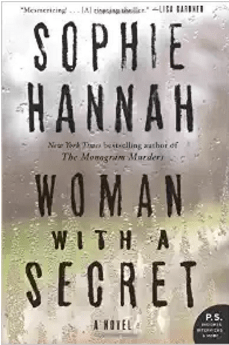
Cover for Woman with a SecretNicki Clements is a woman with a secret that involves an embarrassing incident with a policeman. So, when she sees him stopping cars along the road on her route to take her son’s forgotten gym bag to school, she turns around and goes another way. Unfortunately, the police are investigating a murder, and her behavior makes her look suspicious.

Nicki knows nothing about the murder, but she does know the victim, Damon Blundy, a controversial columnist. Or at least, she thought she knew him until recently. That is part of the labyrinth of secrets Nicki is keeping.

Detective Simon Waterhouse is back in form, assisted on occasion by his wife ex-CID officer Charlie Zailer. This murder is an odd one, appearing as it does to leave clues for the police, but Simon is just odd enough himself to figure them out.

Sophie Hannah is up to her usual with this novel, presenting us with a complicated crime plotted and carried out by a very twisted individual. All of Hannah’s characters tend to be peculiar, including Waterhouse. We get deeply involved, especially with Nicki, whose painful past is pursuing her even now.

Related Posts

The Dead Lie Down

The Truth-Teller’s Lie

The Wrong Mother

Day 964: The Girl Who Kicked the Hornet’s Nest

Cover for The Girl Who Kicked the Hornet's NestI did an odd thing here. I saw that the third book of the Millennium Series was out in a graphic novel by Denise Mina, the terrific Scottish mystery writer, so I ordered it without looking for the other two (which I have since bought). So, I am reading and reviewing them out of order.

Thrust like this into the last volume and having not read the original books for several years, I had difficulty at first getting oriented. I especially had some problems with the multitude of characters, not realizing a cast of minor characters appears at the end. I remembered the general plot but not all the subplots. Still, this is not a problem for those who have read the series from the beginning.

Of course, the plot is the finale of the story of Lisbeth Salander, unjustly accused of murder of three people and of attempted murder of her own father, Zala. It is up to Mikael Blomkvist and the staff of Millennium Magazine as well as her other friends to try to help gather the evidence for her trial. In the meantime, the police are searching for her half-brother Niedermann, the scary murderer who can feel no pain.

The art and story line of this graphic novel are really fine, getting a bulky novel right down to its essence. This is the first time I’ve read the graphic novel for a book I’m already familiar with, and it made me contrast the two. I think the one thing a graphic novel loses is all sense of the original’s climactic moments. In particular, I’m thinking of two scenes: the one during the trial when Lisbeth finally speaks and the fight in the factory. The fight boils down several pages of suspenseful writing into a couple of frames. There’s no way to build up suspense similar to that of the novel. Still, my dabbling in this genre has made me feel it is an interesting one as long as I stay away from super heroes, which really bore me.

Related Posts

The Girl with the Dragon Tattoo

The Girl Who Played with Fire

The Girl Who Kicked the Hornet’s Nest

Day 950: Arrowood

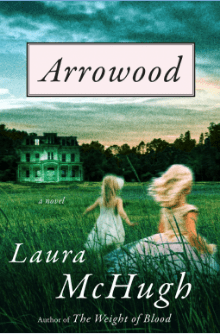
Cover for ArrowoodArden Arrowood has returned after many years to her dying home town of Keokuk, Iowa. She has inherited her grandparents’ house, a stately old home on the banks of the Mississippi. Although she has yearned for home, it is the place of her family’s greatest tragedy, the disappearance of her baby twin sisters when she was eight years old.

Arden has been a troubled young woman, and she is hoping to make a fresh start in her home town. But incidents keep pointing her back to the tragedy. She has been contacted by the site owner of Midwest Mysteries, for example, who thinks the man believed to have kidnapped the girls is innocent.

link to NetgalleyArden has also been hoping to reunite with Ben Ferris, her best friend as a child and her first boyfriend. She is surprised to find he has joined his father’s dentistry practice. But then again, she herself has failed to complete her graduate degree in history and has a secret reason for having quit school.

This novel is atmospheric and gripping. Although it is not difficult to figure out that one character is a bad guy, the solution to the mystery has a couple of twists. I was reminded when reading this book of Gillian Flynn’s Sharp Objects. Although I think Sharp Objects is the better novel, I enjoyed reading this one.

Related Posts

Sharp Objects

Dark Places

Echoes from the Dead

Day 945: Literary Wives! How to Be a Good Wife

Cover for How to Be a Good WifeToday is another review for the Literary Wives blogging club, in which we discuss the depiction of wives in modern fiction. If you have read the book, please participate by leaving comments on any of our blogs. Be sure to read the reviews and comments of the other wives!

Ariel of One Little Library
Emily of The Bookshelf of Emily J.
Kate of Kate Rae Davis
Lynn of Smoke and Mirrors
Naomi of Consumed By Ink

My Review

Marta has stopped taking her medication. She has been on it for years, and the only other time she stopped, she suffered symptoms of severe depression. This time she keeps glimpsing a young blond girl. Although the girl doesn’t speak to her, she seems to be trying to tell her something.

Marta has been married to Hector for many years, and they have a grown son. Marta seems inordinately upset because their son has left home to go to college. Her marriage to Hector seems almost cartoonishly old-fashioned. Her mother-in-law gave her a book about being a good wife when she married Hector, a book that was out of date when she got it. But she has tried to follow it. Aside from behaving like a 50’s housewife, she has been set limits by Hector beyond which she is not allowed to drive. It is not safe, he claims.

The more we learn about Marta’s life, the more disturbing this novel seems. Are we to believe that Marta is descending into madness, or does it seem as if her memories of her past life are oddly murky and she’s finally remembering?

I’m not sure if we’re to believe that Marta is an unreliable narrator or not. Certainly, no one in the novel ultimately believes her, but I do. I found this novel chilling and completely compelling.

What does the book say about wives or the experience of being a wife?

Caution: My answer to this question involves spoilers, so if you don’t want to know, stop reading now.

I don’t believe we can generalize at all from this novel, because Marta’s is a peculiar circumstance. If we believe her, then she was captured as a young girl and held captive by Hector for two years under the house. She eventually escaped, but he recaptured her, kept her drugged, and created false memories for her to convince her she was a different person. She has lived as a drugged captive, trying to please her husband and feeling love only for her son.

Again, this is a novel about power, and Hector holds all the power in this relationship. The only power Marta has is in subversive minor disobedience, like smoking and pretending to take her pills. Although Marta finally escapes, it is at a terrible cost, since no one believes her. Are we to believe there is really no record of her kidnapping or that they either didn’t look hard enough or she is delusional? I know what I believe, but you may not agree.

Related Posts

Before I Go to Sleep

The Happy Marriage

Finders Keepers

Day 909: Big Little Lies

Cover for Big Little LiesBest Book of the Week!
From the very beginning of Big Little Lies, we’re aware that someone has been killed, but we don’t know who, or why, or by whom. Liane Moriarty’s novel artfully builds suspense as it draws you in to care about certain of the characters.

The action of the novel is centered around Pirriweee Public School, and it begins six months before school trivia night, when the death occurs.

Madeline Mackenzie is taking her five-year-old daughter Chloe to kindergarten orientation when she has a small accident. Jane, the younger single mother of Ziggy, helps her, and Madeline and her friend Celeste befriend her. Jane is moving to the area in a few months when Ziggy will be in kindergarten with Chloe and Celeste’s twin sons Max and Josh.

During the orientation, the kindergarten teacher notices that someone has been choking Amabella, so she brings this up in front of all the children and parents, asking Amabella to say who hurt her. Amabella doesn’t want to say but ultimately seems to indicate Ziggy. Ziggy states clearly that he didn’t hurt Amabella, so Jane believes him.

However, Renata, Amabella’s high-powered corporate mother, starts a campaign with some of the other mothers to ostracize Ziggy. This begins with not inviting him to Amabella’s birthday party. All of this behavior escalates, and for a while I thought it might be taking on a comic edge, like the school-based nonsense caused by helicopter parents in Where’d You Go, Bernadette? But underlying it all is the knowledge that someone will end up dead.

And the characters have their secrets. Madeline, whose husband Nathan deserted her with a newborn baby 14 years earlier, is upset because he and his new wife Bonnie seem to be winning her older daughter away from her. And Jane’s and Celeste’s even darker secrets come out later.

This novel is striking in its ingenuity and in how much Moriarty brings you to care for its characters. I was deeply involved from beginning to end. The conclusion was eminently satisfying. I’ll be looking for more books by Moriarty.

Related Posts

Where’d You Go, Bernadette?

Relativity

Quiet Neighbors

Day 904: Some Must Watch

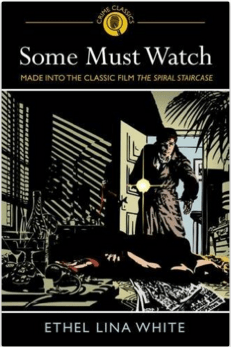
Cover for Some Must WatchSome Must Watch is the novel that inspired the thrilling old movie The Spiral Staircase. Ethel Lina White, the author, was one of the early women mystery writers, another novel of hers being the basis of the movie The Lady Vanishes.

This novel centers around an isolated country house, the home of Professor Sebastian Warren, his mother, sister, son, and daughter-in-law. The main character is Helen Capel, a servant in the household.

At the beginning of the novel, Helen is coming back to the house at dusk. She is worried because she must pass through a desolate landscape and young women have been murdered in the district. Her way takes her through a plantation, but she changes direction because she thinks she sees a man lurking among the trees.

The novel takes place in the space of one night during a violent storm. At the beginning of the evening, everyone becomes alarmed because another dead woman is found dead near the local pub and Dr. Parry thinks she was killed in the same plantation where Helen saw someone. The house is full of people, so the Professor decides that they should all stay inside during the storm and not admit anyone, and they will be safe.

However, as the evening continues, one incident after another occurs that causes the people to leave the house. After a while, it seems to Helen as if some intelligence is working so that she will be alone to face the killer.

In some ways, this novel seemed rather crude, especially in the interactions between characters and the dialogue. I have run into this before with novels of a certain vintage and am not sure if it reflects people’s actual behavior and way of speaking at the time, the expectations of the genre, or simply the ability of the writer. Not very much attention is given to character development either. The focus is squarely on the plot. Still, I think the novel is interesting as representative of an early thriller.

Occasionally I comment on the publication quality of a book. I believe that my copy is an on demand publication by Between Things (not the one pictured above). Its biggest eccentricities are the starting of chapters on the left page and a typographic oddity of placing an underscore before and after phrases that I assumed were in italics in the original. There were a few other careless errors but not as many as I have noticed lately in some other regular press runs. Still, I am beginning to avoid on demand printing, if I recognize it ahead of time.

Related Posts

Murder at the Manor

The Z Murders

The Tiger in the Smoke

Day 901: As She Left It

Cover for As She Left ItAt some point, I decided that the heroine of As She Left It just got herself involved in trying to solve too many mysteries. So, I didn’t find this novel quite as good as I have McPherson’s others. Also, there is at least one whopping big coincidence.

Opal Jones has moved back to the house in Leeds where she grew up. Her mother recently died, and she then learned that the house was in her own name. Since her life is in some disarray, she decides to move back.

Opal hasn’t been to Leeds for 10 years, since she was 13. She also hasn’t been in touch with her alcoholic mother. She has been totally unaware that 10 years before, a little toddler, Craig, whom she used to babysit, disappeared when he was under the care of his grandparents, Dennis and Margaret. Through a series of misunderstandings, each of his grandparents thought the other was looking after him. Opal decides to try to find Craig.

Some other neighbors in her street are old men, members of a jazz band with whom Opal used to play the trumpet. One of the old men, Fishbo, says he hasn’t been in touch with his family in New Orleans since Hurricane Katrina. Opal decides to try to find Fishbo’s family, despite warnings from his friends.

Opal also finds a puzzle in the posts of part of her bed. Needing something to sleep on, she has bought a magnificent bed for a very low price, not realizing until she got it home that the headboard and footboard are mismatched. In the posts of half the bed, she finds messages of distress, but she needs the other half of the bed to see the entire message. In trying to find the other half, she meets Norah, a little old lady suffering from dementia living in a house full of antiques. Soon she believes that someone is looting Norah’s house of its valuable furniture.

Having embroiled herself in these mysteries, Opal begins receiving threats, but she doesn’t know how the threats are connected with the mysteries. There is also the mystery of the person next door, whom she hears crying at night. Since she can’t believe her neighbors would have taken Craig, she wonders if his kidnapper has moved in next store. But then, all of her neighbors seem to be hiding something.

Although I liked Opal and was interested in the story, there just seemed to be too many threads to the plot. Overall, I think, it limited the possible suspense of the novel. The coincidence, too, of what happened to the other half of the bed is pretty unbelievable. But a lot of the puzzles are noise, to keep Opal from facing her past.

Related Posts

Quiet Neighbors

The Child Garden

The Day She Died

Day 885: The Last Summer of the Camperdowns

Cover for The Last Summer of the CamperdownsHi, all, I just wanted to tell you before I get started that I began a new project, attempting to read all of the Man Booker Prize shortlisted books since 2010. See my new Man Booker Prize Project page for more information, and join me if you want to.

* * *

The Last Summer of the Camperdowns is one of those books that I made a note I’d like to read some time ago, but by the time I got to it, could not remember what it was about. When that happens, I don’t read the cover. I just plunge in. I was surprised to find myself reading a sort of modern gothic novel.

Riddle Camperdown is a 12-year-old girl spending the summer at her family’s dune-side house on Cape Cod in 1972. Her name says a lot about the eccentricity of her family, for she is named after Jimmy Riddle Hoffa (yes, that one), and her father sometimes calls her Jimmy. “Camp” Camperdown is a labor organizer, composer, and politician, a noisy brash, boisterous, charismatic true believer. His wife, Greer, seems a mismatch for him. She is a cool, chic ex-movie star with an acid tongue. Riddle, who adores her father, thinks her mother only cares about money and status.

Another of the couple’s regular arguments starts up when they learn Michael Devlin is returning to the area. Michael is a rich, privileged man who used to be Camp’s best friend, but an incident during World War II drove them apart. Riddle is also fascinated to learn that Michael was engaged to Greer and stood her up at the altar.

Riddle and Greer are avid riders, so when that afternoon they go over to see Greer’s friend Gin, Riddle wanders off to the yellow barn to see a mare with a foal. When she is in the barn, something horrible happens, something she doesn’t see but only hears. She thinks she hears someone or something being chased through the barn and then dragged back to the tack room. She is terrified, but just as she is getting the nerve to open the tack room door, Gin’s employee Gula comes out.

Riddle is already terrified of Gula, so she pretends she hasn’t heard anything. Inexplicably, though, she is too terrified to tell her parents.

Soon, they learn that Michael Devlin’s youngest son Charlie has disappeared. It doesn’t take long for Riddle to guess it was Charlie she heard in the barn. That night, the barn burns down with several horses in it.

As Riddle is repeatedly terrorized by Gula, her parents’ marriage seems more and more fraught. Michael Devlin begins threatening Camp’s political campaign with a tell-all book, and Camp fears what he sees as his wife’s attachment to Devlin. In the meantime, Riddle falls in love with Michael Devlin’s oldest son, Harry.

This novel is quite suspenseful, with a plot that is far more complex than it first seems. If there were two small things I didn’t quite buy, one was the extremeness of the Camperdowns’ arguments at first. The other was how long it took Riddle to tell the truth, considering how Gula was threatening her, even going into her room and leaving things. Although ultimately Riddle was also hiding the fact that she hadn’t told the truth right away, I would think she would be too scared not to tell.

Related Posts

The Little Friend

Once Upon a River

Swamplandia!

Day 860: Thursday’s Children

Cover for Thursday's ChildrenFrieda Klein has not been back to her home town of Braxton since she was 15, so she is surprised to hear from Maddie Capel, once a member of her group of friends. Maddie is concerned about the behavior of her teenage daughter Becky and wants Frieda to try to find out what’s bothering her.

Frieda is eventually able to get Becky to tell her that she was raped. A man came into her bedroom at night and raped her. Then he told her that no one would believe her if she reported it. Frieda believes her, though, because the same thing happened to her when she was a teenager, and the person used the same words. Frieda’s mother didn’t believe her at the time, and unfortunately Maddie doesn’t believe Becky.

In fact, once Maddie hears what Frieda has to say, she wants her to stay away from Becky, but she agrees to let Frieda see her one last time so she can recommend a different therapist. Frieda thinks Becky seems better, and Becky agrees to report the rape to the police. However, before she can do so, she is found dead, presumably having hanged herself.

Frieda doesn’t think Becky killed herself, though. She thinks the same person who raped her has been assaulting other troubled girls over the years. She also thinks the person learned Becky was going to the police and murdered her.

Frieda is determined to find the perpetrator, which means tracking down all her male friends from the time as well as a popular teacher who was reputed to have affairs with students. She also learns that her mother, whom she hasn’t seen in 23 years, is dying of cancer.

This novel is the fourth in Nicci French’s mystery/thriller series featuring psychotherapist Frieda Klein. Frieda is an interesting and complex character, extremely reserved but with a few close friends. A thread that continues from the first series is the existence of a serial killer that only Frieda knows is still alive. I enjoy this series, which always presents a challenging puzzle.

Related Posts

Blue Monday

Tuesday’s Gone

Waiting for Wednesday

Day 846: The Girl on the Train

Cover for The Girl on the TrainRachel has been having a hard time the past year or two. Her husband Tom left her for another woman, and her excessive drinking lost her her job. She is so ashamed of this that she pretends to go to work every morning on the train so that her flatmate won’t know.

On the train each day she passes her old neighborhood, and she spots a couple living in a house four doors down from where she used to live. She fantasizes that the two are a happy couple and even gives them names. But one day as she passes by, she sees the wife kissing another man.

That weekend, the wife, whose name is Megan, disappears. Throughout the book, some chapters are written from Megan’s point of view, starting a year before and moving quickly to the present. Immediately, it becomes clear that Megan is a woman with secrets.

Rachel goes to the police with her information about a lover, mainly because she knows they will look first at Megan’s husband Scott, and Rachel doesn’t think he did anything. But Rachel’s credibility is soon destroyed by Tom and his new wife Anna, who let the police know she’s been stalking them when she drinks too much.

In fact, the night Megan disappeared, Rachel was in the neighborhood trying to see Tom. But she was drunk and only has a hazy memory of being helped up by a red-haired man she sometimes sees on the train. After the incident, she awakened at home with a gash in her head that she can’t remember getting.

Rachel can’t seem to keep herself from inserting herself into the investigation, even lying to Scott that she and Megan were friends. Of course, it will all fall apart. The reader wonders, did Rachel herself kill Megan?

This novel has been compared to Gone Girl after that novel’s great success. I realize that is a marketing ploy, but it actually had the effect of making me avoid The Girl on the Train for a while. That said, I think a better comparison is with the novels of Sophie Hannah, which feature troubled heroines who are usually being gaslighted by someone.

As such, it is an effective thriller, difficult to guess. As Rachel slowly pulls her act together, we get to like her. I liked this novel well enough, but Gillian Sharp is great. I’ve admired her work since well before Gone Girl became popular. So, no comparison.

Related Posts

Gone Girl

Sharp Objects

The Wrong Mother