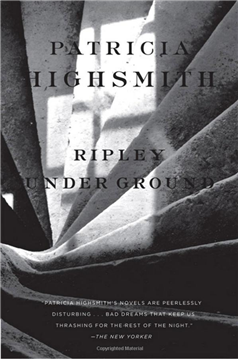
Day 454: Ripley Under Ground

Cover for Ripley Under GroundIn the second novel of Highsmith’s Ripley series, Tom Ripley seems much more of a bumbler than in The Talented Mr. Ripley and the plot unnecessarily convoluted. In the first book, Highsmith succeeded in making us care about Ripley’s fate almost despite ourselves, but in Ripley Under Ground, Ripley’s troubles seem to be caused by hubris.

Ripley is living in France in his beautiful house with his wealthy wife Heloise at the beginning of the novel. He has done well from the death of Dicky Greenleaf but occasionally finds ways to raise a little extra cash.

One recurring source of money has been some businesses built around the work of a famous artist named Derwatt. The businesses are completely fraudulent, however, because Derwatt has been dead for five years. He committed suicide in Greece, and Buckmaster Gallery was originally opened to sell his paintings as an homage by his friends. His paintings were soon all sold, however, and it was Tom’s idea to “resurrect” him, as a recluse living in Mexico. Derwatt’s devoted friend Bernard Tufts has been painting forgeries ever since, to be sold by the gallery with a small token going to Ripley.

Gallery owner Jeff Constant contacts Ripley in a panic. Thomas Murchison, the American owner of a Derwatt, thinks his painting is a fake, and he is coming to the next Derwatt opening to speak to the gallery owners. In an attempt to bamboozle Murchison, who is planning on meeting with an art expert, Tom masquerades as Derwatt at the opening and assures Murchison that the painting in question is his. Murchison has some theory about the use of color in the painting, though, and is unconvinced, even ridiculously suggesting that Derwatt may not remember his own painting.

As himself, Tom meets Murchison in the lobby of his hotel and invites him to France to see his own Derwatts. Tom’s intention is simply to try to convince Murchison he is wrong about the painting, but of course he ends up having to murder him.

This starts us on a complicated series of events, where Tom buries the body then digs it up, confesses his murder to no less than four people, travels all over Europe looking for an errant Bernard, and is, of course, the number one suspect in Murchison’s disappearance. If this isn’t enough, while Tom is trying to cope with all these problems, people continually arrive on his doorstep and the phone rings at every inopportune moment. Ripley’s return is not an unqualified success from my point of view, as everything is over-complicated and the pace of the novel is too frenetic.

Day 441: The Talented Mr. Ripley

Cover for The Talented Mr. RipleyThe first Ripley novel, The Talented Mr. Ripley, is a re-read for me after I recently bought a set of three Ripley novels. If you are familiar with Tom Ripley only through the terrific movie starring Matt Damon, prepare to find the original Ripley a lot less likeable.

We first meet young Tom Ripley just eking out an existence in New York, but he is already engaged in a con—inept because he can’t even collect the proceeds of his mail fraud. Nevertheless, when a middle-aged man seems to be tailing him one night, he is afraid it is the police.

The man turns out to be a wealthy businessman named Herbert Greenleaf. He has been trying to get his son Dickie to come home from Italy and take up his responsibilities, but Dickie has shown no interest in returning. Apparently, some of Mr. Greenleaf’s friends have misunderstood the depth of Tom’s friendship with Dickie, whom he has only met once or twice, and have recommended he send Tom to Italy to try to convince Dickie to come home. Tom sees in this project a free trip to Europe, getting out of New York at a very good time, but he also intends to do his best for Mr. Greenleaf.

Tom is a man with a troubled past and a will to succeed with the right people. Except for his fastidiousness, he seems almost a blank slate, so eager to please that he constantly lies about himself, his work, his education. He wants to be liked but finds people shying away from him after awhile. He is a talented mimic. Tellingly, he only feels guilty when he tells the truth about himself.

Tom travels out to the small seaside village of Mongibello to find Dickie, who does not remember him. In an attempt to ingratiate himself, Tom confesses why he is there and how much Dickie’s father is paying him. Dickie is amused by this and invites him to stay, encouraging Tom to spend the money from Dickie’s father on the two of them even though Dickie has plenty of his own money.

Tom becomes enamored—it is unclear whether of Dickie or Dickie’s lifestyle—for Dickie is free to go wherever he wants, and his only serious endeavor is to try to paint, which he does badly. Dickie’s close friend Marge Sherwood poses a problem to their friendship, though. She is immediately jealous and suspicious of Tom, telling Dickie he is probably gay. Since Tom’s sadistic aunt, who raised him, used to taunt him with being a sissy, Tom has sought to deny this, even to himself.

None of these characters is particularly likable. Dickie is a spoiled rich kid who uses Tom but believes himself used, who thinks only of himself, and strings Marge along so he’ll have some company in the long winter months. Marge, although seen only through Tom’s eyes, is clinging and jealous. Tom is, of course, Tom, whom we only begin to understand slowly.

The situation is ripe for disaster, and Tom eventually commits a much more serious crime than mail fraud. This event happens only a third of the way through the book, and the fascination of the novel is in watching how Tom Ripley hides his crime, how he manages to profit by it, and what he is forced to do to avoid suspicion. He is surprised to find within himself an ability to coldly and analytically carry through his crimes with little notice—actually commit them almost without planning—although he is somewhat bumbling when it comes to the cover-up.

But Ripley learns, and we watch with fascination as he slowly develops his inner sociopath. This is an absolutely spellbinding novel by an author who was depicted in a recent biography as a sociopath herself. Another goal for my personal reading—pick up that biography!