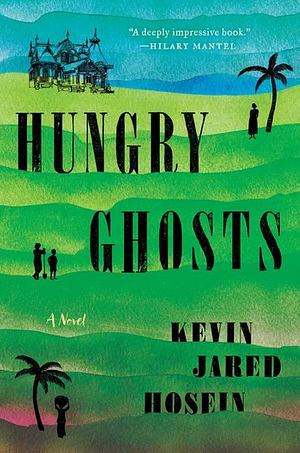
Review 2476: Hungry Ghosts

I feel safe in saying that if I wasn’t reading Hungry Ghosts for my Walter Scott project, I wouldn’t have read it at all. It is absolutely brutal.

In 1940s Trinidad, Krishna lives with his family in the Barracks, run-down ex-military barracks that are leaky and filthy, where five families live in each building, one to a room. Krishna’s father Hans has aspirations for better and insists that Krishna attend school in the village, but there he is mercilessly teased and bullied by other students as well as teachers. Krishna and his cousin Tarak have begun to hang with two twin brothers, Rudra and Rustrum, who have a bad reputation because their father was a murderer.

Hans works for Dalton Changon, a prosperous man. Changon’s wife Marlee has recently noticed some disturbing changes in his behavior—a heightened paranoia and a tendency to hallucinate. Then he disappears during a night when there’s a terrible storm.

Marlee receives a threatening note, so she offers Hans a large amount of money to stay on the property overnight as a guard. He accepts, thinking to save a down payment on a house. However, soon he is involved in a torrid affair with Marlee, not even returning to his home when his wife, Shiveta, is hospitalized for an infected foot.

Meanwhile, Krishna, defending himself from some village boys who try to drown Tarak’s dog, injures Dylan Badree. Because Dylan’s father is a policeman, Krishna is put in jail and is only released after Marlee’s intervention. But the boys’ feud begins to go in evermore dangerous directions.

This book contains graphic descriptions of drowned dogs and murdered dogs and the killing of a rabbit. Everyone in it who seems like a good person either becomes bad or is victimized. The language of the book is impressive, but sometimes Hosein uses such obscure words that it seems pretentious. Hosein certainly describes a vivid world, but it’s not a place I wanted to be in.

Related Posts

Fortune

A Brief History of Seven Killings

The Cold Millions

Review 2177: Fortune

Fortune, shortlisted for the Walter Scott Historical Fiction Prize, is set in late 1920’s Trinidad. People have been jumping out of windows in New York, but there is an oil boom in Texas, and Eddie Wade foresees another one in Trinidad.

Sonny Chatterjee has oil seeping into the soil of his cocoa plantation, and his plants are dying. Charles Macleod of Apex Industries has been trying to get an oil lease from him, but he has seen the destruction caused by the large oil companies and refuses to let that happen to the land his father worked so hard to buy. However, Eddie convinces him that his smaller company will take more care and give Sonny a better deal, so Sonny agrees that if Eddie can come up with the $10K to get started, he can. The trouble is, Eddie has no money.

Eddie’s truck breaks down on the way into town, so he walks. Local businessman Tito Fernandes picks him up and trusts him instantly. Even though Tito is in serious difficulties because of his stock market investments, he finds the money Eddie needs.

The back cover of the novel makes clear that the fly in the ointment will be provided by Tito’s much younger wife Ada, and the affair that begins between her and Eddie. This novel is based on a real event—a fire in 1928. Smyth has changed the name of one historical person from Bobbie to Eddie, but it’s not clear just how much else is fictional. Certainly, I found the love triangle aspect uninteresting and unimaginative, but I guess if it really happened . . . .

The fact is that I didn’t actually care about any of these characters. Further, the writing is close to being spare, but it lacks the specificity and vividness of most spare writing, so I can only call it trimmed. It’s more mundane in nature. The setting itself occasionally comes to life but more often does not. I didn’t feel like I knew what it was like to be in Trinidad at this supposedly exciting time.

Related Posts

Sugar Money

The Lacuna

Washington Black