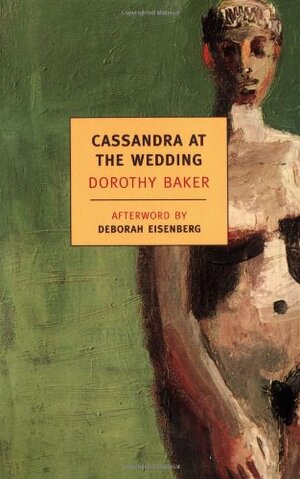
Review 2464: Cassandra at the Wedding

At the beginning of this novel, we meet Cassandra Edwards preparing to attend her twin sister’s wedding. Although her narrative is clever, entertaining, and disarmingly truthful, it is clear something is wrong.

Slowly we learn it is Cassandra’s intention to talk Judith out of the wedding, which she views as a horrible mistake. The Edwards have lived on their ranch as a self-contained until, intellectual, cultured, staying away from the affairs of others. When the girls began studying at Berkeley, Cassandra at any rate spent a lot of time with others, trying new things out. Despite having always tried to maintain their individuality, they finally decided, at lease according to Cassandra, that they only needed each other would move to Paris. But first, Judith decided she would try one year by herself studying music in New York. And now she has returned with a fiancé.

When Cassandra arrives at the ranch and we see the two women together, it seems clear that Cassandra is the less mature and more egotistical. She doesn’t seem to be able to see the situation from any point of view but her own. She is like a whirlwind of talk and distress, trying to push Judith toward her own goal. Cassandra does something drastic at the end of this section, but I don’t want to give it away.

In the second section, Judith narrates. We learn that although she loves Cassandra , contrary to what Cassandra believes, Judith wants to bet away from her. Judith is the calmer, more mature twin, and she finds Cassandra exciting but exhausting. I seems clear that Cassandra has attributed some of her own attitudes and ideas to both of them.

Cassandra may sound like an irritating character, but somehow she is appealing. We enjoy being with her as she navigates the rough seas of more maturity. I very much enjoyed this book, which has likable characters and looks honestly at the difficulties involved in finding an identity, especially if you’re a twin, and becoming one’s own whole person.

Related Posts

Beneath the Visiting Moon

Rhododendron Pie

Rebecca

Day 727: I Know This Much Is True

Cover for I Know This Much Is TrueI have only read one other book by Wally Lamb, the more recent The Hour I First Believed, and when I began reading I Know This Much Is True, it was like deja vu all over again. In a very long novel, crass, belligerent, macho protagonist with anger issues ignores his own problems in attempting to cope with a family member with serious mental health difficulties.

In this case, Dominick Tempesta has a twin brother Thomas who is a paranoid schizophreniac. Thomas has seemed to do very well lately, so Dominick is shattered when Thomas goes to the public library one day and chops off his own hand in an effort to halt Operation Desert Storm. When Thomas is sent to Hatch, the high-security facility for the most dangerous patients, instead of Settle, where he usually goes, Dominick is convinced there is some mistake. His misgivings are confirmed when Dominick himself is severely beaten by one of Hatch’s security guards while he’s trying to get someone to call Thomas’ doctor. He begins trying to get Thomas out of there.

In his efforts, he meets with Thomas’ social worker Ms. Scheffer and with Dr. Patel, one of the therapists who is supposed to evaluate Thomas. Dr. Patel asks Dominick to discuss his and Thomas’ past with her so that she can gain more insight about Thomas. But eventually she begins treating Dominick.

So, the present-day chapters of the novel, set in the early 90s, are interspersed with chapters describing incidents from Dominick’s childhood and adolescence. These incidents include upbringing by a mild-mannered mother and abusive stepfather Ray, Dominick’s constant curiosity about the identity of his real father, Dominick’s jealousy at their mother’s favoritism for Thomas.

In the end, you get to understand and feel for Dominick, if not actively like him. His insight about himself is helped along by finding a manuscript written by his grandfather, another similarity with his other novel. This novel explores issues such as bullying and abuse, mental illness, the way Americans raise boys, the closeness of twins, the way our own history flows from the history of our parents.

As with the other book, I liked it well enough but perhaps not well enough to subject myself to another 1000 pages of Wally Lamb.

Related Topics

The Hour I First Believed

The Gathering

In the Lake of the Woods