
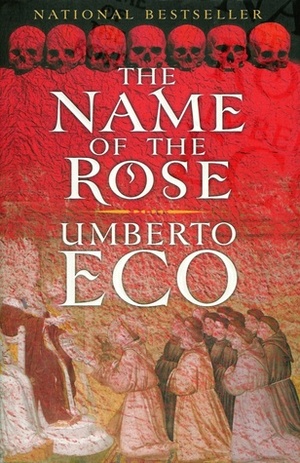
Adso of Melk, an elderly monk, feeling he is nearing his death, leaves this manuscript that tells, for the first time, the events of 1327 in an Italian abbey.
It’s been a long time since I read this book, so I remembered more vividly the movie version, which concentrates on the mystery aspects of the novel. But the novel is more about the religious and political upheavals of the time.
As a Benedictine novice, Adso travels into Italy with a learned Franciscan monk, William of Baskerville from Hibernia. William has been asked to mediate an important meeting between two factions of monks—the Franciscans and other Minorite sects who believe in the vow of poverty and are aligned with the French King, and other sects who think the vow is heretical and follow the Pope in Avignon.
Once they arrive at the magnificent abbey high on a mountaintop, the Abbott, Abo, asks William to look into another issue that has recently occurred. Adelmo of Otranto, an illuminator from the scriptorium, has been found dead on the slope below the abbey’s Aedificium, a fortified building that contains the kitchen, the scriptorium above it, and the library above that. It’s not clear whether Adelmo jumped or had help, and Abo wants William to figure out what happened, preferably before others arrive for the meeting. William quickly ascertains that Adelmo must have fallen from the library, but he learns that only the librarian is allowed in the library, a man named Malachy.
Although William has been denied access to the library by Abo, he soon figures out that there is a way to get into it besides the locked entrance. After a visit to the scriptorium, where William and Adso inspect Adelmo’s work area and meet some of the monks, another monk is found dead, Venantius, a Greek scholar. This makes William surer that the deaths have something to do with the library.
He and Adso sneak into the library at night. It is a labyrinth. Moreover, they disturb someone who runs away and are almost poisoned by the air in one of the rooms.
More monks associated with the library die, and William becomes convinced that they are dying because of a secret book. He and Adso must learn the secrets of the library, and William comes to believe that the murders are related to the history of the monastery.
I have concentrated on the mystery, too, but there’s a lot more going on in this book. It is concerned with the conflict between Louis of France and the illegitimate Holy Roman Emperor, between two popes, and the then recent history of the Inquisition against certain heretical religious groups. It has several learned debates, in which the monks disagree about what seem, to the modern eye, to be obscure and trivial issues. And it fully shows the superstitions of even the most learned of men (except William) and the pit of fear that was life in this monastery.
Although the novel seems straightforward, there is a lot more going on. To me, Eco seems to be mocking the beliefs of the church at times—some of the learned disputes make such ridiculous statements (believed at the time) that I couldn’t help laughing. And I couldn’t help noticing that at least two of the characters’ names, William of Baskerville and Adelmo of Otranto, hearken back to previous mystery and gothic fiction.
A New York Times reviewer from 1980 asserts that the entire novel refers to the time when it was written (the 1970s, I assume), so obviously he also found second meanings and playfulness in the novel.
The novel moves you along despite several learned discourses. The medieval mind also seems to like lists, and I have to admit skipping through several of those. This is at once a challenging and compelling read.

 What? Me Read?