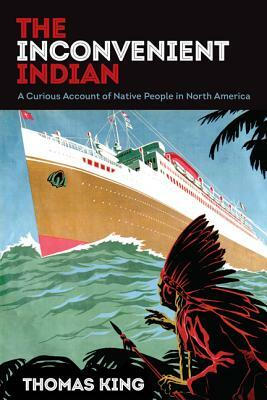
Review 2526: The Inconvenient Indian

For some reason when I bought this book, I thought it was fiction. It’s not, nor is it a history of the relationship between native peoples and the various entities that have ruled Canada and the United States. (King repeatedly calls these two countries North America. He doesn’t deal with the inequities and atrocities of Mexico, which of course is also in North America and probably has committed plenty.) It is a series of chapters on such topics as residential schools, government attempts at assimilation and allotment, treaties that have been ignored, and inequities under law.

Thomas King is a writer, speaker, and activist who is part Cherokee. Born in California, he is now a citizen of Canada and has won, among other awards, the Order of Canada.

His writing style is acerbically funny and more personal than you’d expect. He reminds me of Bill Bryson with more sarcasm.

This book is an eye opener for anyone who thinks that our native populations are no longer oppressed. It didn’t make me cry like Bury My Heart at Wounded Knee did when I read it years ago, but it gave me a lot to think about. King’s main message is that all government programs for our natives amount to land grabs.

Related Posts

Killers of the Flower Moon: The Osage Murders and the Birth of the FBI

Mayflower

There, There

Review 1848: The Mayor’s Wife

A friend told me about Anna Katharine Green, who is supposed to be one of the first women mystery writers, and since then I’ve seen several reviews of her books. So, I found a copy of The Mayor’s Wife, written in 1907.

Miss Saunders is hired as a companion for his wife by Mayor Packard, who is also running for governor. He is to be away a lot on the campaign trail, and he has become concerned for his wife, Olympia, because lately she has been behaving oddly. He wants Miss Saunders to try to ascertain what is wrong with Mrs. Packard.

It’s not too long before Miss Saunders discovers that the house has had several tenants because it is supposedly haunted. The neighbors, two old ladies who used to own the house, also spend their time staring into the room given to Miss Saunders.

Although the household staff is generally friendly, Mrs. Packard’s moods vary wildly, and two of the household are unfriendly. The butler is hostile and suspicious, while Mr. Steele, Mr. Packard’s secretary, is cold.

It turns out there is a lot to discover in the house, and Miss Saunders finds hidden treasures, deciphers codes, busts the ghost, and finds out what is wrong with Mrs. Packard. Most of these secrets are easy to guess, including one involving a secret identity. Like many older mysteries, this one is more concerned with puzzles than characters, including spending several pages on cyphers.

Related Posts

The Notting Hill Mystery

The Moonstone

The Billiard-Room Mystery

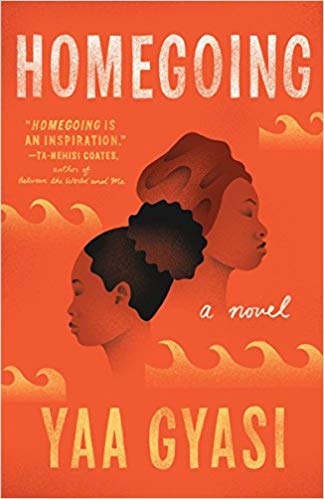
Review 1471: Homegoing

Writers seem to be experimenting with the form of the novel these days, not always successfully. Yaa Gyasi uses the form of linked short stories to good effect, however.

In paired stories, the novel follows two half sisters and their descendants through 300 years of history. In 18th century Gold Coast, Effia is being courted by the son of a king, but her mother, Baaba, tells her to hide the fact that she has reached womanhood. Her suitor eventually marries someone else, and Effia is married to a white man, James Collins, the governor of Cape Coast Castle. The Castle is where slaves are kept before being shipped to the colonies.

Esi is the daughter of Big Man and Maame, a former slave to Effia’s family. In her attempts to befriend Abronoma, her family’s slave, she sends a message to Abronoma’s family to tell them where she is. Thus, she herself becomes a slave when her slave’s family attacks and captures her village.

The novel checks in with each of eight characters of the girls’ descendants, sometimes telling the entire stories of characters’ lives, other times dealing with significant moments. Both families are affected by this great evil in their lives, slavery and its aftereffects. This structure allows Gyasi to explore some of the key events in the histories of Ghana and the United States.

At first, I thought I might get frustrated with the format, because I often want more from short stories. But because the stories are about two families, some of the characters are present in more than one, and you can at least find out what happened to them. Many of the stories are grim, but the novel ends hopefully. Gyasi’s voice is a fresh one, and I found this novel captivating.

Related Posts

Sugar Money

Washington Black

Beloved

Day 309: Parrot and Olivier in America

Cover for Parrot and OlivierBest Book of the Week!

Peter Carey’s Parrot and Olivier in America is a fictional riff upon Alexis de Tocqueville’s trip to America in the early 19th century, from which resulted the classic Democracy in America. Olivier de Garmont is the character meant to be Tocqueville, an aristocrat with liberal leanings who is nevertheless an elitist snob.

Parrot is his servant, a man who has lived a colorful but frustrating life. An Englishman, he has had his life disrupted since he was a boy by another French aristocrat, the Marquis de Tilbot, who spirited him away from England after his father, a typesetter, was arrested as an accomplice to forgery.

In dangerous post-revolutionary France, Olivier’s mother has decided it would be wise for Olivier to leave the country, as his liberal leanings have offended the conservatives, but he is unacceptable to the liberals because of his aristocratic birth. She ends up shipping him off to America with Parrot as his secretary, on loan from Tilbot and instructed to report back Olivier’s movements.

But America inflames Parrot’s own democratic leanings. He believes himself to have a talent for engraving that he has never been able to develop while working as Tilbot’s servant, and he resents his status as a “vassal.” While Olivier feels that their rocky start has developed into a relationship that is almost love, Parrot affectionately? calls him “Lord Migraine.”

This novel is narrated in alternating chapters by Olivier and Parrot. It is entertaining–wittily and robustly written–although sometimes we seem to have stumbled into a Dickens novel, especially when reading about Parrot’s early life. In fact, I read recently that Carey wrote an earlier book, Jack Maggs, based on Magwich of Great Expectations, so that feeling is probably not too far off.