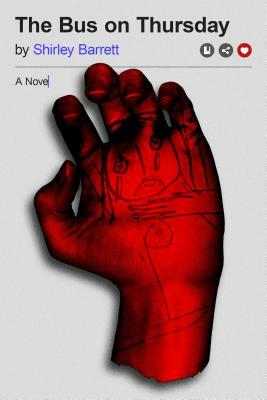
Review 2664: The Bus on Thursday

Well, this is certainly a strange book. It has been billed as a horror novel, but I think that’s misleading.

Eleanor Millet begins her story, which is related as blog entries, in a bad place. She is recovering from breast cancer after a mastectomy. She has lost her boyfriend and her job and has had to return to live with her mother. She is angry and outspoken and pretty darn funny, but we notice right away that she has poor taste in friends and men.

Her description of the path her cancer diagnosis took grabbed me right away, because last year I was called back (which in itself is fairly terrifying) for first an ultrasound mammogram and then two, count ’em, two biopsies. Luckily, I was okay, but Eleanor was not.

Now Eleanor can perhaps turn her life around. She gets her dream job—a teaching position in a very small town in the Snowy Mountains. But already she seems to be behaving a little off-kilter.

Eleanor is urgently needed because the previous teacher, Miss Barker, has disappeared without a trace. The school staff are Eleanor and Glenda, the school secretary, and the school holds all of the town elementary and middle school students up to age 14, with one boy, Ryan, who seems suspiciously older. Glenda behaves as if Eleanor has committed a crime by taking Miss Barker’s place, and Eleanor’s home used to be Miss Barker’s and has a lot of locks on the doors.

Things start out strange, with people treating Eleanor in an oddly hostile way, and two people telling her that her cancer was her own fault. The local minister tells her she had cancer because she is possessed by a demon.

This is all very strange, but Eleanor’s reactions are over the top, and she almost immediately begins drinking too much, having an inappropriate relationship with one of her students’ guardians, and behaving inappropriately with her students. She starts having bizarre dreams and soon we’re wondering about her reliability as narrator, even her sanity.

I am a critic of book blurbs, and the one on the back of my book seems particularly misleading, speaking of a “portrait of recovery and self-discovery.” Things are a lot darker than that.

Related Posts

Rush Oh!

The Bloody Chamber

Arcadia Falls

Review 2659: Study for Obedience

The unnamed narrator moves to another country, one she describes as a northern country of her family’s ancestors, to live with and be housekeeper to her recently divorced brother. She has been raised, she says, to curb her natural inclinations and be obedient. Certainly, her relationship with her brother looks more and more disturbing as the book progresses. For example, a point that comes out early on, she bathes and dresses her brother, who is not an invalid. Later, we learn that he insists she watch TV with both the sound and the subtitles off.

But how trustworthy a narrator is she? Her whole existence seems colored by a twisted view of life. For example, early on, she says that when she quit her job, her coworkers were so pleased to get rid of her that they gave her a big party. Well, isn’t that a tradition for a long-serving employee?

Her attitude is entirely negative—taking everything on herself. Despite being fluent in several languages, she is unable to learn the language of her new home. Almost immediately after her arrival, her brother departs for an unexplained reason, so she finds herself cut off, unable to make herself understood, with only a three-legged dog for company. She begins to sense that she’s being blamed for a series of agricultural disasters, as if she’s a witch. Since her Jewish ancestors were forced to leave this area during the war, she reads a lot into this.

Actually, she reads a lot into everything, tortuously examining every glance, every event. The book doesn’t really have a plot; it’s more about her exhaustive examinations of everything. If it hadn’t been so short, I would have quit reading it, because as another StoryGraph reader said, I felt like I was being psychologically tortured.

There is a turn to the book, but it just becomes more perverse. I read it for my Booker Project.

Related Posts

The Safekeep

The Weight of Ink

The Gustav Sonata

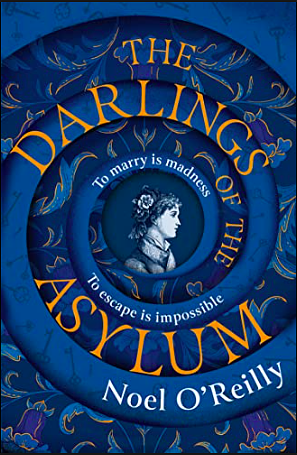
Review 2647: The Darlings of the Asylum

Violet Pring is more interested in her art than marriage, and she meets an artist, Mr. Lilley, who thinks she shows great promise. But it’s 1886, and Violet’s parents are pushing her to marry her childhood friend, Felix Skipp-Berlase. Felix is wealthy, and Violet’s parents want her taken care of, as they are broke. Felix is willing to have Violet continue her art career, but that doesn’t seem to cut any ice with Violet.

Violet’s mother is perennially ill, and she has a doctor, Dr. Rastrick, who makes Violet nervous. Violet finally agrees to marry Felix, but on the eve of the engagement party, she commits an indiscretion with Mr. Lilley. A few days later, Violet wakes up in Dr. Rastrick’s asylum.

The novel seems to be about Violet’s unfair incarceration because her ambitions are ahead of her time. However, we find that Violet is not altogether a reliable narrator, because she has memory lapses.

The thrust of this novel is confusing. At first, it seems that the evil scientist with absurd ideas about treating mental patients is dominating a gothic novel. I don’t want to give too much away, but this idea shifts and shifts again. And Violet’s adventures turn toward absurdity by the end.

I think O’Reilly has written more of a 21st century heroine than a 19th century one, and not a terribly convincing one. He also doesn’t seem to know what his own book is about—a girl learning how to take control of her own destiny? a girl learning to understand her parents better? a girl coming to sympathize with the stresses on women in poverty? the difference between Dr. Restrick’s approach and that of the new field of psychiatry? It doesn’t seem like he knows.

Related Posts

The Other Side of Mrs. Wood

Jamrach’s Menagerie

Affinity

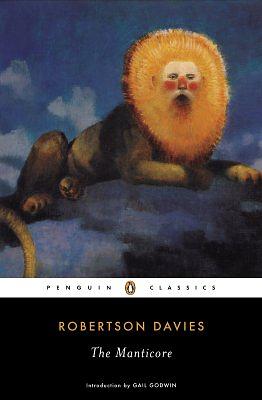
Review 2637: The Manticore

The Manticore is the second volume in Robertson Davies’ Deptford Trilogy. The trilogy itself is about the ramifications through several people’s lives of one malicious act—a snowball with a rock in it thrown by Boy Staunton at Dunstan Ramsey when they were children.

Davies takes up this story again in The Manticore with the next generation, specifically David Staunton, Boy’s son. At the end of Fifth Business, Boy was found dead, having apparently driven himself off the end of a pier, but oddly found with a stone in his mouth. David is a successful, much-feared criminal attorney, but he realizes he drinks too much when he finds himself shouting during a magic show, “Who killed Boy Staunton?” This scene has all kinds of ramifications that David himself doesn’t know about but we do, because we learned in the previous book that the magician, Magnus Eisengrim, was the self-reinvented baby who was prematurely born after the throwing of that stone and may somehow be responsible for Boy’s death.

Davies uses the device of having David seek therapy to develop the story more, in particular what a horrible father Boy was despite David’s continued regard for him. (In fact, it’s fairly clear that Boy was a horrible person in many respects, despite the general respect for his wealth and accomplishments.) In this way, David is an unreliable narrator because there are so many things he doesn’t understand that others, including the readers, do.

To keep his therapy a secret, David goes to Switzerland and seeks the help of Jungian psychiatrist Dr. Johanna van Hallen. This therapy begins on page 7 and lasts for most of the book, so David tells story after story and Dr. van Hallen talks him through therapy. I have no idea if these discussions truly reflect Jungian therapy or if the therapist would indeed go into discussions of archetypes and so on, but the stories were far more interesting than the revelations of Jungian techniques.

The ending of this book I found a little too symbolic and fantastic—in a mild way. I’m not sure how I feel about this book overall.

Related Posts

Fifth Business

The Northern Lights

The Bird Artist

Review 2452: La Rochelle

Mark Chopra is a neurologist who lives alone and has apparently never had a partner. He also seems at first to have no friends except a much younger couple, Ian and Laura. The draw there is Laura, with whom he is in love. As for friends, it gradually becomes clear that he has other friends, but he disregards them.

Mark judges the stories Laura has told him and his own observations and thinks that Ian doesn’t treat Laura the way she deserves. At the pub at the start of the novel, Ian tells Mark that Laura has left him to think about their future. He doesn’t know where she is and doesn’t look for her, saying she’ll come back when she’s ready.

Mark is a highly intelligent person who tends to overthink things. He starts worrying about Laura, thinking she could have had an accident or even have been kidnapped. But he does nothing except hang out with Ian every night, getting so drunk that he can’t remember things and smells like booze at work. He ignores the warnings of coworkers (his other friends that he doesn’t seem to recognize) about his job.

Toward the end of the novel, Mark finally does something, but the trip there wasn’t pleasant for me. Mark is not a reliable narrator. He knows more than he tells until toward the end of the novel. But I also found him an unpleasant person. Despite being, he finally claims, willfully abstinent, he seems to think of women only in terms of sex. He meets a couple and immediately wonders how often they have sex. He makes constant demeaning comments about female anatomy. He expresses his gratitude toward a female friend and coworker by mentioning her bra size! Is this supposed to be a side effect of Mark’s lifestyle choice? Is it supposed to be funny? I have no idea. I found this character to be deeply unpleasant despite his desire to be a knight errant for Laura. It was no surprise at all to me to find him ultimately having no interest in what he finally gets, even though it’s what he wanted.

The plot eventually has some surprises, but after a labyrinthian scheme finally reveals itself, the whole idea just seemed stupid to me. The characters go to all kinds of trouble instead of speaking a single sentence. (I think Roger Ebert used to call that the “idiot plot,” in reference to movies.) I really wouldn’t have finished this book if it hadn’t been part of my James Tait Black project.

Related Posts

Amsterdam

The Sense of an Ending

Eileen

Review 2451: Endless Night

Mike Rogers is a wanderer who moves from job to job, never seeming to amount to much. But he has a taste for finer things. One thing he wants is to have an architect he’s met build a house at Gipsys’s Acres, but even though the property is going cheap because of the curse on it, he can’t afford it.

He goes up to look at the property one day and meets Ellie Guteman. She is a young, wealthy heiress who has slipped her leash from trustees who keep her so protected that she never has any fun. With the help of her companion, Greta, she contiues to see Mike, and they daydream about buying Gipsy’s Acres and building their dream house. Eventually, they decide to get married on the day she turns 21. (Here’s some book serendipity, a concept coined by Bookish Beck, two books within a week that have houses being built that may turn out to be haunted. The other is The House Next Door.)

All goes well until they move into Gipsy’s Acres. Ellie keeps meeting Mrs. Lee, an old gypsy woman who warns her of danger. Someone throws a stone through the window. Even though Ellie’s relatives are American, they show up for visits, and they are not very nice. And Ellie has offered Greta a place to live. Lots of people seem not to like Greta, including Mike.

The novel is narrated by Mike, who seems disarmingly straightforward. However, there is a lot going on under the surface, and Mike is an unreliable narrator.

Although I guessed what was going on fairly early, that didn’t ruin my appreciation of how Christie slowly builds suspense. Then, at the very end, the novel took a turn I didn’t expect. Note that gypsies don’t fare well in the comments of characters.

Related Posts

They Do It with Mirrors

Taken at the Flood

Murder at the Vicarage

Review 2238: Castle Rackrent

Castle Rackrent is a novel I picked for my Classics Club list. Published in 1800 although set before 1782, it is an early example of the use of an unreliable narrator.

That narrator is Thady Quirk, a servant to the ancient Irish Rackrent family, but the novel is also annotated by a scholarly character called the Editor. Thady informs us in the first paragraph that he’s known as “Honest Thady,” a phrase that puts us on the alert.

Thady quickly runs through the older history of the family and then tells in greater detail the story of the last three owners of the Castle, Sir Murtagh, Sir Kit, and Sir Condy. These are satirical tales of mismanagement either by penny pinching and bleeding the tenants or by wasteful consumption. Thady is vehement in his avowals of support for the family and in this role makes some astonishing assertions, such as, about Sir Kit who married a woman for her money and then locked her away for seven years because she refused to give him her jewels, “He was never cured of his gaming tricks, but that was the only fault he had, God bless him.”

This novel is a light commentary on the class system and its abuses, as the series of barons get up to all manner of hijinks while the servants (particularly Thady and his son) arrange to purchase assets at low prices. It is moderately funny but is considered by critics to be an astonishing first novel by a woman at this period.

Related Posts

Evelina

A Double Life

The Good People

Review 1591: Ducks, Newburyport

The unnamed narrator of Ducks, Newburyport is a 40-something Ohio housewife who works from home making pies and cinnamon rolls for restaurants. She is a survivor of cancer, and she and her husband Leo are both working very hard to pay off her medical bills. She has four children, a sulky teenager, Stacy, from her first marriage and three young children from her second.

Ducks, Newburyport consists mostly of her mental ramblings as she goes about her day, a timid woman who rarely speaks her mind and is obsessed by her failures as a parent and daughter and by violent incidents in the news. The book almost completely consists of one 1,000-page sentence, if you can call a bunch of phrases beginning with “the fact that” or sometimes just lists of words a sentence. Periodically, this monologue is broken by a few paragraphs about a female cougar and her cubs.

Ducks, Newburyport breaks just about every rule connected with literature. It breaks the Strunk and White rule about not using “the fact that” about 50 times per page. It uses no traditional sentence structure or paragraphing except in the lion sections. It breaks notions of narrative. (It’s not stream-of-consciousness.) And it has a plot, sort of, but not in the traditional sense. I’m not sure if the novel is an elaborate joke or just Ellman thumbing her nose at the rules and winning awards while she does it. Lots of people have compared it to Ulysses, but Ulysses is more poetic. The narrative style alone may drive you nuts.

I noticed that Ellman gets a few things wrong. Some are to do with the age of her character, who makes lots of cultural references, many of which are too old for her. Certainly, the narrator is interested in old movies and songs, but the mistakes I’m talking about have more to do with Ellman being closer to my age than her narrator’s. She talks about everyone having their tonsils out when she was young, but that’s a 50’s or early 60’s thing rather than an 80’s. And similarly, she says just about every woman in America is on hormone replacement therapy, but that wasn’t even being prescribed as much when I was hitting menopause, and I’m older than Ellman. Some of her verbal habits, like calling underwear me-oh-mys just seem ridiculous and old-fashioned. Of course, this last could be characterization.

I also thought Ellman has been living in the U. K. too long to get an American housewife quite right. Just a small example is her repeated references to Bath Oliver biscuits. I doubt if many Americans know what those are, even if they’ve eaten them. I had to look them up, and I have eaten them. In general, as well, Americans don’t eat beans on toast, a phrase that she repeats excessively. Of course, again, that could just be a phrase that’s lodged in her head.

These are small things that you’d think her editor would have caught, if editors even edit anymore.

Did I like it? As soon as I got a feel for what the novel would be like, I assumed I wouldn’t finish it and kept waiting to decide to stop reading. But I found it oddly hypnotic, and I finished it. I found the narrator annoying as well as unreliable. She says she doesn’t remember things, but 80% of the novel is her memories. She also says she doesn’t remember her dreams and then relates them to the tune of several a page sometimes—another rule broken—which I found irritating, because I don’t like reading about dreams in fiction.

Would I read it again? No way. Does it deserve two (at least) prestigious literary awards? I have no idea.

Related Posts

4321

Milkman

The Lesser Bohemians

Review 1585: Eight Perfect Murders

I had a hard time rating this high-concept mystery on Goodreads, because there were things I liked about it and things I didn’t like. Overall, however, I felt it was a fast-paced novel with a love for books, especially old-fashioned crime novels.

Malcolm Kershaw has a visit from the FBI at the beginning of the novel. He is part owner of a mystery and crime bookstore in Boston. Years ago, when he first went to work there, he wrote a blog post named “Eight Perfect Murders” in which he listed eight mystery novels with near-perfect murders. Agent Mulvey has figured out that someone is using the list to re-create not the murders but the spirit of the murders. Moreover, one of the victims is someone Malcolm knew, an annoying woman who used to frequent his bookstore before she moved away. Agent Mulvey wants Malcolm to help figure out if any other deaths are related to his list.

Right away, I knew Malcolm wasn’t a trustworthy narrator, and almost immediately I guessed there would be some connection to the death of his wife, Claire. The novel takes lots of twists and turns, but I expected some of them. Still, it clipped right along, was well written, and was full of references to fiction I loved.

Why did I have trouble rating it? First, it got bogged down in the explanations at the end. The murderer explains things, and then Malcolm explains what he’s been holding back, and it’s a lot. Finally, I don’t know that I like so much these high-concept twisty-turny novels that are so popular lately, possibly because they have too many twists to be believable. They remind me of the old mysteries that are only concerned about the difficult puzzle, only with better characterization.

Then again, the book is strongly atmospheric, set in a frozen, stormy Boston, and I liked most of it. There are almost no clues about the identity of the murderer but lots of clues about Malcolm’s own secrets.

I see that Goodreads has this novel labeled Malcolm Kershaw #1. I hope that’s a mistake. I’m just saying that because of the ending. Now I bet you’re mystified. (Note: I am posting this review from my notes about six months after I read the book, and I can remember almost nothing about it. That doesn’t happen very often, so I doubt that this book is going to become a classic mystery.)

Related Posts

The Seven Deaths of Evelyn Hardcastle

Eileen

The Bone Garden

Review 1578: After the Party

In 1938, Phyllis Forrester and her family return to England from a long period of living abroad. Phyllis has been yearning to be near her two sisters, so they settle down on the Sussex coast.

Through her sisters, Phyllis gets involved with two different sets of people, with some overlap. Her socialite and snobbish sister Patricia introduces her to an upperclass group interested in social events. Her activist sister Nina is involved in the new Peace Party that runs educational classes and camps for youngsters. It’s not too difficult to figure out that their revered leader is Oswald Mosley.

It’s difficult to decide whether Phyllis is an unreliable narrator through innocence, obliviousness, or lying. I think most likely both of the first two. Certainly, this novel downplays the most negative aspects of Mosley’s party. Anti-semitism is mentioned but is not emphasized, and Phyllis denies the group is Fascist, which of course is what Mosley thought would be best for England. No mention at all is made of the blackshirts or links to Germany. But perhaps Connolly trapped herself into this point of view by using Phyllis as the narrator. In any case, for me the effect was a sort of whitewashing of this movement.

The novel starts slowly and takes a long time to get to its meat, which is the imprisonment of Phyllis and her husband without any due process. If Phyllis can be believed, her activities were fairly benign and this imprisonment was uncalled for. It also involves a betrayal.

I didn’t have much sympathy for Phyllis or really anyone in her circle. The socialites early on are involved in an incident of throwing a terrified pig off a balcony, which some of them seem to think is funny. Although Phyllis doesn’t seem to think it was funny, she also doesn’t seem horrified by it, either. It’s not clear to me what the author’s intent is toward any of her characters unless she is criticizing the class as a whole, both in their leisure and political activities. If so, the criticism is muted.

Periodically, we hear from Phyllis in 1979 when she is being interviewed by someone. If anything, her views have become more right wing. I found this novel rather unsatisfying. Is it a sympathetic one for someone unfairly imprisoned or does it chillingly depict these upperclass people? The novel is one I read for my Walter Scott project.

Related Posts

The Remains of the Day

Hons and Rebels

The House of Mitford