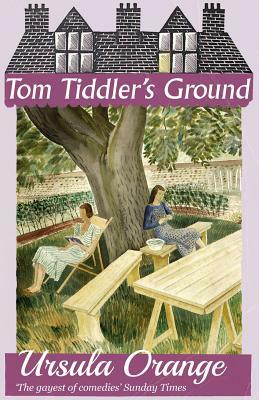
Review 2328: Tom Tiddler’s Ground

At the beginning of World War II, socialite Caroline Cameron takes her baby daughter to stay in a country village with her old school mate, Constance Smith. Caroline is witty but spoiled, and she has begun to feel that her husband John is coddling her too much. She thinks that Constance is nice but naïve, and her husband Alfred, who married up, is a social climbing bounder.

Caroline is surprised by how involved she gets with the lives around her. Constance also has an evacuee mother and baby staying with her. The mother is a sullen girl who pays little attention to the badly underweight baby. Once Nurse and Caroline change his food, he begins to gain weight and Constance begins to care for him.

Alfred is embarrassed because his half sister Mary moved to town as the grocer’s wife. He tries to avoid her, but Constance welcomes her.

Caroline, however, is being tempted into an affair with Vernon, an actor friend. She is displeased with her husband because he doesn’t want to discuss his first marriage, which she’s heard conflicting stories about. When she is in town with Vernon’s friends, she finds herself telling stories about her country friends and then feeling a little disloyal to them.

Although it deals with some serious issues, this is a charming novel about growing to understand other people.
Related Posts

Company in the Evening

Begin Again

Which Way?

Review 2282: #DeanStreetDecember! Company in the Evening

I finally could fit a book for Dean Street December into my schedule! This event is being hosted by Liz of Adventures in Reading, Running, and Working from Home.

In 1940 London, Vicky is fairly satisfied with her life. Five years ago, in the midst of divorcing her husband Raymond for infidelity, she discovered she was pregnant. But she is getting along fine raising her daughter Antonia with the help of an old family retainer, Blakey. She works three days a week as a literary agent and devotes the other days to Antonia. She is an independent woman who doesn’t feel the need for company except for an occasional visit or outing and dislikes sentiment and receiving sympathy.

However, she finds herself inviting company when her mother tells her she’d like to sell her house and move in with her sister. The problem is what to do about Rene, Vicky’s widowed and very pregnant sister-in-law, who has little money and no family and lives with Vicky’s mother. Vicky has a spare room and feels she owes it to her mother to offer Rene a place to stay, even though she and Rene have almost nothing in common. She has no desire to invite her, but she does.

Soon enough, she becomes convinced that they are incompatible. Her efforts to get along with Rene usually end up being misunderstood. Worse, Blakey dislikes her. She is always brusque, but to Rene she is sometimes disrespectful.

Then Vicky runs into Raymond. The other woman returned to her husband, and Raymond is just recovering from a bout of tuberculosis and hopes to take a desk job in the army. They begin occasionally spending time together.

This novel takes a thoughtful look at marriage and at Vicky’s preconceptions of how marriage should be as she takes another look at what broke up her own. It is an intelligent, witty, and involving story. I liked it very much.

Related Posts

Begin Again

Sally on the Rocks

Bewildering Cares

Review 1362: Begin Again

In the 1930’s, generational social changes away the Victorian age occurred, including sexual and social liberation. Begin Again follows four young women recently down from Oxford as they try to redefine themselves in the light of these changes.

Leslie is living at home, but she regularly visits her friends Jane and Florence in London. She has a romantic idea about the freedoms the two girls have and wants to get a place of her own in London, an artist’s studio, using her inheritance. Her mother doesn’t want her to use up her inheritance and has suggested she live with her aunt. Leslie, in truth, would like a little opposition to her plans instead of her mother’s acceptance and prefers complete independence to living with her aunt.

Jane and Florence are living the realities of the independent life, which means no servants and often very little food. Jane takes everything in her stride and doesn’t seem to have any deep feelings for anything or anyone. Unfortunately, this includes her boyfriend, Henry, who wants constant assurances of her devotion.

Florence, however, hates her office job and sometimes feels miserable about her and Jane’s lack of comforts. She feels that the girls who started work straight out of school have the advantage over her and that her Oxford education is not valued at work.

Sylvia lives in her parents’ home but has a lover, Claude. Despite their mutual devotion, Sylvia has kept Claud away from her family, assuming they will not get along. She believes in being absolutely honest and behaving honestly rather than worrying about how others are affected by this honesty. Her younger sister, Henrietta, has been taking Sylvia’s beliefs seriously, maybe more seriously than Sylvia intends, and is thinking of embarking on an affair with a middle-aged married man.

Each of the girls has to adjust her theoretical views about life to deal with reality. This is a sometimes amusing, true-to-life novel about how naive, idealistic young women learn to adapt between the gaps of Victorian and Edwardian values and Oxfordian theories and real life. I enjoyed it very much. The characters are depicted affectionately and seem very real.

Related Posts

My Mortal Enemy

The Home-Maker

Someone at a Distance