Day 681: Literary Wives! The Bishop’s Wife

Cover for The Bishop's Wife

Today is another Literary Wives discussion about the book The Bishop’s Wife by Mette Ivie Harrison.

Be sure to read the reviews and comments of the other wives!

***

Linda Wallheim is the wife of a Mormon bishop. She has no official role in his duties but he occasionally asks her to help him by talking to someone he thinks is troubled. The couple’s lives are busy with many church functions and many visitors for the bishop. But it is one woman who doesn’t come who is soon to cause an uproar.

Jared Helm comes over very early one morning with his five-year-old daughter Kelly to report his wife Carrie missing. He claims she got up in the middle of the night and left. Linda is angered by his crude and sexist remarks about his wife and begins to wonder about his story. She is even more concerned when the Westons, Carrie’s parents, tell Linda and her husband Kurt that Carrie would never have left without Kelly.

Soon, there’s a full-blown police investigation into Carrie’s whereabouts. Although Jared’s father Alex is even less likable and more misogynistic than Jared, Linda tries to stay on pleasant terms with them to look after Kelly.

In the meantime another neighbor finds out suddenly that he is dying. Kurt has noticed that Anna Torstenson has a problem, and Kurt and Linda soon find out that her husband Tobias is dying. Anna loves Tobias, but she is his second wife and he has refused to be sealed in the temple with her, meaning they will not live out eternity together. He has instead often talked about his first wife. As he gets very ill, he wants to visit his first wife’s grave, but neither Anna nor either of Tobias’ grown sons know where she is buried. Upon examination, different people realize they’ve been told different things about the cause of her death.

This novel is fascinating, as much of interest because of the details of life in a modern Mormon ward as for the mystery. Linda is a complex character, always ready to help but sometimes struggling with her role in her husband’s work. The novel is apparently based upon a true case.

What does this book say about wives or the experience of being a wife?

I think that The Bishop’s Wife is the most complex of the books I have read for this club in its examination of “wifehood.” As in the other books, there are several marriages depicted, some of them quite off-kilter. Linda’s and Kurt’s is very much a partnership. Although her primary role is as a wife and mother, he engages her in his work when he can, even though people’s confidences remain confidential. When he thinks a troubled person might be more likely to confide in his wife, he asks her to visit them. Although they have several disagreements about her involvement in the Helm case, he agrees that she must do as she thinks best.

Anna finds, I think, that she has subsumed some of her own personality to please her husband. It takes her awhile, but she learns to look forward to a new start to her own life after his death.

Some of the other marriages depicted are shaded by childhood trauma or by completely dysfunctional relationships. Linda is sensitive to any hints of sexism, but there appears to be plenty in the community. One of the things I found a little shocking was the speed with which one widower decides to remarry and the acceptance that decision apparently has in the community. And there is another marriage that is entirely shocking.

Literary Wives logoIn what way does this woman define “wife”—or in what way is she defined by “wife”?
The old-fashioned phrase “help meet” seems to describe Linda’s role as wife. She is concerned about the hours Kurt puts into his work without being jealous of the time taken away from her. She and Kurt have a warm give and take of views, and she has a close relationship with her sons. Her biggest regret is the death of her stillborn daughter.
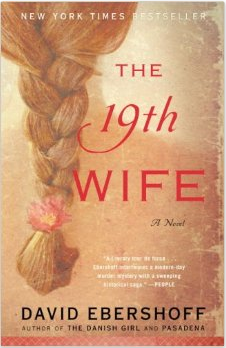
Day 612: The 19th Wife

Cover for The 19th WifeBest Book of the Week!
The 19th Wife is actually two interleaved novels, one as interesting as the other. The novel that begins the book is a modern mystery. The novel that dominates the book, however, is historical, about Ann Elizabeth Young, Brigham Young’s 19th wife, whose lectures after she left the Latter-Day Saints were partially responsible for ending the authorized practice of polygamy within the church.

In the modern story, Jordan Scott is a young man who grew up with the Firsts, a fundamentalist Mormon group that still practices polygamy. At the age of 14, Jordan was booted out on his own because he held his stepsister Queenie’s hand. Jordan’s intentions were not amorous, because he is gay, but he realizes that the young men are ejected from the group so that the old men can keep the young girls for themselves.

Jordan is living in California when he reads that his father has been murdered and his mother, Becky Lynn, arrested for it. As his mother is a complete believer who actually dumped him out on the highway herself those years ago, he does not believe she murdered his father. The evidence against her is that another wife saw her coming from their husband’s room looking upset. Jordan’s father was texting someone just before he was killed and remarked that his 19th wife was at the door. That wife is Becky Lynn.

While Jordan tries to find out what happened that night, we read the story of Ann Elizabeth Young, a woman born into the Church of Latter Day Saints but who has always been clear on the evils of the practice of polygamy. This story is told through fictional excerpts from her autobiography, newspaper clippings, statements by Brigham Young, and other documents.

Ann Elizabeth begins with the story of how her own parents, once devoted to each other, were forced into polygamy by Brigham Young, and what pain it caused her mother every time her husband took another wife. This pain was amplified by the hypocritical ruling that the first wife had to accept all future wives into the household before further marriages could take place. Ann Elizabeth’s own first marriage is also marred by threats of polygamy, which her husband uses to manipulate her despite having promised before marriage not to practice it.

Well written and convincingly characterized, this novel is absolutely engrossing. Although I found the modern mystery interesting in its insights into fundamentalist Mormonism as currently practiced, I found the story of Ann Elizabeth’s life even more compelling. Ever since reading Jon Krakauer’s Under the Banner of Heaven, I have been fascinated by this subject.

Day 274: Red Water

Cover for Red WaterBest Book of the Week!
I read this book on the recommendation of friend Dave Palmer. Thanks, Dave!

In Red Water Judith Freeman has accomplished something difficult–created characters whose beliefs I have no sympathy for, and who I’m not sure I even like, and made me want to read about them.

The novel is about the aftermath of the Mountain Meadows massacre of 1857, when 120 Arkansas emigrants on their way to California were slaughtered in southwestern Utah. This event is one for which the Church of Latter-Day Saints has never to this day admitted responsibility. In particular, this novel is about John D. Lee, the Mormon bishop who was eventually hanged for his part in the event, from the points of view of three of his wives.

Red Water begins with Lee’s execution in 1877, as Emma Lee looks back at her conversion to the religion in England, journey to Utah, and acceptance of Lee as a husband. Although he is twice her age and she will be his eighth wife, he is charismatic and commanding, and she marries for love.

Once she arrives in southwestern Utah, a barren and harsh landscape, she begins to hear things that disturb her. The initial version she is told of the massacre is that the settlers were slaughtered by Indians. But Lee has their stock in with his, and the settlement has a room stuffed with men’s, women’s, and children’s clothing, some of it badly stained. Other versions of the story come out, ones that point the finger partially, or wholly, at the Mormon men, some alleging her husband was a leader. But Emma feels she must trust her husband.

Emma finds she has other hardships. She is not Lee’s eighth but seventeenth wife, although the other nine have left him. There is jealousy among some of the remaining wives. Lee’s families are so far-flung that Emma often goes days without seeing him. The land is bleak and unforgiving, and the work is hard. But Emma decides to face every hardship cheerfully.

Ann is Lee’s child bride, married to him at the age of 13 shortly after his marriage to Emma. Her narrative begins after Lee’s death as well, when she has long been separated from the family. On a pursuit of a horse thief from Idaho to southern Utah, she finds herself back in Lee’s old territory and reflects upon her life with him.

Ann marries Lee to keep her mother, who has lost faith and criticized the Mormons, under Lee’s protection. Despite their age difference, she is also attracted to him. After an initial rough start with Emma, the two became the closest of friends.

However, by the time Brigham Young sends Lee away from the southern settlements that he helped found and banishes him from the order as a scapegoat for the massacre, Ann has made some disillusioning discoveries and decides that Lee’s driving forces are greed and the pursuit of power. She leaves the family to wander on her own, often dressed as a boy.

Once Lee is thrown off by the Mormons, Emma and Rachel keep faith with him, but only Rachel willingly shares his prison. Her narrative is the last. As an old, bitter woman, she fights to survive in a remote area of northern Arizona where Lee has sent her.

This novel is fascinating for the details of the characters’ beliefs and the hard lives that they must live in settling these wild parts of the country. I also find fascinating the ability of men to rationalize as the will of god whatever foul or greedy things they want to do. Freeman’s portrayal of her characters, however, is amazingly unjudgmental and perceptive.

On a side note, for those who are interested in this subject, an excellent nonfiction source about modern fundamentalists, whose beliefs and rationalizations are strikingly similar to those depicted in this novel, is Jon Krakauer’s Under the Banner of Heaven.