
 Last seen in Paris in The Girl with No Shadow, Vianne Rocher has been living there on a boat with Roux and her two daughters. However, the wind is about to blow her back to Lansquenet, the village she left at the end of Chocolat. In fact, her summons comes from the dead, as she receives a letter from her long-departed friend Armande. Armande’s grandson has reached his majority and, with other papers, received and forwarded a letter for Vianne telling her that Lansquenet needs her help.
Roux is mysteriously reluctant to return to Lansquenet, so Vianne takes her daughters Anouk, 15, and Rosette, 5, for the journey back to the village. She arrives during Ramadan and finds the village practically in a state of war. A large population of Moslems has moved into Les Marauds, the slums where Vianne had her chocolaterie. At first cautiously welcomed into the community, the Moslems now are at odds with the original inhabitants.
This state of affairs is almost uniformly being blamed on Ines Bencharki, a veiled, mysterious woman dressed in black. However, it has most urgently affected the fate of Vianne’s old nemesis, Father Francis Reynaud. He has been accused of burning Madame Bencharki’s home, the same building Vianne used for her chocolaterie, which Ines had turned into a school for Moslem girls. Father Francis is expecting to be transferred out of the village by the bishop. Ironically, he finds himself forced to turn to Vianne for help.
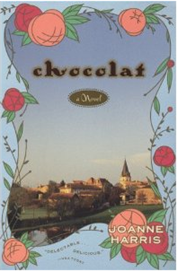
Although I continue to enjoy Vianne and her family, I feel that this novel does not contain the magic of the previous two and is a little more predictable. Vianne’s doubts about Roux’s fidelity seem too foreseeably wrong. We know that Vianne favors the underdog, but considering Reynaud’s unrelenting treatment of her in Chocolat, their alliance seems unlikely. The flavor of the small village that makes us want to return there, so evocative in Chocolat, is missing.
Also, few of the secondary characters, so colorful and interesting in the other books, are given much consideration here. Luc, whose house Vianne and her family are staying in, barely gets a mention. Even though Vianne makes friends with several of the Moslem women, their personalities do not stand out, one from the other. Only the old lady Omi is her own self. The sole old friend who gets any attention is Joséphine.
Nevertheless, it is always a pleasure to spend time with Vianne. There is real danger in this novel and an evil villain. And as always, the novel is beautifully written.

 What? Me Read?