Day 538: Treasure Island

Cover for Treasure IslandIf I had to guess which of Robert Louis Stevenson’s books is the most popular, I’d pick Treasure Island. My own favorite is Kidnapped, though, and I probably wouldn’t have reread Treasure Island except that it came free with a reading app for my iPad. Still, it’s a pretty good adventure story.

The plot is familiar to everyone. Jim Hawkins and his parents run the Admiral Benbow Inn in an isolated location near the English seashore. A shifty old sailor comes to stay. He seems to be on the watch for someone, and asks Jim to alert him to strangers. Soon more shifty sailors arrive looking for him. The Hawkins’ guest is drinking himself to death, though, and he dies soon after Jim’s father does. In his sea chest is a treasure map.

Jim has gone for help to the Squire Trelawny and Dr. Livesey. Soon they prepare a ship to go collect the treasure, taking Jim with them. A crucial misstep occurs when the Squire hires the crew without waiting for the captain (something that seemed not only improper but stupid to me). He hires as the cook a one-legged man named Long John Silver. Silver and a good part of the crew turn out to be pirates who know about the map and want the treasure.

I was struck by a few cases when the protagonists behave nonsensically, the biggest being abandoning the ship when they find out a mutiny is afoot. Almost all the sailors are ashore at that point. It seemed like they should just sail away to another part of the island.

Still, the novel is written really well, and Stevenson is good at building suspense. I’m sure that successive generations of young people are thrilled to discover this adventure story.

Day 528: A Tale of Two Cities

Cover for A Tale of Two CitiesIt has been a long time since I read A Tale of Two Cities, and I did not remember anything except its broadest outlines. The novel is unusual for Dickens in two respects. It is his only historical novel, and it is probably the grimmest. Although he handles some weighty subjects in other novels—the poor laws, the civil justice system, mistreatment of children, abusive schools—this novel about the French revolution shows little of his celebrated sense of humor.

The novel centers around a much smaller cast of characters than usual for Dickens. It begins with Dr. Alexandre Manette, long a resident in a French prison for reasons we do not learn until the end of the novel. When the book begins, he is free but severely disturbed from trauma. His daughter Lucie travels with his banker Jarvis Lorry from England to bring him back to London.

Five years later, he is living contentedly with his daughter in England. Their friend French émigré Charles Darnay is tried for treason on bogus charges, but he is released when his defense proves that the principal witness cannot tell him apart from Sidney Carton, a barrister. These characters will soon become well acquainted.

When the novel returns to France, it shows us the extreme poverty of the poor as well as grim depictions of their mistreatment by aristocrats. Darnay returns to France to meet his uncle, the Marquis St. Evrémonde, and renounce his inheritance. St. Evrémonde’s careless slaughter of a young child when he runs over him in his carriage and his disdainful treatment of his nephew are all we see of him before his murder.

Secretly, a revolutionary society is growing and taking note of atrocities such as those committed by Evrémonde. Wine shop owners Monsieur and Madame Defarge are involved, and at first we have sympathy with their cause.

Charles Darnay marries Lucie Manette in London, but Sidney Carton has fallen in love with her as well. Although he considers himself unworthy of her, he pledges to do anything he can for her or for anyone she loves.

Meanwhile, France falls into revolution and brutal chaos. It becomes a place where revenge is more important than justice.

The fates of the main characters reach a climax when Charles returns to Paris to help an old retainer and is denounced by the revolution. Although he has committed no crime, his relationship to St. Evrémonde puts him in peril. Dr. Manette’s sanity is also threatened when he, Lucie, and Jarvis Lorry travel to Paris to try to help Charles.

The novel is a little more melodramatic than I prefer, unleavened as it is by Dickens’ usual antics. Only a couple of major characters provide momentary relief, and Madame Defarge is like a heavy dark cloud hovering over everything. The novel is also a bit disjointed through moving back and forth between the two cities. Still, Dickens always manages to bring tears to my eyes.

Day 452: Under the Wide and Starry Sky

Cover for Under the Wide and Starry SkyUnder the Wide and Starry Sky traces the relationship between Robert Louis Stevenson and his wife Fanny from shortly before the two meet. At that time, he was a young man still trying to decide his profession and she was a married woman, although separated from her husband, ten years his senior and with children.

Fanny Osbourne has a great creative urge, and she has moved to Paris for art lessons for both herself and her grown daughter Belle, leaving her philandering husband in America. Fanny meets Stevenson while on a recuperative visit to southern France after the death of her youngest son.

The novel follows closely the entirety of their relationship from courtship to his death and her life afterwards, mostly from Fanny’s point of view. They separate because Fanny wants to give her marriage another chance, but they finally come together again. Stevenson, called Louis by his friends, is a sickly man, and his health often requires them to move to climates that are better for his lungs. When it seems as though he cannot live much longer, they find that his health revives on ocean voyages, so they go to sea and finally settle in Samoa until his death.

Although Horan appears to follow faithfully the course and events of the couple’s life together, and the novel is interesting from that standpoint, she never really brings the characters or settings to life. Aside from Fanny’s devotion to Louis, Horan concentrates on her frustration at not being able to live her own creative life. The characters seem relatively flat.

http://www.netgalley.comI was struck also by how, on the original voyage to the South Seas, Horan describes almost nothing but one chieftain until they get to Samoa. If she was working from journals or letters, surely she could have researched further to find out or even imagine what the islands would have been like for Louis and Fanny, seeing them the first time. Instead, we come into their voyage toward the end, as if all the sights and experiences are routine. I’m missing the sense of wonder. Although this novel should have been fascinating in its focus on some amazing lives, it generally does not fulfill its promise.

Day 380: Lady Gregory’s Toothbrush

Cover for Lady Gregory's ToothbrushLady Gregory’s Toothbrush is more of a biographical essay than an extensive biography of Lady Gregory, one of the founders with William Butler Yeats of the famous Abbey Theatre in Dublin and a huge figure in the Irish cultural revival of the 1890’s and early 1900’s. The title of the book is based on a comment she made that reflected her own inconsistencies, that is, her firm roots in the Protestant aristocracy against her support for the culture of rural, Catholic Ireland. When Playboy of the Western World was being produced by the Abbey, there was a huge uproar by Catholic nationalists. Lady Gregory remarked that the dispute was between “those who use a toothbrush and those who don’t.”

Tóibín’s sketch effectively shows the contradictions in Gregory’s character. It would be easy to dismiss her as an elitist snob, but Tóibín makes very clear her contributions to Irish theatre and folk lore. She was one of the first people traveling to rural Ireland to collect Irish folk tales before they were forgotten. As well as writing her own plays as part of the movement to encourage and advance Irish culture, she collaborated with Yeats on his without credit, and some of her contemporaries believed she wrote the bulk of one or two.

An interesting detail from Lady Gregory’s life is how this redoubtable woman cossetted and gave in to Yeats. Tóibín recounts her son Robert’s indignation, for example, when he found that his mother had served Yeats “bottle by bottle” the entirety of his prized Tokay handed down to him by his father.

Copper Beech in Coole Park
The copper beech at Coole Park

Tóibín makes very clear the love she had for her husband’s estate, Coole, which she carefully preserved for her son while he was in his minority. There she entertained many of the great talents of Ireland, including Yeats, his brother Jack, J. M. Synge, George Bernard Shaw, and Sean O’Casey. The home no longer stands, Tóibín says it has been covered in concrete, but I myself have seen the great copper beech bearing their initials.

If I have any complaint of this short book, it is at my own ignorance (even though I have done some reading), for my lack of knowledge of the events of this time and particularly of the plays discussed makes it difficult to understand some of Tóibín’s remarks, particularly the furor around some of the plays. Having never read or seen Playboy of the Western World, for example, I don’t understand what was so upsetting (and indeed he implies that a modern audience may not).

Tóibín effectively and elegantly draws a brief but balanced portrait of this complex woman, showing us both her accomplishments and faults. Although I have read some of Yeats’ poems and some of Shaw’s plays, this short work makes me want to do more exploring around these figures in the Irish cultural nationalism movement and their works.

Day 356: Great Expectations

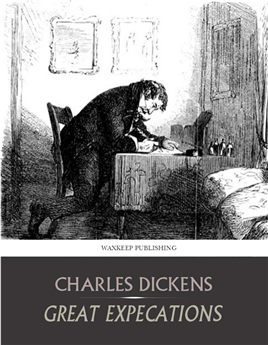
Cover for Great ExpectationsGreat Expectations has long been my least favorite of Dickens’ more substantial novels, because I dislike the character of Pip. However, upon my re-reading it after many years, I’ve changed my opinion, because only in this novel does the main character undergo a complete change of his assumptions and values.

The novel begins with Pip as a young boy growing up in a vast and desolate wasteland of marshes. He is cared for by his ambitious and abusive older sister and kindly brother-in-law Joe Gargery. In the opening scene he is in the cemetery looking at his parents’ graves when he meets the escaped convict Magwich.

Under Magwich’s instructions, the terrified boy steals some food from his sister’s pantry and a file from his brother-in-law’s smithy. Magwich might have got away, but Pip tells him he met another convict on the way, so Magwich throws away his chances of escape to fight the other man, his sworn enemy.

After this odd and atmospherically fraught incident, Pip is soon engaged to entertain the wealthy but deranged Miss Havisham, an old woman who was long ago deserted at the altar and has lived the rest of her life in her bride clothes with her wedding cake rotting away on the table. Miss Havisham introduces Pip to her beautiful ward Estella, and from that time he is captured. He fails to understand, however, that Miss Havisham has brought Estella up to enthrall and torture men.

Pip grows old enough to apprentice as blacksmith to Joe, but his association with Miss Havisham and Estella has made him discontented with his lot. Soon, though, he is informed that he has “great expectations,” that an unknown benefactor has chosen him for his or her heir, and he is to become a gentleman. Pip and his associates assume his benefactor is Miss Havisham, and Pip thinks that she intends Estella to be his.

With only a few qualms of guilt, Pip throws off his childhood, including his gentle, loving friend Joe, to become a gentleman and chase after the dream of Estella. It is only through a series of misfortunes that he realizes he must learn to look at his life differently than he understood it and comes to appreciate his true friends.

I am not at all sympathetic to Pip’s desires and think the pursuit of Estella is a worthless one, but Dickens’ strengths are in his characterizations and complex plots. In addition to a cast of unusual, lovable, or repellent characters, he does a masterful job of developing Pip into a wiser and more honest man.

Day 323: Oliver Twist

Cover for Oliver TwistOliver Twist was one of the first adult books I read as a child, although I believe that David Copperfield was the very first one. This book is, of course, Dickens’ famous indictment of the British treatment of and attitudes toward the poor, as followed through the adventures of Oliver Twist, an innocent and hapless young orphan.

Oliver is born in the workhouse after his mother dies in childbirth without identifying herself. He is named by the beadle and brought up at a baby farm, the intent of which seems to be to starve as many babies to death as possible. The story really begins when Oliver is 10 years old and is moved to the workhouse to begin an illustrious career picking oakum, which is unraveling and picking apart old ropes. There he is voted by the boys to be their representative in asking for another bowl of thin gruel at mealtime (or rather is the only one naive enough to agree to do it).

This act brands Oliver as a malcontent, and he is apprenticed out to a coffin maker with dispatch. His employer seems disposed to be kind, but he is bullied by a “charity boy,” Noah Claypole, as well as by the housemaid and the coffin maker’s wife. Finally, after being unjustly punished for standing up for himself, he runs away.

Oliver’s adventures lead him to London, where he innocently falls in with a gang of thieves lead by the infamous Fagin. Oliver’s struggles to make his way in life without becoming a criminal and the mystery of his identity are the focuses of the rest of the book.

Although this novel has a few amusing and lovable characters, it is fairly grim compared to some of Dickens’ later efforts. It is merciless in its satire of institutions such as the workhouse and the law courts. Oliver himself is more of a symbol for goodness than a fully developed character, yet we are touched by his plight.

It is a long time since I read this novel, and I found I had forgotten just how complex the plot is. Although I do not feel that it is as good as some of Dickens’ later works, as his first serious novel, it is compelling reading.

Day 270: The Secret Garden

Cover for The Secret GardenBest Book of the Week!
The Secret Garden was one of my favorite books as a young girl. I recently had occasion to reread it and was surprised to find it just as entertaining as I remembered. I also noticed for the first time how beautifully written it is.

We might be inclined to sympathize with ten-year-old Mary Lennox at the beginning of the novel. After all, she has survived a cholera outbreak in India that killed her parents, and she was left alone when the remaining servants abandoned the house. But Mary is spoiled and bad-tempered. She goes to live with her uncle, Archibald Craven, in Yorkshire, and she doesn’t like anything she sees. The food is horribly bland. The house is located on a desolate stretch of moor, and her uncle isn’t even there, so she is to be kept by servants. Well, she knows how to handle servants.

To her surprise, the English servants are not afraid of her temper; they expect her to do as she’s told. Largely left to her own devices, she explores the huge, rambling house and the gardens around it. Her young maid Martha tells her the story of a secret garden that used to belong to Uncle Archibald’s wife. His wife died, and he had the garden locked and the key buried.

Running around outside, Mary starts to improve her health and temper. She makes friends with a robin, and Martha’s mother sends her a jump rope. Soon she is rosy-cheeked and stops turning her nose up at the food.

Mary makes the acquaintance of the taciturn gardener, Ben Weatherstaff, and eventually finds the door and the key to the secret garden. The plants are dead, because it is early spring, but she wonders if the garden can’t be revived with a little help. She gives Martha some of her allowance to buy gardening tools, and Martha’s young brother Dickon delivers them. Dickon is a fascinating boy who roams the moors and makes friends with the animals, and with Mary. Soon, both Mary and Dickon are working every day in the secret garden.

Her nights have occasionally been disturbed by someone crying. One night she follows the noise and finds that a boy is living in the house, her cousin Colin. He is an invalid who has not been out of his bed for years, and he is even more spoiled than Mary. After putting him in his place, Mary begins to feel sorry for him. She reads him stories and tells him about the secret garden as if it were story, but he soon figures out that it is true. Eventually, she and Dickon take him out into the garden in a wheelchair.

This book is a tale about how living things can heal bodies and minds. As Mary’s health improves and she works in the garden, her temper improves. The magic of the garden brings Mary together with her friends and eventually reunites the Craven family.

Day 173: David Copperfield

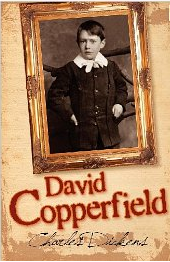
Cover for David CopperfieldBest Book of the Week!

I believe that David Copperfield was the very first book I ever received as a young girl that was not a children’s book. My dad brought it home for me one day when I was sick (beginning my collection of Modern Classics back when they were hardcover), and it transported me to another world.

People have differing opinions about which Charles Dickens book is best. For example, author Nick Hornby blogged that Great Expectations was one of the greatest books ever written. I myself have never fallen under the spell of Great Expectations, though. David Copperfield is my favorite. Tolstoy thought Dickens was the best of all English novelists and considered this book Dickens’s finest work.

David is the narrator of his own story, and he begins it on the night of his birth. David is a posthumous baby, and the novel begins with the first appearance of Aunt Betsey Trotwood, who comes to greet the appearance of her niece and terrifies David’s gentle, foolish mother. When David turns out to be a boy, Aunt Trotwood is mightily offended and departs.

Although David’s early childhood is idyllic, worshipped as he is by his mother and Peggoty the maid, it soon takes a turn for the worse. David’s mother is courted and won by the stern, apparently upright (and ultimately cruel and hypocritical) Mr. Murdstone, and the house is taken over by his cold and fault-finding sister Jane. David is a true innocent with only good intentions, but at every turn he is found to be in the wrong. He is soon shipped off to a typically horrible (if you know Dickens) boarding school.

After a bit of a rocky start, David finds himself made a pet of the popular Steerforth and also befriends Tommy Traddles. However, his mediocre education is interrupted when his mother and baby brother die. Mr. Murdstone sends him to London to lodge with the feckless Micawber family and work in a factory. When the well-meaning but impecunious Micawber is sent to debtor’s prison, David tires of his degrading life and runs off to find the only family he has left, Aunt Betsey Trotwood.

Although Aunt Trotwood is still disappointed that he isn’t a girl, she is kind, and from here, David’s life improves. The story continues with his education, marriage, and young adulthood. It is loaded with some of Dickens’s most delightful characters and a few villainous ones. Alternately turning from comedy to pathos, Dickens expertly drives the story along.

I believe one reason I find David Copperfield so touching is that David’s early life is taken from Dickens’s own. Dickens’s father was sent to debtor’s prison and Dickens went to work in a factory at an early age. This connection translates into a moving experience for the reader.

When innocent and loving David is punished by his stepfather because he is so terrified he can’t recite his lessons or when he is sent off to work in a factory, who remains untouched? When Barkis is willin’ or Mr. Micawber appears on the scene, who doesn’t laugh out loud? When steadfast and valiant Ham dies trying to rescue his rival, who isn’t tearful? When the slimy Uriah Heep finally gets his comeuppance, who isn’t delighted?

If you are not used to reading Victorian literature, you may find the writing old-fashioned, but you will almost certainly be carried along by the story.

Day 126: Dombey and Son

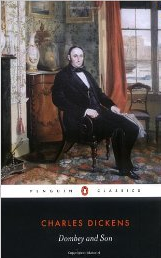
Cover for Dombey and SonI recently re-read Dombey and Son after not having read it in so long that I could not remember its plot. The novel is Charles Dickens’s tale about Paul Dombey, a wealthy, cold, self-important man who cares only about his son, not about his wife or his gentle, loving daughter Florence. His wife dies in childbirth, and his son Paul is weak and often ill, but Paul and Florence have a loving relationship. When Florence is kidnapped as a child, she is rescued by Walter Gay, a young employee of Dombey. Dombey ships him off to Barbados to get him away from Florence, but Walter’s ship is lost and he is presumed drowned.

With Walter gone, Florence has only her brother Paul for her friend. Then Paul dies, and her father even resents Florence for the love his son had for her, which he did not give to his father.

Dombey meets a beautiful widow, Edith Granger. She is a cold, haughty but impoverished woman, and Dombey essentially “buys” her by marrying her. She despises Dombey for his pride and herself for having married him for his money. The only person she is kind to is Florence, which provides more fuel for Dombey’s dislike of his own daughter. His attempts to subdue his wife end in her disgracing him as best she is able by running away to Dijon with Mr. Carker, one of Dombey’s rivals. When Florence attempts to offer sympathy, Dombey strikes her and she leaves the house, friendless and destitute.

Although the novel is not critically accepted as one of Dickens’s major works, it is still enjoyable. It is full of vibrant characters–mostly those of good will but also some villains–and it is gripping to the end. Some critics have noticed a change in the novel that takes place with the death of the young Paul, believing that having the colorless Florence and the unlikable Dombey as the main characters is not enough to carry the story forward. The absence of Walter and his uncle through much of the book is also thought to be a problem. However, the novel has all of the Dickens hallmarks–social commentary, comic absurdity, realism, pathos, and transformation. Dombey and Sons was written before most of Dickens’s real masterpieces like Bleak House or David Copperfield, but it certainly shows the movement from his lighter, shorter works toward the qualities of his more major works.

Day 97: The Mystery of Lewis Carroll

Cover for The Mystery of Lewis CarrollThe Mystery of Lewis Carroll: Discovering the Whimsical, Thoughtful, and Sometimes Lonely Man Who Created “Alice in Wonderland” examines modern ideas about Charles Dodgson (Lewis Carroll) and attempts to debunk them. Jenny Woolf does a good job of providing evidence that his friendships with children, rather than being pedophilic tendencies as is interpreted today, were regarded by Victorians as innocent and probably were innocent. She also shows that the modern interpretation of his pictures of nude children was not one held by people of his own time, and that they regarded this pastime and the resulting pictures as harmless because children were considered innocent.

In fact, Woolf provides evidence that his friendships with young women were much more subject to question and talk. She posits that he cultivated a persona of being older than he actually was so that they would not be questioned, even though these relationships were almost certainly innocent as well.

Woolf depicts the Reverend Dodgson as a sensitive, artistic man who cared for his family and loved entertaining children. His position at Oxford did not at that time allow him to marry. A number of years during the time he was a young man are missing from his diaries and he refers to feelings of guilt in later entries, leading Woolf to conclude that something happened, possibly with a woman, that he regretted. Her theory is that he cultivated relationships with young girls as a return to innocence.

The book is interesting, but with a caveat. It is very short, almost shorter than the subtitle, but Woolf is so focused on one or two ideas that it often seems repetitive. A good deal of information about Carroll’s life is missing because he or his relatives removed pages from his diaries and his relatives destroyed a great deal of material after he died. Although this has often been interpreted as the family’s attempt to hide nasty secrets, Woolf is not convinced that there was much to hide. She blames a good deal of the current perception of Carroll on the initial emergence and misapplication of certain theories of psychology in the infancy of the science.