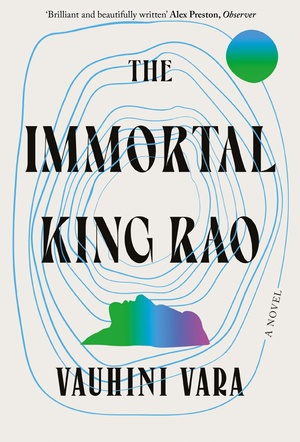
Review 2435: The Immortal King Rao

Just a note before I begin my review. I finally took up WordPress on their offer of my own domain, which came with the plan I was using. So, if you have a bookmark set to my blog, please change it to https://whatmeread.com. If you have subscribed to my blog by email, I’m sure your email links to the blog will be automatically redirected, and I suspect there are redirects for anyone who types in my old URL.

The timing for me in reading this novel was unfortunate, because I’m not much of a dystopian fiction fan and I had unfortunately read two others recently, accidentally but also because there are so many coming out recently. One of these novels was excellent, though. I read The Immortal King Rao for my Pulitzer Prize project.

In a prison in near-future Seattle, Athena Rao is writing her social profile as proof that she didn’t commit the crime she’s accused of. Athena is the daughter of the disgraced King Rao, a Steve Jobs/Mark Zuckerberg type guy who invented the Coconut—the first computer designed for the general public—and apparently the whole idea of social networking. He was disgraced and adopted a solitary life on an island in Puget Sound until he decided on a further achievement—to create a daughter from his deceased wife’s frozen embryos who is connected from birth to the Internet.

If you’re thinking mad scientist, this isn’t really the emphasis of the novel. Instead, we learn about King Rao’s early life in India and later life in America, we hear what happens when Athena decides to leave home, but we also learn of the disintegration of the world’s governments toward a planet run by an algorithm that is supposed to be fair, and of the immanent threat to the planet of climate change.

There is a lot going on in this novel, a fact that seems to have impressed critics. Personally, I was at first taken by the descriptions of Rao’s childhood in India, but tired of it once it became involved in family disagreements. I wasn’t very interested at all in Rao’s life as a student and then entrepreneur in America. I was most interested in Athena’s story and her attempts for her life to mean something. Although Vara handles everything very well, I think there is too much going on here for me.

Related Posts

The Memory of Animals

Our Missing Hearts

The Sunlight Pilgrims

Review 2312: Bright Young Women

Bright Young Women is a novel centering around the true story of a famous serial killer, whose last killings took place in a sorority at Florida State University in Tallahassee in 1978. Apparently, Knoll believes as I do that men commit such acts at least partially for the attention so she calls the killer The Defendant throughout the book instead of his name. So will I.

The novel is narrated by two different people in three different time frames. In 1978, Pamela is the president of a sorority and is about to become an important witness. In 2021, she is still trying to track down evidence that will lead to the body of one of his earlier victims.

That victim is Ruth, the second narrator, who in 1975 had the misfortune to meet The Defendant at the beach in Issaquah, Washington.

This novel doesn’t want to focus on The Defendant so much as on the girls he was after. The novel sticks with Pamela from the day before the crime through the days after she sees a strange man fleeing the sorority house, but it focuses on Pamela’s self-development afterwards. At the beginning, she is living an expected life as head of the sorority with the brightest girls on campus, engaged to Brian and planning to attend law school, only an inferior school even though she was accepted to Columbia because Brian couldn’t get in. Pamela is obviously in shock after the event because she doesn’t realize for hours that two of the girls are dead. But she clearly tells the sheriff that although she at first thought the man she saw was Roger, her best friend Denise’s boyfriend, she realized the man was a stranger. Nevertheless, the sheriff focuses on Roger, and this is only one instance of the incompetence of the law enforcement work on the case. Pamela is disregarded and patronized time and again in this novel.

One of Knoll’s themes is her idea that The Defendant, having performed poorly at college and not having been accepted into law school, was picking out successful, attractive women to kill. Then the media fed into his own view of himself by depicting him as smarter and more handsome than he was, despite his ridiculous performance when he eventually defended himself. Basically, they admired the killer while denigrating his victims.

Ruth’s self-evolution takes her from a lesbian woman dominated by an unloving mother who doesn’t want the neighbors to know her “shame” to a confident, lovely girl who has found a place for herself, largely because of the help of her friend Tina. It is Tina who later comes to Pamela and tells her she thinks The Defendant murdered Ruth as well as the sorority girls. Although Tina is right about everything, law enforcement disregards her and warns Pamela against her.

Knoll’s late 1970s certainly sound more like the 60s to me. In Michigan, I didn’t know any girls who were interested in sororities or still used hair spray or dressed as described in the novel anymore. Then again, it was Florida.

I found this a fascinating novel with a strong feminist message. I am looking forward to what Knoll does next.

Related Posts

The Shining Girls

The Broken Girls

Killingly

Review 1756: The Cold Millions

Best of Ten!

Sixteen-year-old Rye Dolan and his older brother Gig are wanderers through the Northwest, among thousands of other men looking for work when they can get it, in 1909. Indeed, the town of Spokane is teeming with them. It is a thriving town that has grown rapidly, and at first glance it seems to consist only of fabulously wealthy mine owners and the destitute.

The mine owners only accept workers through corrupt employment agents. Men pay a dollar, a day’s pay, for a referral for a job they may not get, and most of the money gets kicked back up the chain to the employer. Gig is a member of the IWW, or Wobblies, who are trying to recruit members to their union during a Free Speech Day that protests against the employment agents, the poor pay and working conditions, and the corrupt Spokane police department.

Rye isn’t so sure he believes in the union, but on Free Speech Day when the police begin beating and arresting the protesters, he is inspired to jump on a soapbox next to Gig and sing the union songs. So, he and Gig are arrested and thrown into jail along with 500 other men, into packed cells and brutal conditions.

Rye, because of his age, gets out of jail early with the help of a lawyer and Elizabeth Gurley Flynn, a crusading 19-year-old union firebrand (an actual historical figure). However, Rye sort of unwittingly makes a deal with Lem Brand, a mine owner, to give him information in exchange for getting Gig out of jail.

This novel vividly depicts the kinds of conditions that made unions evolve in the first place and the fight the unions had to stay in existence. Does that sound unexciting? Well, this novel has an appealing center around the two brothers, features a historical figure we should know more about, and is full of intrigue, action, and skullduggery. It is harrowing at times, alternating narrators among several characters who don’t always end up alive at the end of their narratives. I was enraptured.

Beautiful Ruins

The Paragon Hotel

The Long Take

Day 1249: Wild Beauty: Photographs of the Columbia River Gorge, 1867-1957

Cover for Wild BeautyAlthough we live in Washington, one of the most beautiful wild areas nearby is the Columbia River Gorge between Washington and Oregon. That’s why, when we saw a program about Wild Beauty on television, we had to have a copy of the book.

Wild Beauty is a collection of stunning photos of the Gorge, taken between 1867 and 1957. The introduction explains how the Gorge was formed geologically and tells about advances in the field of photography during the time these pictures were being taken. Then, the book is divided into five sections, roughly chronological.

Section I features the photography of Carleton Watkins, who made several trips up the Gorge between 1867 and 1885. The introduction explains that the state of photography at the time required him to cart along large panes of glass and a portable darkroom, because the photos had to be developed immediately. Each picture is accompanied by a short caption telling what is known of the photo. This section contains the first known photo of the famous Multnomah Falls.

Section II shows photos by a variety of photographers between 1885 and 1910, when advances in both transportation and photography made it easier to take photos in the Gorge.

Section III is devoted to the work of Lily White and Sarah Hall, whose photographs tended more toward the artistic than the historical. The two women traveled up and down the Gorge on a houseboat between 1903 and 1905.

Section IV features photography along the Gorge’s new scenic highway between 1911 and 1929, including some photos that are hand tinted.

Section V features photos between 1930 and 1957 after dams were built along the river. Many of these are also hand tinted.

This book is full of stunning photographs that provide a historical record of the Gorge. This is an interesting book for people interested in the beauty or history of Oregon and Washington or the history of photography.

Related Posts

Wild

The Hare with Amber Eyes

The Memory Keepers Daughter