 Today I am doing something a little different–participating in a virtual book-discussion group with Literary Wives. Literary Wives is a group of bloggers who are wives and are reading books about how wives are depicted in fiction. Toward the end of my normal review of this month’s choice, I will answer some specific questions that appear in every Literary Wives review. Be sure to check out the other reviews by Audra of Unabridged Chick, Ariel of One Little Library, Emily of The Bookshelf of Emily J., Carolyn of Rosemary and Reading Glasses, Cecilia of Only You, and Lynn of Smoke and Mirrors.
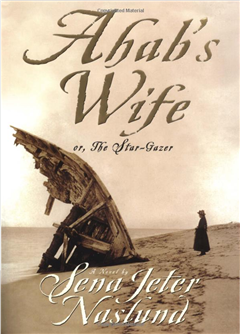
I have quite got to like what appears to be a newish fashion of rewriting works of fiction from a different viewpoint. Although it has produced some mediocre results, it has also produced some gems, a few of which are Wide Sargasso Sea by Jean Rhys, The Solitary House by Lynn Shepherd, and now, Ahab’s Wife by Sena Jeter Naslund.
I was somewhat put off by Naslund’s writing style in her most recent novel, The Fountain of St. James Court; however, it is imminently suited to her most well-known novel, this one, which is a reworking of Moby Dick. This novel is truly an adventure. It begins with a brief look forward to Una Spenser’s delivery alone in a cabin in the wilds of Kentucky of Ahab’s child, which does not live long, and the subsequent discovery that her mother has died in the snow while going for help. If this isn’t enough going on, while she is in labor, Una also has an encounter with bounty hunters looking for an escaped slave. Later, she helps the slave girl escape.
After this glimpse ahead in time, the novel returns to take a relatively straightforward path, beginning with twelve-year-old Una’s banishment from this same cabin in Kentucky. Una has faced some abuse at the hands of her father because of a difference in religious beliefs, so her mother sends her to her Aunt Agatha and Uncle Jonathan, where they live on a lighthouse island off Massachusetts. So begins Una’s fascination with the sea.
Although not every 19th century woman would think life with a loving, thoughtful, intellectually curious family confining, Una eventually finds it so, when she is sixteen. Her feelings are complicated by the arrival of two young men who come to prepare for the installation of a new light for the lighthouse. They are best friends Giles Bonebright and Kit Sparrow. Una knows she likes them both but is not at first sure which one she likes best. This fateful meeting is to affect the rest of Una’s life.
But I am writing nothing here that reflects how unusual this novel is. First, it documents the extraordinary life of an extremely uncommon character. If some of the other characters are not so fully drawn, you really feel as if you know Una. Next, in its occasional long asides and fits of oratory, it is a fitting companion to Moby Dick, with its dissertations on bits of whaling gear and its exhortations by Ahab. If any woman is a match for Ahab, Una is. Finally, its language and ideas are lyrical and soaring, as Una grows intellectually, meets her own life full on, and becomes acquainted with historical figures from her time and place.
If I have a caveat, it is that I feel the exceptional Una would have had more problems of acceptance in the actual 19th century American setting. In keeping with a theme about the enjoyment of life, not only does Una throw off debillitating experiences with little trouble or regret, but she also finds warm friends and acceptance everywhere she goes. It would give away too many plot points to discuss why I find this unlikely.
For Literary Wives: What does this book say about wives or about the experience of being a wife?
This novel does not draw on a conventional idea of a wife, particularly for the time it is set. For Una, being a wife seems to mean giving unstinting loyalty up to a point, but this loyalty can vanish fairly quickly if the relationship becomes disrespectful, and Una’s natural ebulliance takes her over some terrible difficulties with relative (and perhaps unlikely) ease.
I don’t think Una lets the conventional notions of wifehood affect her at all. She just does what she wants and what she thinks is right, but her ideas of right are different from other people’s. For her, a husband seems to be the more modern idea of a partner. Certainly, mutual respect, sexual attraction, and love enter into this equation but not so much the typical 19th century idea of duty.
In what way does this woman define “wife”–or in what way is she defined by “wife”?
I don’t think Una is defined by “wife” at all. I think “person” is more what Naslund is interested in. In a review of this book, it was referred to as a feminist, earth mother, reinterpretation of Moby Dick. I don’t see the earth mother so much, but the feminism is certainly there. “What was a promise? A way to enslave the future to the past,” Una thinks at one point.

 Best Book of the Week!
 What? Me Read?