Review 2278: The Romantic

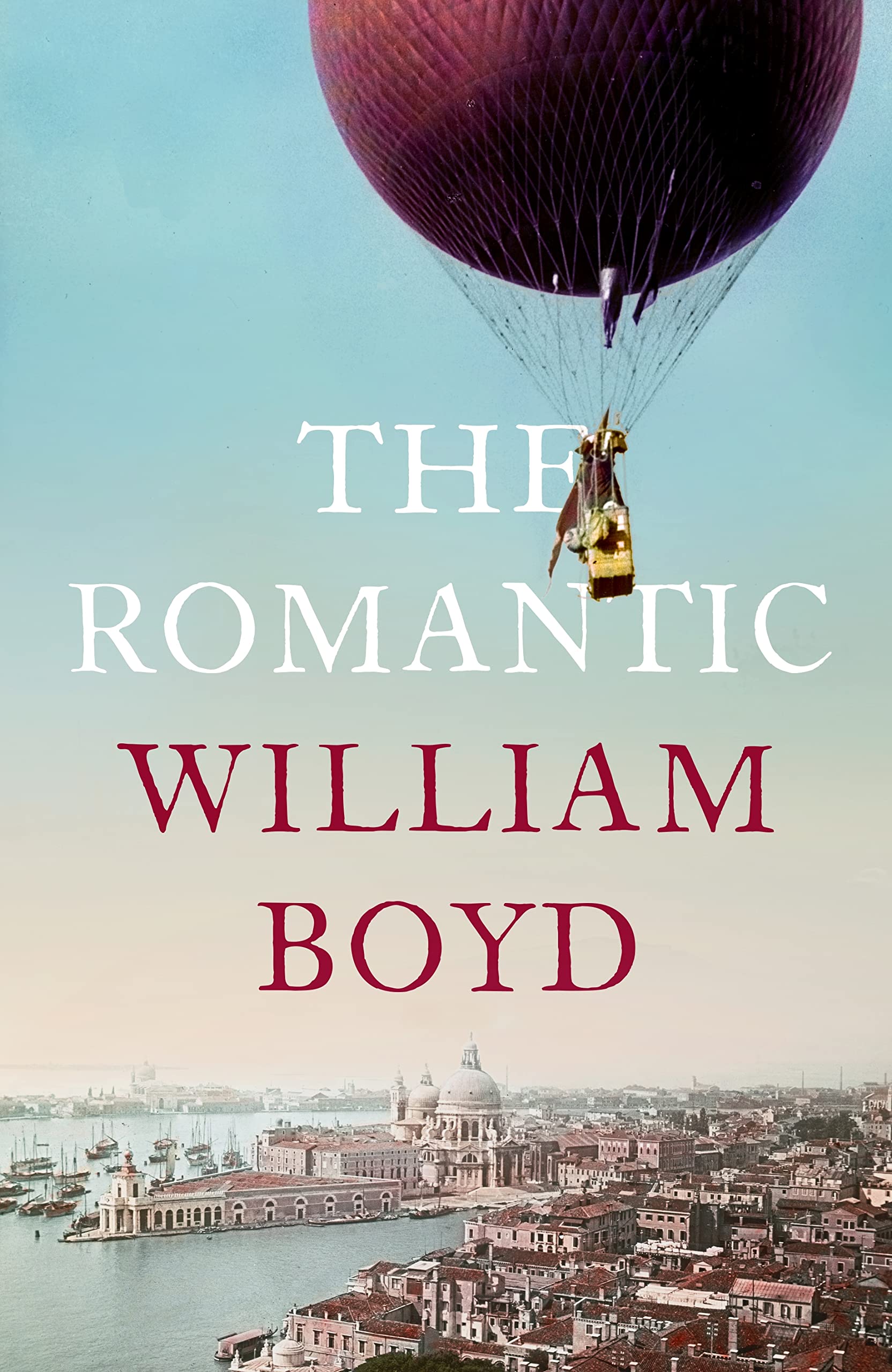
In the 19th century, Cashel Greville grows up in Ireland under the care of his aunt, who is governess to Sir Guy Stillwell’s family. But it’s clear to the reader, if not to Cashel, that all is not what it seems. Sure enough Cashel’s aunt moves them to Oxford, where they take up residence with Sir Guy under the name of Ross, and Cashel’s aunt Elspeth gives birth to twins, Hogan and Buckley. It is not until Cashel is 15 that Elspeth reveals she is his mother and Sir Guy his father.

Outraged, Cashel runs away from home and joins the army as a drummer boy. If you think I’m giving too much away, this all happens within the first 50 pages of this 450-page book, in which Cashel is on the field at Waterloo, hangs out with the Shelleys and Lord Byron, writes a best-selling novel but is cheated by his publisher and ends up in the Marshalsea, attempts to form a commune in Massachusetts, and so on. Oh yes, he also meets the love of his life in Ravenna, Italy, but she is married to a rich old man.

Cashel’s eventful and perhaps not altogether believable life (he claims to have discovered the source of the Nile before Speke and to have thwarted an antiquities smuggling scheme with the help of Sir Richard Burton) is supposedly documented by an autobiography and other papers that came into Boyd’s possession. With this claim, Boyd begins another of his “whole life” novels, maybe the most picaresque and least believable.

I usually like Boyd’s novels—in fact, some of them I have loved—but I had trouble connecting with this one. I’m not sure why, especially since it received uniformly positive reviews. It is fast moving despite its length. Maybe too fast. I didn’t feel like I got to know Cashel or really any of the characters. All of the women are ciphers, even Cashels’ great love. Boyd spends more pages on a sexual encounter with her than on Cashel’s marriage and its subsequent breakup.

Given Boyd’s plans for the adventures in this novel, maybe he needed to make it a lot longer.

Related Posts

Love Is Blind

Sweet Caress

Passion: A Novel of the Romantic Poets

Review 1408: Love Is Blind

Although generally speaking, I love William Boyd, I should have known better than to read a book named Love Is Blind. Even from the title, I could tell it was about a man who falls in love with a woman who is trouble, a plot that I hate. Although men love to write books upon this subject, most of the women incarcerated in the United States are there because of a man. Of course, it happens for both sexes, but a man enthralled by a lethal siren is the least of it and, for me, not interesting.

In 1894 Edinburgh, Brody Moncur is a piano tuner of significant skills. He is offered a position of assistant manager in his company’s Paris office which he takes, determined to get away from his controlling father.

In a promotional effort, Brody makes a deal with John Kilbarron, a famous pianist, to play only his company’s pianos. Soon, he has fallen in love with Lika, Kilbarron’s mistress, who is an opera singer. They begin an affair, and his life becomes a series of efforts to win her away safely from Kilbarron.

Disturbingly, we get very little sense of what Lika is like as a person. She serves pretty much as Boyd’s MacGuffin. The novel just focuses on Brody’s obsession and its consequences. It’s obvious that Lika has her secrets, and to me, it was even obvious what the major one was.

As well written as it is, I simply didn’t enjoy the theme of this book. As with Boyd’s other recent books, it takes in a sweep of history and visits many places while it meanders to its denouement.

Related Posts

Sweet Caress

Euphoria

The True Heart

Day 764: Sweet Caress

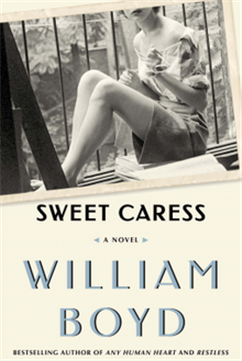
Cover for Sweet CaressAlthough I have by no means read everything by William Boyd, Sweet Caress reminds me most of his Any Human Heart, perhaps because it’s the story of one person’s life. This novel is about Amory Clay, a photographer born in 1908. Boyd creates the impression that Amory is a real person (so much so that I googled her twice) by interjecting photos of her life into the novel.

Amory leads an unusual life almost from the start of the novel. Although her father suffers from depression and other problems as a result of World War I, she is so content with her home life that she is upset when her parents send her away to school. Her parents are not well off, but Amory learns later that a legacy from an aunt is dedicated to her education.

Her mother wants her to attend university, but she decides early that she doesn’t want to go. Her favorite uncle, Greville, gave her a camera on her 10th birthday, and she wants to be a professional photographer.

Then a violent incident brings her home. Her father arrives at school unexpectedly to take her to tea. But his intention is to commit suicide, and he doesn’t want to go alone. Amory survives the drive into the lake and even saves her father, who is committed to an institution for a long time.

Soon after, Amory becomes Uncle Greville’s assistant. He is a society photographer, and although Amory does not enjoy this type of work, she must start somewhere. But she takes a risk with an unusual betrothal photo, and its reception ruins her chances. Soon Amory is off to capture the decadent night life of Berlin.

Amory leads an extraordinary life that contains many sorrows and triumphs. She is a war correspondent for both World War II and the Vietnam War, she is attacked by fascists rioting in London, she travels with lesbians to Mexico, she encounters a Charles Manson-like figure in 1960’s California. She almost unwittingly marries a lord and has a family. These are just some of the events of her life, its story punctuated with paragraphs from the “present time” of 1978, when Amory is an old woman.

link to NetgalleyI found this novel involving, although not as much as I did Any Human Heart. For one thing, I wasn’t always convinced I was hearing a woman’s voice, and in no way was this because of Amory’s adventurous life. Also, Amory’s voice is a reserved one, with certain exceptions. Still, it is a fascinating story that manages to cover a great deal of modern history.

Related Posts

The All-True Travels and Adventures of Lidie Newton

The Signature of All Things

The Lacuna