Day 1002: The Crowded Street

Cover for The Crowded StreetThe Crowded Street was Winifred Holtby’s second book, and like her others, one of its themes is a woman’s duty to herself and to a larger society than her local community. The novel’s main character is Muriel, who always tries to do what is right and good.

We first meet Muriel when she is nine and follow her for the next twenty years. In the first scenes of the novel, Muriel is excited to be attending a party. But her desire to enjoy the party by watching the others conflicts with the ideas of her mother, who thinks she should be dancing and socializing.

During the party, she dances with Godfrey Neale, who becomes important to her later in the novel. But in trying to escape her mother, Muriel falls into a situation where her behavior is misunderstood and the party is ruined for her.

Muriel begins a pattern of always trying to please her mother. Mrs. Hammond, though, has married beneath her and has spent her career social climbing to make up for it. Although Muriel would like to learn about astronomy and is interested in math, the only way she can please her mother is by marrying well. Unfortunately, she is shy and only moderately attractive. Still she decides fairly early on to devote herself to her mother.

Only one friend, Delia, urges her to do more. She tries to get Muriel to go to college, but Muriel is naive and for a long time believes what her mother tells her, which is that men do and women wait for them to act.

It took me a while to relate to Muriel, probably because she is so naive. But eventually I became engrossed in her story, as she learns to view her world and her mother with a more skeptical eye. Having grown up in the 50’s and 60’s, I remember my own mother coming out with some of the things implied or said in Holtby’s novel, only my own reaction was one of indignation. But that was 30 years after the setting of this novel.

I very much enjoyed this novel about Muriel and her slow turning toward a more feminist outlook.
Related Posts

The Land of Green Ginger

Anderby Wold

South Riding

Day 343: Poor Caroline

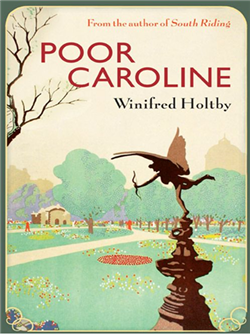
Cover for Poor CarolinePoor Caroline begins with the death of Caroline Denton-Smyth, a do-good spinster who has dreamed of forming the Christian Cinema Company, which will clean up the film industry. This satire of charitable organizations is a little different from the other Winifred Holtby novels I have read, which are about small town Yorkshire.

Caroline, an elderly eccentric, although virtually penniless, forms the film company and manages to put together a board of directors of dubious character. Basil St. Denis is an elegant dilettante who is hoping to use the charity to make some money. Clifton Johnson is a seedy American scammer. Joseph Isenbaum is a wealthy social climber (and not a Christian) who wants St. Denis to sponsor his son at Eton. Charles Guerdon is a Quaker nonentity, Father Mortimer is carrying scars from World War I, and Hugh Macafee is a film inventor who is obsessed with his work. The makeup of the board alone is an object for satire.

Caroline is in some ways admirable, with a buoyant, energetic personality, who devotes herself to one cause or another, only to have it fail or have the rest of the workers desert her. However, she is totally self-absorbed as she pursues her goals.

There are only two completely sympathetic characters in the novel. Caroline’s young cousin, Eleanor de la Roux, wants to learn to be successful in business and break ground for other women. Roger Mortimer, a young Anglican priest, wants to live a life of poverty and service and falls in love with Eleanor.

I am not sure whether I like this novel or what I think about Caroline herself. She is completely blind about her charities, and from the point of view of her relatives has cadged from them shamelessly for years. Certainly she is a believable type, reminiscent of Mrs. Jellyby in Dickens’ Bleak House, who spends all her time on charities for Africa while her children are uncared for and her house falls to pieces.

Day 300: The Land of Green Ginger

Cover for The Land of Green GingerJoanna Burton is a naive girl with a huge sense of adventure who has always wanted to travel the world in this most touching of Winifred Holtby’s books. Born in Africa but brought to England as a small child, Joanna has never felt like she quite fit in and has always wanted to return to the “land of green ginger.” During World War I she meets a young officer, Teddy Leigh, who tells her he is going to give her the world as a golden ball, and she believes him.

Several years later, however, she is living on a Yorkshire farm with two little girls and an ailing husband. Not only was Teddy gassed during the war, but he hid from her his history of tuberculosis.

As Joanna struggles to deal ineptly with the farm, her husband, and her children, a nearby landowner asks if they could take a Hungarian man in as a roomer. Joanna is so preoccupied with her troubles that she doesn’t notice her husband’s irrational jealousy or the rumors starting up in the village about her relationship with the Hungarian.

This novel is beautifully written and painful to read at times, as the readers see Joanna unconsciously make misstep after misstep and the neighborhood gossips become vicious indeed. Holtby only wrote a few books before she died at the age of 37, but she was a master at depicting life in the Yorkshire countryside and small towns.

Day 255: Anderby Wold

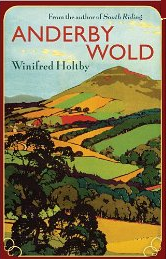
Cover for Anderby WoldMary Robson is a young married woman who has been working for years to save her family farm, Anderby Wold. She even married John, her much older husband, whose hard work has kept it going these past years. She is a managing woman who thinks it is her duty to oversee the welfare of the village, making herself disliked by many. Because of her preoccupations, she seems much older than she actually is.

One day she encounters David Rossiter, a young radical journalist who disagrees with everything Mary believes in. David is trying to get farm workers interested in unionizing, and Mary becomes unsuitably obsessed with the younger man. The schoolmaster, Coast, becomes involved in the unionization issue expressly to make trouble for Mary, whom he detests.

Anderby Wold is an interesting slice of Yorkshire life in the 1920’s. It reflects the issues of the times, when farmers were facing increased demand for workers’ rights. Another of Winifred Holtby’s consistent themes that appears here is getting on with life after the death of a loved one. This novel is Holtby’s first, and its realistic depictions of village life of the times reflect her background as a journalist.

Day 199: South Riding

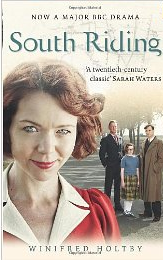
Cover for South RidingI had never heard of Winifred Holtby until I watched the excellent Masterpiece series South Riding. I enjoyed it so much that I picked up several of Holtby’s books. Holtby published 12 novels in the 1920’s and 1930’s, as well as pursuing a successful career as a journalist and nonfiction writer. She is known for regional fiction about Yorkshire and has a prize for regional fiction named after her.

Set post-World War I, South Riding is the story of the conflict between the landed gentry and social progressives in a Yorkshire town. Sarah Burton comes to town as the headmistress of a girl’s school. She has many progressive ideas and wants to improve the school and the quality of education provided to the girls. To accomplish her goals, she asks the town to invest more money in the school.

She immediately runs afoul of Robert Carne, a local landowner. He has very conservative ideas about the town and school, but he also has some heavy concerns. Previously prosperous, he has spent all his money on care for his mentally ill wife. He also has the care of a young daughter who is having her own problems.

Unlike the television series, the novel has a huge sweep and does not concentrate on Sarah, but presents the stories of about fifteen other major characters. It deals with issues like education, poverty, and governmental corruption as well as family relationships. The characters are all carefully delineated so that you feel that you know each one.

The novel is beautifully written, although it gets just a little preachy at the end. Some reviewers have compared Holtby to George Eliot because of her interest in local social issues and her breadth of scope.