Review 1390: End Games in Bordeaux

I had already planned to post this review today, but last week I noticed that September 1 was also the beginning of Readers Imbibing Peril, where participating readers read mysteries, horror, suspense, and so on between September 1 and October 31. I usually read a fair number of books in those categories anyway, not to mention trying to read something suitable for Halloween. So, here goes. Let me count this book as my first entry!

* * *

Those who select the shortlist for the Walter Scott Prize have an annoying tendency to choose books from the middle or end of a series. I read five long Matthew Shardlake novels just to read Heartstone for my project and then felt it wasn’t necessary to have read the other books. I didn’t realize that The Quality of Mercy was the second of two novels until I began reading it, but I found that it was easy enough to figure out what I had missed.

So, when it came time to read End Games in Bordeaux, I reasoned that since it was a mystery, it probably wasn’t necessary to read the preceding three books. That turned out to be a mistake. Not only does the novel check in periodically with a plethora of characters whose relationship to the main character is not explained, but an understanding of the plot relies heavily on the cases covered in the previous books. So, I was fairly well confused the entire time I was reading the book.

World War II is winding down. There are rumors that an invasion by the Allies will come soon. Superintendent Lannes is suspended from duty by order of the Germans for reasons that are not clear.

Count St.-Hilaire asks him to find a young girl who has run off with a ne’er-do-well, Aurélien Mabire. When Lannes finds Mabire, however, the girl isn’t with him. Mabire is, in fact, gay, and he lured the girl away with a promise to meet her father, long estranged from the family. Mabire was working at the bidding of Labiche, a crooked advocate whom Lannes despises.

The situation begins to deteriorate as people begin changing sides preparatory to the end of the war. Lannes finds himself being threatened and rumors being spread about him.

I had to wonder if I would have liked the book better if I had understood who some of the characters were and what the background was. I’m not sure I would have. The novel is narrated in terse little blocks of text while we skip from one situation to another, which doesn’t give me confidence that I would have found it much more understandable. Perhaps Massie was relying on readers’ knowledge of the other works in the series, but novels need to stand on their own. In the case of a series, therefore, some reiteration is necessary. Furthermore, the writing style makes me not want to go back and read the books in the series that I missed. One quote on the cover says the characters are evoked vividly. Well, maybe they are if you’ve read all the books. I didn’t find that to be the case.

Related Posts

City of Shadows

The Information Officer

Munich

Review 1384: The Spoilt City

Cover of Fortunes of WarThe Spoilt City is the second book of Olivia Manning’s Balkan Trilogy. I was confused about why this series had two series names until I read recently that this trilogy along with her Levant Trilogy are called The Fortunes of War.

The war, of course, is World War II. The Spoilt City begins during the summer of 1940 in Bucharest. When newly married Harriet Pringle arrived in the city less than a year before, it was opulent in its wealth, and Romania being agriculturally rich, loaded with good food. Although the country is neutral, it has been sending most of its food to Germany, and now it is becoming difficult to find anything good to eat.

King Carol has been trying to maneuver between threats from Germany and Russia. Romania has been an English ally, but when Russia is rumored to be ready to invade, Carol throws his lot in with the Germans. They immediately cede large portions of Transylvania to Hungary. The Iron Guard, an outlawed group of Fascists, reappear in the streets, and Germans begin arriving. People begin calling for Carol’s abdication. The English, who were formerly welcome, begin to feel threatened.

Harriet, who has married on three weeks’ acquaintance, is beginning to understand her husband, Guy. While he is popular with everyone and has an open, gregarious nature, he glosses over difficulties that she must tend to. He has offered the impoverished Prince Yakimov a place to stay while he acted in Guy’s play. When the play is over, Harriet doesn’t know how to get rid of him. Later, Yakimov repays this hospitality with a foolish betrayal.

The impending Drucker trial is all anyone talks about. Drucker, a wealthy Jew, is facing trumped-up charges after refusing to hand over his oil leases to the King’s mistress. Much of the family money is in the name of his son, Sasha, who has been forced into the army. Sasha, formerly Guy’s pupil, deserts and comes to Guy for help. Guy and Harriet hide him in a room on the roof, another danger to them.

Now that things have got going, I found this second book a lot more interesting than the first. I didn’t really like Harriet in the first book but found her much more likable in the second. With such a naïve and impractical husband, she is often faced with having to take care of unpleasantness. I am looking forward to the third novel and will probably also read the Levant Trilogy.

Related Posts

The Great Fortune

Midnight in Europe

Munich

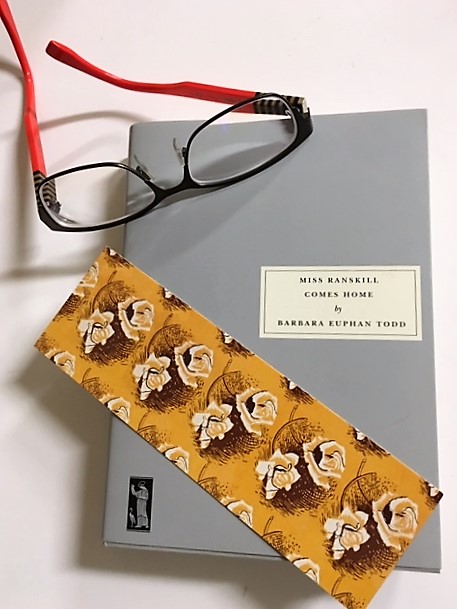
Review 1381: Miss Ranskill Comes Home

When I read that Miss Ranskill Comes Home is about a woman stranded on a desert island, I thought of some romantic comedies from the 50’s. But the novel is more serious than that. It’s about a woman struggling to find her place in a world completely changed.

The novel opens with Miss Ranskill burying the Carpenter, which is what she called the man who was her companion on the desert island where they both have been stranded since falling overboard. The Carpenter died, but he left her the boat he’d been building. When she casts off, hoping to encounter a ship, she occupies herself with the stories they used to tell each other about going home.

Miss Ranskill is picked up by a ship, but World War II has begun since she was lost. She doesn’t understand how the world works or have any papers. She gets off to a bad start after she arrives in England when she leaves her escort out of embarrassment. Even when she returns to her sister, she is made to feel like an encumbrance. Having lived literally stripped to the essentials, she doesn’t feel much sympathy for wartime bureaucracy or the pleasure some seem to take in their deprivations.

This novel is an unusual one. At times I didn’t buy what happened to Miss Ranskill after she returned home, particularly her reception. I also got irritated with her seeming determination to ignore the rules of wartime, even if some of them were silly. Still, this is a thoughtful examination of some of the attitudes of that time and ultimately a touching story.

Related Posts

Mariana

The Great Fortune

Robinson Crusoe

Review 1379: The Nightingale

I wasn’t impressed by the only other Kristin Hannah novel I read, but my brother recommended The Nightingale so strongly that I decided to give her another chance. I know I’m probably in the minority.

The novel begins with an old lady living in Oregon in 1995 who is moving into a retirement home and is sorting through old papers with her son. Her son finds the identity papers of Juliette Gervaise, a person he’s never heard of. This launches most of the rest of the novel, set in France during World War II.

The two Rossignol sisters are very different women. Vianne is a mother, wife, and schoolteacher. When the Nazis arrive in the village, she is careful to follow orders and try to stay out of trouble. Isabella, however, is a rebellious teenager who runs away from school and immediately begins distributing fliers for the Resistance.

As Vianne fights to survive and protect her daughter, Sophie, she eventually finds that she can’t always follow the rules. In the meantime, Isabella’s involvement with the Resistance becomes more dangerous. Obviously, one of hooks of the novel is to find out which sister becomes the little old lady in Oregon.

It took quite a while, but I did become involved in this novel. It’s an interesting story, based on a real one. I still, however, consider the writing mediocre and trite and the characterization flat except for a few characters. I found the novel affecting, though.

Related Posts

Winter Garden

Life After Life

The Women in the Castle

Review 1355: Transcription

Cover for TranscriptionBest of Ten!
Things are not always what they seem in Transcription, Kate Atkinson’s latest novel, but it isn’t until the last pages of the book that you understand what’s going on. For this novel, Atkinson returns to the time period that was so fruitful for her last two, World War II.

Juliet Armstrong hearkens back to 1940, when she becomes, at 18, a transcriptionist for a team in MI5 that is bugging the meetings of Fascist sympathizers acting as fifth columnists. She is at once extremely naive yet clever and prone to lying. She has a crush on her handsome boss, Perry Gibbons, and does not understand that he is using her as a beard. The team’s work centers on Godfrey Toby, who has infiltrated a group of Nazi sympathizers.

In 1950, Juliet is working for BBC radio on a children’s show, but she occasionally harbors refugees from Communist Europe for her old bosses. One day, she spots Mr. Toby in the park, and he pretends not to know her. Later, she receives a note that says, “You will pay for what you did.” She fears that her life during the war is catching up with her.

Transcription seems much more straightforward than Atkinson’s last two books, but Atkinson always has something up her sleeve. The last few pages turn the novel on its head, but getting there is a pleasure. Atkinson finds some sly humor in the mundanity and ineptness of the spying operation and entertains us with Juliet’s amusing turn of thought and exactness of expression. I loved this book.

Related Posts

A God in Ruins

Life After Life

Started Early, Took My Dog

Review 1336: The Great Fortune

Cover of Fortunes of WarThe Great Fortune is the first book of Olivia Manning’s Balkan Trilogy called Fortunes of War. I didn’t know quite what to think of it but am interested enough to continue.

Harriet and Guy Pringle are newlyweds on their way to Bucharest in the autumn of 1939. War is on the horizon, but Guy is in a reserved profession as a teacher at a university. It is his second year in Bucharest, and Harriet realizes very quickly that, while she is a stranger, Guy has already made a place for himself there among the English expatriates and diplomatic staff, the university staff, as well as other groups.

Harriet is not always a fan of his friends, particularly Sophie, a Rumanian student who would like Guy for herself, and Prince Yakimov, an English-born son of a Russian expatriate. Yakimov was once the companion of a wealthy woman and has been left destitute upon her death.

Although everyone is interested in the worsening news from Western Europe, they are also oddly detached. For example, Guy has been warmly welcomed into the home of the Druckers, he a Jewish banker whose son is Guy’s student. When the king’s mistress wants his oil rights, both Drucker and his son are arrested for pro-German sympathies, the son because the father’s Swiss bank accounts are in his name. Although the agriculturally rich Rumanians are supplying much of the German food, he is not released, nor do we hear much about his fate.

I thought Harriet supercilious and Guy totally oblivious of the results of his actions on others, particularly Harriet. Still, I found this period and setting interesting.

Related Posts

Midnight in Europe

Munich

The Glass Room

Review 1314: The Paris Architect

Cover for The Paris ArchitectLucien Bernard is an architect in 1942 Paris who is eager to prove his abilities as a modernist designer. He has an opportunity to design a factory for Auguste Manet, a wealthy businessman, and is undeterred by the knowledge that it will be used to manufacture arms for the Germans. All he wants is the opportunity to advance his career.

But first, Manet wants his help in designing an undetectable place to hide a person. He has been helping Jews hide from the Gestapo until they can leave the country. Lucien has no love for Jews and is terrified he’ll be caught. But he takes on the challenge.

This is an interesting premise for a novel, but Belfoure’s writing ability isn’t up to the task. The writing, especially the dialogue, is crude and obvious. Most of the Germans are cartoonish as villains, and other characters are flat as pancakes. Lucien’s secret is threatened from several directions, which is supposed to heighten the tension but almost makes it ridiculous. Lucien’s assistant hates him and is involved in helping his own uncle finds Jews, while Lucien’s mistress is two-timing him with a Gestapo officer.

Most problematically, Lucien is a jerk. He is supposed to evolve into a good guy during the novel, but there is a fairly late scene where his reaction to thinking his girlfriend is cheating on him is brutal. Of course, he is rewarded by falling in love with a beautiful model in Paris.

As you can probably tell, I disliked this novel.

Related Posts

Half-Blood Blues

A Country Road, A Tree

The Zookeeper’s Wife: A War Story

Day 1300: Munich

Cover for MunichRobert Harris’s newest book, Munich, takes place during four days in September 1938, during which England’s Prime Minister, Neville Chamberlain, met with Hitler, Mussolini, and the President of France to try to avoid war over Czechoslavakia. Or at least Chamberlain was trying to prevent war. As he has done before, Harris manages to create suspense around an event the outcome of which we already know.

He does this by introducing two characters, friends from Oxford who are now diplomats. Hugh Legat is a junior secretary for the Prime Minister. Paul von Hartmann is in the German foreign ministry, but he is also a member of a group who would like to bring down Hitler. The group asks him to attempt to encourage a strong response from England on the Sudetenland issue by leaking secret German aspirations in Europe to England through his friendship with Hugh. The group believes that if war is declared, the German army will stop Hitler.

This mission is a dangerous one for Hartmann, who already has one SS officer on his tail. Meanwhile, Hugh in trying to be a liaison is continually stymied by orders from his jealous boss.

I felt a little more detached from this one than I usually do for Harris’s work. It depicts Chamberlain, though, as a much more determined and politically savvy man than he is believed to be now. I get the feeling that Harris, who states in the afterword that he has been fascinated by this meeting for years, wants to show Chamberlain in a more positive light than history generally affords him.

Related Posts

An Officer and a Spy

Conclave

Conspirata

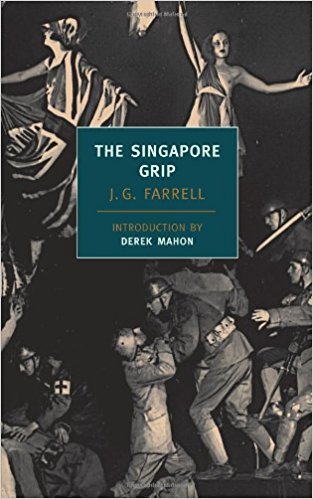
Day 1218: The Singapore Grip

Cover for The Singapore GripThe Singapore Grip is the third of J. G. Farrell’s Empire trilogy, which takes a sardonic look at various parts of the British Empire. The Siege of Krishnapur is set in the nineteenth century during the Sepoy rebellion. Troubles takes place in Ireland during the Troubles in the early 20th century. The Singapore Grip is set during the Japanese invasion of Malaya in World War II.

The novel begins in 1939. Walter Blackett is a powerful Singapore businessman whose sole concern is the profits of his company, Blackett and Webb. Despite the Allies’ need for rubber, Blackett is concerned with keeping the price up and spends his time fixing prices and manipulating the market.

His senior partner dies, and Walter awaits the arrival of Matthew Webb, his partner’s heir. Although Walter’s beautiful daughter, Joan, spends her time tormenting various young men, she readily agrees to help her father’s ambitions by marrying Matthew.

Matthew is a naive and feckless young man, whose ideals have been somewhat battered during his work for the League of Nations. Although he is chubby and unprepossessing, Joan makes a dead set for him, dismaying Ehrendorf, the previous favorite. But Matthew is more interested in Vera Chiang, a Eurasian girl who may be a prostitute or possibly a Communist or maybe neither.

This novel is peopled with Farrell’s usual peculiar characters, including a figure from Troubles, Major Brendan Archer. As Singapore begins descending into chaos, the Major attempts to organize a volunteer fire department. But his efforts are hampered by a lack of interest, as the Singaporians concentrate on selling things and the Blacketts focus all their activities on a Jubilee celebration of the company.

Farrell’s cynical look at the last years of the British in Singapore is occasionally hilarious, with a dark and deadpan humor. It also contains much to consider, as various characters discuss the benefits of colonization (whether there are any), theories of commerce, and other ideas that obsess them.

Related Posts

Troubles

The Siege of Krishnapur

The Garden of Evening Mists

Day 1217: A Footman for the Peacock

Cover for A Foot man for the PeacockA Footman for the Peacock is a strange little novel. The novel was controversial when it was first published during World War II, because it depicts an upper-class family that tries to avoid its civic duty during the war. But that activity seems almost incidental to the rest of the plot.

What is the plot? The narration flits around in time but centers on the Roundelay family. Their current configuration consists of Sir Edmund and Lady Evelyn and their household of two daughters, three elderly aunts, and three or four servants, including the retired and senile Nursie. When we finally seem to be settling somewhere, on the new Lady Evelyn’s growing acquaintance with the village and regional customs, we stay only long enough for her to hear an old running song, which Evelyn in her innocence takes to be about hunting. then we skip over to her daughter, Angela.

Angela seems to have a sensitivity to an upper-floor servant’s bedroom where the words “Heryn I dye, Thomas Picocke, 1792” are etched on a window pane. She makes an odd connection between this room and an unfriendly peacock in the grounds of the estate, which seems to be signalling Nazi bombers to destroy the house.

I guess I found this novel, which has a supernatural element, peculiar enough to be amusing, but it certainly has an unusual premise. I had more of a problem with the scattered narrative style, which took a long time to get somewhere. Ultimately, the novel becomes a story of class abuse and cruelty in the 18th century.

Related Posts

Harvest

Longbourn

His Bloody Project