Day 742: Witch of the Glens

Cover for Witch of the GlensKelpie is about fourteen or fifteen and only remembers a gypsy life traveling with Mina and Bogle. They use her to steal and read the crystal, for she has second sight. Mina keeps promising to teach her witchcraft without actually showing her any. Still, they are often accused of being witches and hounded out of town.

Then one day she pretends to fall in front of a party of young men only to find she has actually injured herself. Although they catch her stealing from them, they are amused by her and take her home with them. The young men are Ian, Cameron, and Alex, returning from Oxford to their home north of Inverlochy.

Kelpie stays at Glenfern with Ian’s family, eventually as a servant, but they treat her kindly. She begins to feel affection for the children, especially little Mairie, and is dismayed when Mina and Bogle reappear. Mina threatens to curse the family if Kelpie refuses to come with them, and since Kelpie believes in Mina’s power, she goes.

The Highlands are in turmoil because Argyll has been commissioned to secure the area for the Calvinist Covenant against King Charles. Argyll’s troops are more prone to burn villages and murder innocents than to fight armies. But Montrose is trying to raise men to fight for the king. Mina sends Kelpie on a perilous task, to steal some hair or a personal possession from Argyll so he can be hexed.

Kelpie’s adventures take her all over the Highlands. When she joins the followers of Montrose’s army, she is happy to meet Ian and Alex again, but she has seen Alex strike Ian down in the crystal, so she is wary of him.

This is an enjoyable novel for tweens and teens full of likable characters and nasty villains, some history, lots of adventure, and another feisty Watson heroine. Kelpie begins re-evaluating her moral choices through the examples of others and the kindnesses she receives during her travels.
Related Posts

Lark

The Loon Feather

Treasure Island

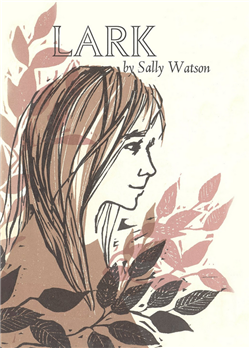
Day 715: Lark

Cover for LarkJust an aside to start. When I was in high school, I had a job at the public library. There I discovered lots of authors I may not have come across elsewhere, and one of them was a writer of books for teens and preteens who specialized in historical novels featuring likable, feisty heroines. I read every one the library had.

Years later, I would try to remember who this author was to see if I could find some of her books and discover whether I still liked them as much. But all I could remember was she had a relatively common name that started with W. I searched Amazon for children’s books with authors beginning with a W. There are a lot of them. Then one day just awhile ago, a word popped into my head, “Lark.” A Google query accomplished the rest. I found a wonderful page on a site specializing in children’s books called “Stump the Bookseller” where you could ask exactly that kind of question, and more than one person asking about the author of a historical novel with a character named Lark. The author was Sally Watson. A little more searching found she is back in print.

* * *

Elizabeth Lennox has not been called by her nickname of Lark since her Uncle Jeremiah came and took her away from her family. He always thought she would make a good wife for her cousin Will-of-God if she was just raised correctly. Since he is one of Oliver Cromwell’s officers and Lark’s father was away fighting with the Royalists, he could do what he wanted. So, he took Lark away and she has been living miserably in a Puritan household ever since. She has no desire to marry Will-of-God, whom she dislikes. She deliberately tries to appear young so that her uncle won’t realize how close she is to being marriageable.

Lark has had nowhere else to go, since her family had to leave for the continent after their property was confiscated. But one day she receives word from her sister up in Scotland, so she decides to go there, not realizing how far away the Highlands are from southern England. She sneaks out of the house in the middle of the night and sets off.

James Trelawney is a young Royalist who disguises himself as a Roundhead to run errands and pass messages in the interests of Charles II. He comes along as Lark is being accosted by a Puritan man after singing a Cavalier song on the road. James takes her for a child, for she looks much younger than her thirteen years. After tossing the Puritan into the river, he reluctantly agrees to take her north, but only because she seems to be too young to leave on her own and she won’t tell him who she is. The two of them have adventures involving intrigue, capture, travels with gypsies, and other exciting incidents.

When I reread a children’s or young adult book, I try to evaluate how interesing it is for both the adult and the intended audience. I don’t think Lark has as much to offer an adult as some of the old classics I’ve reread recently, such as The Secret Garden or Anne of Green Gables. However, I did enjoy it as a bit of light reading. It is written for girls around ten to thirteen or fourteen years old. Although I loved it as a sixteen-year-old, older teens today may be a bit too sophisticated for it. I’m not sure. Still, it has plenty to recommend it, a good background in the history and a pleasant way of presenting it—through James’ confusion about his own loyalties—adventure, humor, and light romance. It is much more innocent than many of today’s books for teens, but that’s not necessarily a bad thing.

Related Posts

Anne of Green Gables

The Loon Feather

Swamplandia!

Day 491: The Here and Now

Cover for The Here and NowI know that Ann Brashares is a popular author of books for teens and young adults, although I have not read her before. The Here and Now is a departure for her, though, because, although set in the present, it is in the science fiction genre.

Prenna and her people are from the future. They migrated back, fleeing from horrible conditions in our future, including a starving planet and a virulent disease called the blood plague that kills virtually everyone who is exposed to it. Prenna and her mother live with the others who came with them, and although they interact with “time natives,” they must obey stringent rules about staying uninvolved with them. Prenna finds this irksome and is aware of people being sent away for innocent mistakes.

Although she flies below the radar at school, Prenna has one friend, Ethan, who behaves sometimes as if he knows something about her. He does. She does not remember, but he witnessed her arrival a few years before. Prenna likes Ethan, but she is forced to keep their friendship on a superficial level.

Prenna’s contact with a homeless man sets up an unexpected chain of events. While trying to discover the cause of the man’s death, she and Ethan begin to believe they can change the course of the future by preventing one act.

I have written before about some characteristics of much young adult/teen fiction that I find annoying. One is a certain style of first-person narration that sounds too much like an adult trying to sound like a teen. It is used in this novel, only it is made worse by the preponderance of choppy sentences, especially in the dialogue. If Brashares believes teens can’t think and talk in complex sentences, she should read the dialogue in The Fault in Our Stars (which admittedly may be too sophisticated but strikes me as authentic). This tendency is worsened by the use of the present tense, almost always a poor choice for fiction.

But let’s look at the plot and characters, since those are what teens will think about. The only characters who are more than moderately developed are Prenna and Ethan. Brashares makes the mistake of believing we will automatically care about Prenna before we really get to know her. As for the other characters, Prenna’s mother is a total enigma who won’t even eat dinner with her daughter, although that is never explained. The other adults in Prenna’s group are basically cartoon villains.

http://www.netgalley.comWhether you can enjoy the plot depends on how much you can suspend your disbelief. I will just point out two things, as vaguely as possible. The first is the unlikelihood of Patient #1 of the blood plague being the same person whose totally separate act causes potential massive efforts to stop the horrible effects of global warming to be stillborn. (And by the way, I didn’t really appreciate the lecture about global warming that suddenly pops into the dialogue.) The second is the completely unbelievable results of Prenna and Ethan’s adventure.

I frankly had a very difficult time getting through this short novel. Teens may enjoy it, but I did not.

Day 487: The Book Thief

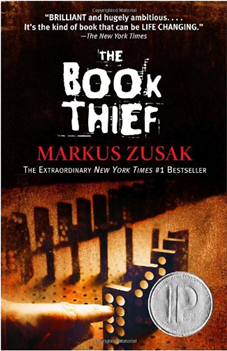
Cover for The Book ThiefLiesel Meminger is nine years old when she arrives at a house in a poor street near Munich. Her mother has given her and her brother up to a foster family because she cannot support them, but her little brother died on the train on the way there. She is dirty and illiterate, and when she arrives at the house of Hans and Rosa Hubermann, she has to be coaxed to come inside.

Although the Hubermanns prove to be loving parents and Hans eventually teaches Liesel to read, it is 1939 in Nazi Germany. Slowly, the difficulties of living in the Third Reich and the hardships of war will affect everyone she knows.

Liesel has already stolen her first book, when a grave digger dropped it the night her brother died. She steals her second book from a fire on the night of a book burning, for small and even large acts of defiance have become a part of her nature.

Zusak depicts a vivid life within Liesel’s little community. The boy that becomes her best friend, Rudy Steiner, has already distinguished himself before they meet by covering himself with soot and pretending to be Jesse Owens during the 1936 Olympics. Hans Hubermann is a failing painter and virtuoso accordion player who is ultimately too kind for his own good. His gruff wife Rosa shows her inner kindness by forcing people to eat her dreadful soup.

The novel is told by Death, which acts as an omniscient narrator, sometimes telling the back story, sometimes giving a glimpse of the future. At the beginning of the book, I thought I was going to find this irritating. By the middle of the book, I was wondering if it added anything that a traditional narrator wouldn’t provide. By the end, I thought it was effective. One little quirk of style that bothered me a little, though, was that Zusak occasionally creates his own words when perfectly good ones that are very similar already exist, like lovelily instead of lovely. I think this is an affectation that adds little to the novel.

The Book Thief accomplishes an unusual goal—to show that there were decent Germans during World War II. One of the kind and dangerous things that Hans Hubermann does is shelter a Jew, Max Vandenburg, in his basement for months. Liesel’s relationship with Max forms a core part of the story.

This novel is involving and affecting. It does have a few difficult scenes, but I think that it is a very readable experience for tweens, teens, and older readers. It has been wildly popular, so obviously readers are enjoying it.

Day 481: St. Lucy’s Home for Girls Raised by Wolves

Cover for St. Lucy'sDifficulties of youth and adolescence are the themes of Karen Russell’s unusual collection of short stories. Many of them are set in the Florida Everglades among bizarre and tacky theme parks or tourist destinations, where children sled through the sand on crab shells or visit enormous conches.

The first story, “Ava Wrestles the Alligator,” provides an introduction to the two sisters who are more fully developed in Russell’s later novel Swamplandia! Abandoned momentarily at their Everglades theme park home, Ava has a murky encounter with the Bird Man and tries to rescue her sister Osceola from her ghost lover. That story is expanded in the novel, which I really enjoyed.

Although certainly all are unusual, some of the stories are more bizarre than others. In “from Children’s Reminiscences of the Westward Migration,” a 19th century family makes a difficult crossing west, their wagon pulled by their father, the Minotaur. In the title story, human children of werewolves are sent away to be raised by nuns so that they can have a better life than their parents.

Russell’s stories are at once peculiar and oddly touching, full of young misfits who are even more out of place than all adolescents think they are. At times funny, such as the descriptions of the wolf-girls’ canine behavior when trying to adjust to their new school, the stories all reverberate with longing. Russell’s writing is brilliantly fierce and original, sparked by her own peculiar vision.

A few of the stories felt to me as if the author was just trying to think of the strangest ideas possible, and she almost lost me in “Lady Yeti and the Palace of Artificial Snows.” But ultimately, I enjoyed the stories, although I prefer the more developed characters and plot of Swamplandia!

Day 477: The Fault in Our Stars

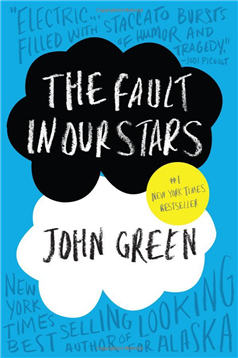
Cover for The Fault in Our StarsBest Book of the Week!
It seems as if I have read more books lately from which I do not get a sense of the characters’ personalities. I don’t feel as if they could be real people but just projections of the author’s plot. But that is not the case with The Fault in Our Stars, which creates for us some unforgettable personalities.

Hazel Lancaster is a sixteen-year-old with thyroid cancer that has spread to her lungs. Unlike the other kids in the support group her mom has talked her into attending, she doesn’t have any hope of survival. She just wants to live as long as she can. At the group, she meets Augustus Waters, a seventeen-year-old ex-basketball player who has lost one leg to osteosarcoma but has a generally good prognosis.

Hazel is witty, smart, and well read. She is obsessed with a novel called An Imperial Affliction by Peter Van Houten, which is about a young girl suffering from a fatal illness, and literally ends in the middle of a sentence. As she and Augustus discuss their favorite books, Hazel explains that she just wants to know what happened to everyone else in the novel. Augustus decides to use his wish from the Genie Foundation to take Hazel to Amsterdam, where she can meet Peter Van Houten and find out what happened after the novel ended.

This novel is about teenagers falling in love, and rarely has fiction depicted two more appealing people. My one very small criticism is that they are scarily smart and funny, in intelligence reminding me more of Salinger’s Glass family than of normal kids. But Green has got the juvenile speech patterns down.

Frightfully well written, touching, funny, and ultimately sad, this novel has much to offer teens, young adults, and adults. Hazel and Augustus are affectingly human, and even Hazel’s parents, those cumbersome quantities so often ignored or eliminated in children’s or young adult fiction (note, for example, how much we see of Bella’s father in Twilight), are deftly characterized by their affectionate jokey interactions with Hazel.

Again, I feel that my capabilities are stretched here in my inability to adequately express how good this novel is. When I first started reading it, I was afraid of manipulation, as there seem to be a lot of “affliction of the month” children’s books out there right now, but that feeling left me almost immediately.

Day 472: Miss Peregrine’s Home for Peculiar Children

Cover for Miss Peregrine's Home for Peculiar ChildrenThe inception of this novel is extremely creative. Ransom Riggs began collecting unusual old photos from bins in resale shops. Then he became acquainted with similar collections owned by other people. He noticed that many of the more interesting photos were of children and decided to write a story around them (some having been lightly edited).

Jacob Portman has grown up hearing his grandfather Abe’s stories about life in a children’s home during World War II after he escaped the holocaust. These stories featured children with seemingly magical abilities all staying in a lovely school on an island off Wales. As he grows older, he dismisses these stories as fairy tales.

Now Abe is getting paranoid and senile, and 16-year-old Jacob is trying to keep his parents from putting him in a home. One day Abe calls Jacob demanding the key to the arsenal of weapons he keeps in his shed. Jacob’s father has hidden the key for fear his father could be dangerous. When Jacob arrives at his grandfather’s home, the old man is dead, and in the woods Jacob thinks he sees a monster with tentacles in its mouth.

Jacob suffers from horrible nightmares after this incident, so his parents put him into treatment with a Dr. Golan. Not so sure he was hallucinating, Jacob decides he wants to travel to the island in Wales and try to find out about his grandfather’s past. His father agrees to take him only after Dr. Golan decides it is a good idea. When Jacob arrives on the island, though, all he can find is a ramshackle old house destroyed in a World War II bombing containing a chest full of odd photographs of children.

Of course, there is more to it than that, and eventually we find ourselves back in the past and in the requisite battle of good against evil. That’s where the creativity of this novel breaks down for me. I love the Harry Potter books, which also have this theme, but they have a richness of detail and originality that is lacking in many other works in this genre. Perhaps I am a poor audience for books written for teens, too, for I often feel they lack fullness of characterization and have a certain first-person teenage narrative style that I find irritating (adult author pretending to be a teenager). This novel also callously discards Jacob’s parents, those too cumbersome quantities for fiction for this age. First, the parents are flat ciphers, and finally we leave them behind altogether.

This is not to say, though, that older children and teens won’t enjoy this novel. I think they will, and they’ll be entertained by looking at the pictures. I think young children could get nightmares from some of them, though.

Perhaps this is unfair, but I’m an adult, and I’m only going to give the best reviews to books that entertain me as an adult, even if they’re for younger people. That’s a high standard but one that is possible to meet and that is a characteristic of the best children’s and young adult fiction.

This book was written to have a sequel, by the way, so don’t expect the ending to be neatly wrapped up.

Day 404: Swamplandia!

Cover for SwamplandiaBest Book of the Week!

Swamplandia! is the third book I’ve read in the past few months that has a strong young female voice (with Tell the Wolves I’m Home and Where’d You Go, Bernadette). All of them were very good.

Before I start, though, a comment on the cover for the hardcover copy of the book, which is not the one I read or the one shown here. I was not really clear about whether this book is considered appropriate for young adults or not (probably), but the hardcopy cover makes Swamplandia! look like a children’s book, showing a very young girl piggyback on a character who looks somewhat like the Mad Hatter, both watching an alligator. Let me warn you that Swamplandia! is definitely not for young children.

Thirteen-year-old Ava Bigtree and her family live on an island in a hokey-sounding amusement park in the Florida Everglades called Swamplandia! There, they dress up as Native Americans (their grandfather, who founded the park, was a German-American farmer from Ohio) and breed and wrestle alligators. Ava’s mother Hilola was the main attraction until she became ill with cancer and eventually died.

Since then the family has tried to cope with its grief while also attempting to save the floundering park. Homeschooled and with little contact with the mainland, the Bigtree kids have been raised in a sort of dream land. They all possess a thorough and subversive knowledge of the history of Florida and of its flora and fauna but not many skills for dealing with the outside world. Kiwi spends almost all his time reading, Osceola believes she has a ghost lover, and Ava is aiming to become a world-famous alligator wrestler.

When tourists stop arriving on the ferry, Chief Bigtree, the children’s father, makes one of his mainland journeys to raise money to save the park, but not before Kiwi apparently abandons them to get a job with the park’s competitor, The World of Darkness. Sixteen-year-old Osceola and Ava are left alone on the island until Osceola floats away on an old barge to join her lover.

Frantic to save Osceola, young Ava joins up with a mysterious man named the Bird Man, who claims to know his way into hell, which is where Ava assumes she must go to bring Osceola back from her ghost lover. As our apprehension grows, we follow Ava’s journey while periodically cutting over to observe Kiwi’s serio-comic adventures at the hell-themed World of Darkness.

Russell creates a lush world in Swamplandia! and a compelling narrator in the innocent/wise Ava. The language of the novel is gorgeous, its heroine engaging. You will find yourself immersed in a damp world bursting with life, and you won’t want to leave it until you know what happens to Ava.

Day 373: Tell the Wolves I’m Home

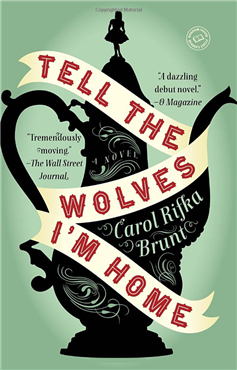
Cover for Tell the Wolves I'm HomeBest Book of the Week!

Although I think Tell the Wolves I’m Home is classified as a young adult novel, it has much to offer adults, too, in reading pleasure. Carol Rifka Brunt gives us a novel in which the voice of the narrator is so strong and the sense of her personality so developed that it is really outstanding.

Fourteen-year-old June Elbus is an unusual girl–a loner who likes to go to the woods and pretend she is living in the middle ages. She loves her Uncle Finn more than anyone and believes he is the only person in the world who understands her. She used to be close to her older sister Greta, but for some reason Greta has started treating her badly. So, when Finn dies of AIDS, June feels as if she has no one. The situation is made worse because it is the 1980’s, and no one understands the virus.

Something strange happens at Finn’s funeral. A man June has never seen before appears and tries to get her attention, but her sister hustles her away. Days later her uncle’s favorite teapot arrives for her with a note in it. The writer explains that he is a friend of Finn’s and asks to meet her. But Greta has told her that this friend, Toby, killed Finn.

A problem is posed by the portrait Finn spent the last months of his life painting. It is one of June and Greta, although Greta acted as if she didn’t want to sit for it. The Elbuses have the portrait in their living room until an article appears about lost works of art, including a picture of the portrait and reporting that its title is “Tell the Wolves I’m Home.” Until then, June didn’t even know her uncle was a famous artist. And who could have photographed the portrait and sent the article to the magazine?

June agrees to meet Toby but becomes jealous of him when she realizes how close he was to Finn. She is shocked to find they were partners for nine years, and she never knew he existed. June is torn because of her ambivalent feelings about Toby and the fact that they are keeping their acquaintance a secret from her parents, until she finds a note to her from Finn in a book, asking her to take care of Toby because he has no one.

Infused throughout with the voice of its teenage narrator, a girl like so many others struggling with feelings of self-doubt, trying to figure out what is right, this novel is beautiful and moving without being in the least sappy. It is really a wonderful book.

Day 236: The Loon Feather

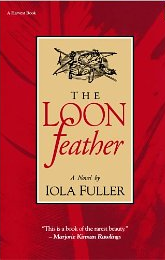
Cover for The Loon FeatherBest Book of the Week!
The Loon Feather by Iola Fuller is one of my favorite books from when I was a girl, and I still read it every few years. A fascinating story set on Mackinac Island, it compelled me to visit every spot mentioned when I was on the island during a vacation.

Set in the early 1800’s, the book starts with the birth of its heroine Oneta. She is Ojibway and the (fictional) daughter of Tecumseh, the famous Shawnee leader. A prophecy at her birth says that she will bring a husband to her people who will be more powerful than a warrior. No one knows what that means, but prophecies are apparently always right.

The beginning of the book traces the seasonal nomadic life of her people, followed during her early childhood. Tecumseh is killed fighting for the British against the Americans in the War of 1812 when Oneta is young, and she is raised by her mother and her grandfather. A wise woman, Marthé, is also important to her as a young child, but Marthé leaves them all to marry a French trapper.

The Ojibway make a yearly trip to Mackinac Island, where part of the settlement from the war is payment of reparations from the Americans. The island is a fascinating mix of Native American, French, and American cultures. Here Oneta and her mother encounter Marthé, who lives on the island with her husband and young daughter, and they gladly visit back and forth. But before the tribe departs for the year, Oneta’s mother becomes ill, and Oneta is left there to care for her until her grandfather returns the next year. After Oneta’s mother recovers, she works as a maid up at Fort Mackinac and meets a French accountant for the Astor Fur Company, Pierre, who marries her.

At first we see things only from Oneta’s point of view as a Native American. As Pierre’s fastidiousness and different tastes clash with his bride’s customs, misunderstandings arise. However, Oneta is eventually sent away to a convent school to be raised as a French girl.

When she returns to the island as a proper young woman, she is at first inclined to disdain her true heritage and must find a balance between it and what she owes to Pierre and Madame, his mother. She also witnesses the struggles of Pierre and her younger brother Paul, who prefers his Native American roots and envies Oneta her heritage.

The colorful setting is populated by French voyageurs, American soldiers and capitalists, and the Native American tribes, who begin to become aware how the workings of history are fundamentally changing their way of life.