Day 318: Cathedral of the Sea

Cover for Cathedral of the SeaCathedral of the Sea was written to relate some of the history of Barcelona and of the Church of Santa Maria de la Mar. Unfortunately for Ildefonso Falcones’ readers, even though there is some fascinating material here, this purpose is all too obvious.

The novel begins with Bernat Estanyol’s wedding. Because of his father’s foresight in making a will, Bernat is allowed to keep his father’s property on his death. Otherwise, it would be forfeit to his lord, as Bernat is a serf. Left relatively prosperous, Bernat decides to marry a shy girl named Francesca. However, on the night of the wedding, his lord chooses to exercise his droit de seigneur, his right to deflower the bride. He follows this act up by forcing Bernat to rape her, too.

This horrible start to their marriage shows no sign of improving after Bernat’s son Arnau is born, and more atrocities follow. Eventually, to save his son’s life, Bernat flees the land, making for Barcelona, where, if he can live for a year and a day without being recaptured, he can become a free man of the city.

The growing Arnau soon becomes the novel’s main character, and he has many hardships to overcome. Missing a mother, he becomes fascinated with the image of Mary at the Santa Maria de la Mar, which is just being built as a cathedral for the common people. The novel follows Arnau’s life and the building of the cathedral together.

Well, sort of. The book’s jacket compares this novel to Ken Follett’s Pillars of the Earth, but there is really very little comparison. The cathedral is only brought into the plot periodically when needed or when Falcones wants to tell us something about it.

And that’s the problem with the entire book. Although the novel deals with the themes of the medieval caste system and the problem of justice for common men, and also treats of the special rights of the area, everything is driven by the plot. Even with a third-person omniscient narration, we seldom learn what anyone is thinking unless it is important to the plot. Characters are not so much developed as given things to say and do.

The plot itself has no focus. When I read at the end of the novel that Falcones followed the Crónica written by King Pedro the Third, that explained a lot. To show this history, Falcones must put his main character through some contortions. Beginning as a bastaixo, one of the men who unload ships and carry their cargo into town on their backs, Arnau runs off to war and later becomes a money lender, an extremely unlikely sequence of careers.

Characters appear as needed, disappear, and then pop up again when they’re needed. This might make sense for some characters but not for all of them. Women are uniformly raped, die from the plague, become prostitutes, or are otherwise mistreated, as if Falcones doesn’t know what to do with them except have something terrible happen to them.

One of the worst instances of this treatment is of Maria, Arnau’s cardboard wife. (The rest of this paragraph is a spoiler.) During all the first years of their marriage, Arnau is involved in a torrid affair with another woman. Arnau wants to leave this woman, but she threatens to tell his guild, which will expel him for immoral conduct, so that he has no work. Arnau goes to war to get rid of her, and when he finally sheds his mistress, do we have scenes of everyday married life? No. We immediately jump five years, and within two pages Maria dies of the plague.

Finally, we come to Joan, Arnau’s adopted brother. Treated with nothing but kindness and love by Bernat and Arnau despite a rocky start in life, he becomes a priest, after which he disappears for years. When he returns, he has suddenly become a hard, self-righteous right hand of the Inquisition.

My conclusion? Falcones is clearly not an able enough storyteller to skillfully handle a complex plot and many characters.

Day 317: Medusa

Cover for MedusaMedusa is the first Aurelio Zen mystery I read after seeing the series on Masterpiece Mystery!, and I found it to be well written and entertaining.

Aurelio Zen is sent north to the Italian Alps, an area on the far reaches of the known universe as far as he is concerned, because a decomposed body of a man was found in a disused military tunnel. The body has a mysterious tattoo, which could be important, but the corpse disappears from the morgue overnight.

Once the body is identified, it turns out to belong to a soldier who supposedly died in a plane crash 30 years ago. It gradually becomes clear that this mystery has to do with events during or just after World War II. To his dismay, the dapper Zen finds himself clambering around in the cave with the Austrian spelunker who discovered the body.

The narrative alternates between Zen’s attempts to unravel a tangle of clues and the thoughts of some older men who know more about what is going on. It appears that someone is trying to protect a secret, and the secret may have to do with a clandestine group that exists within the army.

As always, Zen’s cynicism about the powers that be in the government and the police force (and in this case, the army) is amusing, and Dibdin seems to get a special pleasure from subjecting the finely dressed detective to scenes where he has to climb around in wet, dirty places.

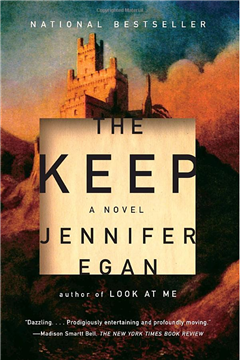
Day 316: The Keep

Cover for The KeepI only recently discovered the pleasures of reading Jennifer Egan when I read Look At Me last year. The Keep is another of her very interesting novels. Her most well-known novel, which I have on my list to read, is A Visit from the Goon Squad, which won the National Book Critics Circle Award.

Danny is an aging hipster who has long occupied the edges of power looking for a way to get some for himself. He is on his way to Europe to take up an invitation extended by his cousin Howard to help develop an ancient castle into a hotel.

Danny is anxious about accepting this position because of his guilt and paranoia over a horrible childhood event, when his older cousin talked Danny into abandoning Howard in a deep cave. However, Howard’s invitation comes at a time when Danny urgently needs to get out of New York, so he goes.

After an unsettling arrival at the half-renovated castle, which contains opulence and filth within rooms of each other, Danny meets an almost unrecognizable Howard, his wife Ann and their two young children, his second-in-command and best friend Mick, and other assorted workers. Living in the keep of the castle is a mysterious old baroness who thinks she still owns the castle. A creepy feature of the property is a dark, reeking pool that may be haunted by two twins who drowned in it.

Back in the states, Ray, a prison inmate, is taking a writing class and begins reading aloud his story about a guy named Danny who journeys to Europe to help his cousin develop a castle into a hotel. Discovering the connection between the two stories, and a third one involving the writing class teacher, is part of the pleasure of reading this deeply involving novel. Egan moves the narrative back and forth in time to tell these two parallel stories, keeping the reader’s interest with consummate skill.

Day 315: Beyond Black

Cover for Beyond BlackI have liked almost everything I have read by Hilary Mantel but could not finish Beyond Black. It is supposed to be extremely black humor, which I usually enjoy, and the idea is certainly an entertaining one, but somehow I felt it went too far, at least for me.

Alison is a medium who travels the rounds of the psychic “fayres.” She actually does see and hear the dead. Alison meets Colette, an event planner, who she hires as her personal assistant. Soon, the two women are sharing a house in a suburban wasteland, where apparently all hell breaks loose. (I did not get this far in the novel.)

Mantel’s skewering of the “fayres” is amusing. Another clever idea in the novel is that the dead are a bunch of seedy characters obsessed with trivial things, just as are many people in life. However, after awhile the sheer bulk of the trivialities becomes overwhelming.

Alison’s spirit guide, Morris, instead of being the traditional Indian chief or swami, is the ghost of an actual hoodlum Alison knew when she was young. I could deal with the spirits constantly talking about minutia, but Morris was incredibly repulsive and disgusting. With the mundanity going over the top combined with my disgust at Morris, I stopped reading.

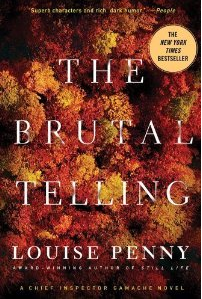
Day 314: The Brutal Telling

Cover for The Brutal TellingI was unable to judge the difficulty of this mystery because I read its sequel first and therefore knew how the mystery would be solved. The other Louise Penny books are not quite so dependent upon sequence, but I suggest that you read The Brutal Telling before Bury Your Dead, if at all possible.

That being said, I still found the novel to tell a compelling story.

A body is discovered in the bistro/antique shop of the small village of Three Pines. The bistro owners, Gabby and Olivier, are appalled but also confused. No one knows who the man is or where he lives. At least they say they don’t, but the reader knows from the first that Olivier knows more about the man than he is saying.

Inspector Gamache and his team quickly determine that the victim was not killed in the bistro. Soon, they find a cabin deep in the woods that apparently belongs to the man, apparently a hermit. They are amazed to find it stuffed with priceless antiques, first edition books, and treasures from Europe thought to have disappeared during World War II. Gamache begins wondering how Olivier has made such a success of the antiques side of his business. And where did Olivier, or for that matter, the victim, come from in the first place?

Louise Penny’s novels always have more going on in them than the mystery. The setting of the small village is beautiful. The characters are interesting, and we learn more about them with each visit. Gamache is warm and perceptive. As always, I think the covers of the paperback editions should win a prize for most beautiful artwork.

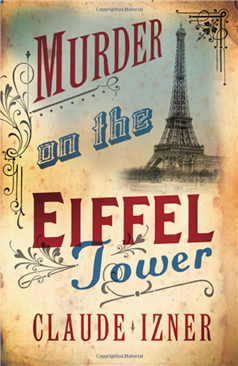
Day 313: Murder on the Eiffel Tower

Cover for Murder on the Eiffel TowerThis mystery set at the opening of the Eiffel Tower has a nice sense of history and is well written, but like mysteries written early in the genre (which it is not), it depends almost entirely upon determining opportunity. There is no indication of motive until the lengthy written confession at the end of the novel–standard early detective fiction nonsense–that is, charming in earlier fiction, but not so much now. This novel was published in 2009.

People begin being killed by “bee stings” on or near the Eiffel Tower the day before Buffalo Bill arrives in Paris for the opening of the 1889 World Exposition. Bookseller Victor Legris starts looking into these incidents after he notices that Kenji Mori, his father figure and business partner, met with more than one of the victims near the time they were killed. He also begins to fear that the woman to whom he is attracted, Russian illustrator Tasha Kherson, could be involved.

I found Victor to be silly, not very good at investigating, and prone to overlooking clues. Many secondary characters are only sketchily drawn and therefore difficult to keep straight. So for me, despite all its promise and its setting in an exciting period of time, Murder on the Eiffel Tower was not a success.

Day 312: Castle

Cover for CastleEven from the first moments of reading the unusual Castle, the novel seems to be about more than is on the surface. That notion turns out to be the case.

Eric Loesch returns to the town where he grew up and buys a large piece of property outside of town. Then he starts fixing up the farm house. He almost immediately becomes fixated on a large rock on the property and eventually finds the ruins of a castle behind it.

This activity seems all very straightforward, but something more is going on, we’re sure. Loesch is an unusual man, as demonstrated throughout by his thoughts and actions. His reactions to seemingly ordinary conversational gambits seem extreme. His emphasis on privacy seems excessive. We also feel, although we don’t know why, that he may have a military background.

Castle is a novel that unfolds slowly but keeps your attention throughout. It becomes clear that there are painful incidents in Loesch’s past, but the novel takes its time getting to them, and Loesch seems to be in denial about some of them.

The writing is skillful, particularly in delineating Loesch’s character through his behavior. In fact, I don’t know when I’ve understood the personality of such an unusual character so particularly before without the author actually telling me about it.

The revelations at the end of the novel are not, for the most part, foreseeable, although I could eventually predict at least one important plot point. All-in-all, Castle is a disquieting, dark tale.

Special Post. Change of Pace

Magic of ReadingTo start out today on a different note, I’d like to post a picture of this beautiful painting called The Magic of Reading. This picture appeared today on the Texas Education Agency web site, and is student art, by Elvina Almeida of the Dealey Montessori Vanguard and International Academy, in Dallas.

Day 311: Lords of Misrule

Cover for The Stewart TrilogyNigel Tranter was a historian and a prolific historical fiction writer whose work can be uneven. During the 1950’s through 1990’s he wrote more than 60 historical novels, some of which employ dialogue and characterization only to drive the plot forward. Such is not the case, however with Lords of Misrule, the first book in his Stewart Trilogy, a novel that is fully realized.

Jamie Douglas is a young esquire to the Earl of Douglas, the most powerful man in 14th century Scotland, certainly more powerful than the King, Robert II, a sorry descendent of Robert the Bruce and doddering old man who just wants to be left alone. The King has spawned a clutch of squabbling Stewarts who are waiting to see what happens when he dies. Unfortunately, his oldest son, John, seems unsuited to power, and his second son, Robert, is ambitious and dangerous.

When Jamie’s lord is foully stabbed in the back by his own armorer during battle, Jamie fears that any of several powerful men may have had enough to gain in the subsequent power vacuum among the Douglasses to have suborned the armorer. But when Robert Stewart, acting as his father’s Governor, appoints his good friend Archie Douglas to take the position of Earl, Jamie’s suspicions point to Robert.

Jamie and some other men lie in wait outside the armorer’s home after they figure out where he is hiding, in hopes they can capture him and question him about who paid him to murder the Earl. Their plans go awry, however, ultimately sending Jamie Douglas north in pursuit of another man, to the Highland territories of the dreaded Alexander Stewart, Earl of Buchan, known as the Wolf of Badenoch.

This novel provides a fascinating glimpse into the rivalries and political in-fighting among the early Stewarts. It has an appealing protagonist, although Jamie is a bit too honest and outspoken for his own good. It also includes a romance, as Jamie is drawn to two different Stewart women while serving a third, his Earl’s widow. Having learned most of my Scottish history from the excellent historical novels of Dorothy Dunnett, I am not accustomed to thinking of Douglasses as heroes, but Jamie makes a good one.