Day 819: The Winter People

Cover for The Winter PeopleReading two books by Jennifer McMahon doesn’t make me an expert on her, but they do have something in common. They both show a fascination with the supernatural and the grotesque.

Like her more recent book The Night Sister, The Winter People is set in Vermont. It takes place in two time periods, the present and 1908.

In 1908, Sara Harrison Shea lives with her husband and daughter on a barren farm near a landmark called the Devil’s Hand. Sara was raised by a Native American woman she calls “Auntie,” whom the nearby villagers visit for potions and spells. We know from the beginning of the novel that she died a terrible death and that parts of her story are recorded in her diary, which has pages missing. In the village of West Hall there have long been legends of “Sleepers,” people who are brought back from the dead.

In the present time, teen Ruthie returns late from a date to find her mother, Alice, gone. When Alice hasn’t returned by the next day, Ruthie and her little sister Fawn begin looking through the house for clues to where she has gone. In a series of hidey holes, they find some strange things, a gun and the wallets of two people from Connecticut. Since the countryside around West Hall is known for people’s disappearances and the Devil’s Hand at the edge of the farm is supposedly haunted, Ruthie begins wondering what her mother could be involved in and doesn’t call the police.

Katherine is grieving the death of her husband, Gary. He had been distraught since the death of their son, but recently things seemed to be better. Then he told her he was going to Cambridge to photograph a wedding but died in a car accident in Vermont. What was he doing there? When Katherine gets back his charge receipts, she finds he ate lunch in West Hall, so she decides to move there to try to find out what Gary was up to.

McMahon builds up quite a bit of suspense in this novel, often from small things like the tapping on a closet door. The novel centers around a series of grief-stricken people and the belief that people can come back from the dead. Can they? And if so, in what form?

Related Posts

The Night Sister

The Night Strangers

Wylding Hall

Day 818: The Making of a Marchioness

Cover for The Making of a MarchionessBest book of the week!
Although The Secret Garden was one of my favorite childhood books, I had no idea that Frances Hodgson Burnett also wrote novels for adults until I read a review of The Making of a Marchioness. The Preface points out that Polly references it in Love in a Cold Climate, but there Burnett’s name isn’t mentioned. In any case, I’m happy to report that it is a delightful novel.

The Making of a Marchioness combines a Cinderella story with a realistic description of an evolving marriage. It has been called “a romance between two unromantic people.” It also has a bit of peril mixed in.

Emily Fox-Seton is a woman in her 30’s of good birth but very poor. When her parents died, her more fortunate relatives made it clear they couldn’t be bothered with her. So, she has created a business of doing small tasks and running errands for her wealthy clients. She has the happy characteristic, though, of being a positive person who perceives kindness everywhere.

Lady Maria Bayne enjoys both Emily’s company and her utility, so she invites her to Mallowe for a house party in August, thinking Emily can help with the arrangements for her annual féte. Emily is delighted to leave the city in summer and soon becomes interested in the competition among three guests to snare Lord Walderhurst, a 50-year-old widower who is also a marquis. She finds herself rooting for Lady Agatha, a beautiful girl from a poor family that has several daughters to marry off.

Lord Walderhurst, though, likes the open expression in Emily’s eyes and her happy, busy ways. To Emily’s astonishment, he proposes, and she gladly accepts.

But that is only the beginning of the novel, about how gratitude and love can provoke love in its turn. Some piquancy is added by a plot development that puts Emily in danger from her husband’s heir, who has always considered Walderhurst’s vast estates as almost his.

This is a lovely novel that brought tears to my eyes. Its characters are prosaic but nice (except the heir). Even selfish Lady Maria is quite lovable. The writing is beautiful, and Emily’s story is touching.

By the way, a recent television adaptation of this novel, titled The Making of a Lady, follows the plot with some changes, but it wildly miscasts the two main characters, making them both younger and more attractive than they’re supposed to be in the novel. Still, I marginally enjoyed it.

Related Posts

Persuasion

Love in a Cold Climate

Major Pettigrew’s Last Stand

Day 817: The Hornet’s Nest

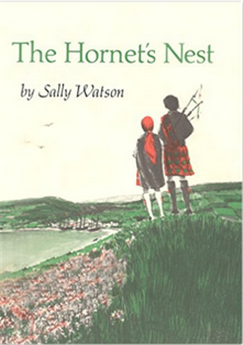
Cover for The Hornet's NestIt is 30 years after the Battle of Culloden, but Highland Scots are still forbidden by their English overlords to wear the plaid, play bagpipes, or honor their heritage in other ways. Rebellious Lauchlin MacLeod and her brother Ronald, teenage children of Laird Kildornie, are always finding themselves in trouble.

So it is on the day they meet their cousin Matthew Lennox, a gentleman from Virginia journeying to visit his English and Scottish relatives. Lauchlin is marveling that this Sassenach is related to her family and doesn’t realize he has been escorted there by a troop of redcoats. She just barely avoids being caught wearing a kilt while her brother hides in the bushes with his bagpipe.

In town showing Cousin Matthew the sights, Ronald and Lauchlin attack some boys who are torturing a kitten. Later Sergeant Tucker arrives at their home to tell them that the boys are the children of Captain Green, the new area commander. The boys have lied about the cause of the attack, and Captain Green isn’t as likely as the previous commander to overlook their behavior. The next incident could be serious.

Cousin Matthew has a solution. Lauchlin and Ronald can travel to Virginia and live with his sister Lavinia until things calm down. Secretly, he enlists them to send news and drawings, for Lauchlin is a gifted caricaturist, about doings in the colonies for a paper he is founding in London called The Gadfly.

So, Lauchlin and Ronald set out for the colonies accompanied by their kitten Haggis. They arrive in Williamsburg in 1773, just in time to witness the lead-up to the American Revolution. It’s not too difficult to imagine where their sympathies lie.

This novel effortlessly mixes the viewpoints from both sides of the revolution, for their Lennox relatives are Loyalists, and some are charming characters. Lauchlin is an ebullient scamp, Ronald a boy who must learn that all Sassenachs are not the same. Their many Virginian cousins dislike them at first but then most of them learn to love them. And Haggis has his own distinctive personality.

This novel is one of my favorites so far of the Watson books I’ve newly discovered, because it is less unlikely than some of them and has really enjoyable characters. Plus, it provides an unusual viewpoint of the American Revolution. Young teens and tweens should love this book.

Related Posts

Witch of the Glens

Lark

Mistress Malapert


Day 816: Literary Wives! The Kitchen God’s Wife

Literary Wives logoToday is another review for the Literary Wives blogging club in which we discuss the depiction of wives in modern fiction. Be sure to read the reviews and comments of the other wives! If you have read the book, please participate by leaving comments on any of our blogs.

Emily of The Bookshelf of Emily J.
Lynn of Smoke and Mirrors
Naomi of Consumed By Ink

My Review

Cover for The Kitchen God's WifePearl has been keeping a secret from her mother, Winnie. She was diagnosed with muscular dystrophy and is trying to avoid the fuss she is sure her mother will make by not telling her as long as she is mobile. She is dismayed, then, to learn that her cousin Mary has told her own mother, Helen, Winnie’s best friend.

At a family engagement party, Helen tells Pearl that she has a brain tumor. She says she’s sure she is going to die and doesn’t want to go keeping secrets, so she will tell Winnie Pearl’s secret unless Pearl does.

When the two women sit down to talk, it turns out Winnie has secrets, too—a whole life before she came to San Francisco from China and another marriage before her marriage to Jimmie Louie. Winnie’s story makes up the bulk of the novel.

Winnie’s unhappy life begins when she is six and her mother leaves. She never finds out what became of her mother, but Winnie herself is banished from her wealthy father’s house to be raised by aunts. In her aunts’ home, she is given a lower status than her cousins. This even applies to her marriage. She acts as a go-between for her cousin Peanut and Peanut’s suitor, Wen Fu, and then is surprised when Wen Fu asks for her own hand. But she learns later that her aunts have deemed Wen Fu’s family not good enough for Peanut.

And they are not good. They strip Winnie of all her possessions and sell them. Once she sees what they are, she manages to hide away a dozen sets of silver chopsticks. Those are the only things she is able to keep. Worse, Wen Fu is physically and sexually brutal. Along with these difficulties and Winnie’s lack of rights are the hardships imposed by the Second Sino-Japanese War and World War II.

The difficulties between Winnie and Pearl and those between Winnie and Helen serve as the framing of the story set in the past. It is this story that is most interesting, even though I never really warmed up to Winnie. What I found most interesting in this novel were the ways of thinking and the customs of pre-revolutionary China.

What does this book say about wives or the experience of being a wife?

Three marriages are described in this novel, but the most time is that spent on Winnie and Wen Fu. This is a classic abusive relationship, where Wen Fu rapes and terrorizes Winnie, including putting a gun to her head, and Winnie thinks it is her fault. The novel focuses on Winnie’s growth of understanding—that her marriage is different than others’ marriages, that she can stand up for herself by leaving. (Her other attempts to stand up for herself are disastrous.)

There is much less focus on the marriage of Pearl and Phil. We learn that they have tacitly taken the easy way on things, that is, not much confrontation or arguing, partially because of Pearl’s disease. Pearl knows, for example, that Phil disapproves of how easy she is on her girls, but it is important for her to avoid stress. All-in-all, they seem to have a good marriage with the usual minor disagreements, like whether they have to attend her cousin’s engagement party.

The marriage between Winnie and Jimmie is the least explored, as Jimmie is long dead in the present-day story, but it seems to have been a happy one. At the beginning of the novel, Winnie is hurt that Pearl has never seemed to grieve for Jimmy. She doesn’t realize that Pearl’s teenage anger was an expression of her grief. Winnie seems to nearly hero-worship Jimmie, but of course compared to Wen Fu he was an angel.

In what way does this woman define “wife”—or in what way is she defined by “wife”?

This is always the hardest question for me, because unless an author is writing an allegory, nothing about a character should define a whole category of people. Maybe we can say here that as a young girl and according to her culture, Winnie believes that a wife is ruled by her husband. She is naive enough about sex to not realize that some of the things Wen Fu wants to do are not normal practices. So, Winnie suffers, I think, because of a lack of rights for women in China at the time but also because of what her culture and upbringing have taught her—and have not taught her.

The title of the novel speaks to this question. The Kitchen God was a man who left his wife for another woman and then lost everything. When he was a poor, sick man, his wife took him in. After his death, he was rewarded for repenting by being made a minor god. Winnie expresses her disgust for the notion that the husband was rewarded for his bad behavior while the wife’s name was not even passed down in the legend. This is a notion she has had to develop as her notions of marriage change and she develops her own ideas of how women should live.

Related Posts

Shanghai Girls

Snow Flower and the Secret Fan

The Ten Thousand Things


Day 815: No Ordinary Time

Cover for No Ordinary TimeNo Ordinary Time tells of the contributions of Franklin and Eleanor Roosevelt to the conduct of the United States before and during its participation in World War II. The book relates how Franklin Roosevelt exercised his acute political awareness of public opinion to nudge the U.S. out of isolationism during the war, foreseeing as he did how the world would be changed if Germany succeeded and how assisting England against the Axis powers allowed the U.S. to ramp up for war. While Roosevelt was concentrating on the war, Eleanor remained his social conscience, attempting to hold on to the social advances of the New Deal, taking up the causes of women and their right to work and of African-Americans and their right to equal treatment.

The book also treats of the relationship between Franklin and Eleanor. Although they were always friends and companions, Eleanor had been devastated much earlier in their marriage to find out that Franklin had been having an affair with her own secretary, Lucy Mercer. This discovery ended certain aspects of their marital relationship. Eleanor’s relationship with her mother-in-law was difficult, too. In many ways, Eleanor was never at home in her own house. When she had to find a way to be of use as First Lady, since the traditional role of hostess didn’t suit her, she began to make a life for herself as Franklin’s eyes and ears around the country. So successful was she at this that when Franklin wanted to rekindle their relationship later in life and asked her to stay home more, she didn’t want to give up her active life.

These were two remarkable people, although they had their faults. At times, Eleanor’s zeal for a cause made her oblivious to Franklin’s need at the end of the day for relaxation. She found it difficult to unbend, always wanting to be active. Franklin, although charming and seemingly affectionate, was occasionally selfish and seemed sometimes to have no care for people who had given him unstinting care and friendship.

Reading this book made me feel as if I really knew these people, a feeling I seldom get from nonfiction. This is a fascinating story, sometimes thrilling, sometimes sad, about an important period in our history.

Related Posts

The Bully Pulpit: Theodore Roosevelt, William Howard Taft, and the Golden Age of Journalism

Team of Rivals: The Political Genius of Abraham Lincoln

Unbroken: A World War II Story of Survival, Resilience, and Redemption

Classics Club Spin 11!

Cover for Far From the Madding CrowdClassics Club has announced another spin. This time I have exactly 20 items left on my Classics Club list. But I don’t want to end up with Henry VI Pt. III before Pt. II, so I’ve done some creative listing, picking an entry to list twice. Classics Club will pick a number on Monday, and that’s the book I’ll read. (Although to be honest, I’ve read some of these already and just haven’t posted my review yet.)

I do wish the Classics Club would stop making their spin deadline be the first of the month, because I can’t tell you how many times it has ended up being the same day as Literary Wives, which is the case this time. The reviews are to be posted by February 1, so I’ll have to post mine earlier. Anyway, can’t wait to find out one of the books I’m reading in December and January!

  1. Henry VI Pt. II by William Shakespeare
  2. The Vicar of Wakefield by Oliver Goldsmith
  3. The Moonstone by Wilkie Collins
  4. Red Pottage by Mary Cholmondeley
  5. Bleak House by Charles Dickens
  6. The Idiot by Fyodor Dostoevsky
  7. Middlemarch by George Eliot
  8. Far from the Madding Crowd by Thomas Hardy
  9. Vanity Fair by William Makepeace Thackeray
  10. Rebecca by Daphne du Maurier
  11. The Remains of the Day by Kazuo Ishiguro
  12. Troy Chimneys by Margaret Kennedy
  13. Beloved by Toni Morrison
  14. The Beggar Maid by Alice Munro
  15. Ada by Vladimir Nabokov
  16. That Lady by Kate O’Brien
  17. A Wreath of Roses by Elizabeth Taylor
  18. The True Heart by Sylvia Townsend Warner
  19. Night by Elie Wiesel
  20. Far from the Madding Crowd by Thomas Hardy

Day 814: Passion

Cover for PassionPassion tells the stories of the Romantic poets from the points of view of their women. It begins with each as a young girl, starting before Romanticism with the broad strokes of the life of Mary Wollstonecraft, Mary Godwin Shelley’s mother, a famous early feminist, writer, and philosopher.

Mary Wollstonecraft dies shortly after childbirth. Her daughter, Mary Godwin, grows up worshipping her mother and taking seriously the ideals of her father, William Godwin. However, he compromises his principles (he doesn’t believe in marriage) by marrying Mrs. Clairmont, a woman Mary detests. Her ideals and the poisonous atmosphere at home make her open to the advances of Percy Byssche Shelley, even though he is already married. She runs off with him at the age of sixteen, unfortunately accompanied by her stepsister Jane (who later calls herself Claire).

Lady Caroline Lamb loves her husband, but she is prone to a certain instability that her husband’s family deplores. When she sets eyes upon the famous Lord Byron, she is entranced and is soon engaged in a flagrant affair. When he breaks with her, she stalks him, sneaking into his rooms, following him around dressed as a boy. Her behavior is a scandal.

The only woman George Byron really loves is his half-sister Augusta. Even she succumbs to his charms. After he makes the mistake of marrying a self-righteous and vengeful woman, his worst secrets come out and he must leave the country.

Fanny Brawne comes late to the novel. She falls in love with a neighbor, John Keats, but he is a victim to a family weakness, consumption.

This material could be sensationally or romantically told, but it remains at a distance from us, more like biographical writing. We do feel sympathy for some of these women, especially for Mary Shelley, but I was not drawn right in. Although the book is named Passion and we know that this emotion was an important force for the Romantics, we don’t really see much of it in the novel, nor truly understand just what the attraction is to this group of neurotic young men. Sometimes I could catch a glimmer of the attractions of Byron, the only one who did not seem permanently deluded about the virtues of humanity. Still, for firmly setting a background for bits and pieces of information I picked up over time, I mildly enjoyed this novel. Although I admire the intent of Morgan’s more serious depictions of figures from literature, I have so far enjoyed most his romance novel, Indiscretion.

Related Posts

Indiscretion

The Secret Life of William Shakespeare

Miss Emily

Day 813: Dry Bones

Cover for Dry BonesCraig Johnson explains that his latest Walt Longmire mystery is inspired by the Dinosaur Wars, which took place in the 80’s between a rancher, his tribe, and the FBI over dinosaur bones discovered on the rancher’s land. The dinosaur in this story is named Jen, and she is a T. rex found on Danny Lone Elk’s ranch.

But first, Walt is called by Omar Rhoades, who has found a body in a fishing hole on Lone Elk’s ranch. It is Danny Lone Elk’s body, and it appears the old man has drowned. Still, Walt isn’t prepared to rule the death an accident, because Danny Lone Elk was a good swimmer.

With Danny Lone Elk’s body in his truck, Walt is driving back to town when he hears shooting. The Lone Elks, it turns out, are trying to drive out Dave Bauman of the High Plains Dinosaur Museum, who has been excavating the T. rex. Dave insists that he has permission from Danny and says he will verify it. Jennifer Watt, the discoverer and namesake of Jen, says she has proof of the agreement, which she videotaped. Randy Lone Elk has been actually trying to dig up the valuable skeleton with a back hoe.

Walt is not happy to return to town to find Skip Trost, an ambitious acting deputy U.S. attorney, who is determined to assert a federal claim to the dinosaur bones. In the meantime, Walt is supposed to be preparing for his daughter Cady’s arrival from Philadelphia with her five-month-old daughter Lola.

Cady has no sooner arrived than she receives a call from the Philadelphia Police Department. Her husband, Michael Moretti, was killed on active duty. Cady and her baby are soon rushing back with Vic, Walt’s undersheriff and Michael’s sister. Walt and his friend Henry Standing Bear are worried that Michael’s death is related to a previous case involving a Mexican hired killer.

As usual, this novel includes a lot of action and is peopled by the recurring characters we grow to like more and more. And there is another pinch of the supernatural. The spirit of Danny Lone Elk has appeared to Walt in dreams and is trying to tell him something.

Related Posts

Any Other Name

Spirit of Steamboat

Hell Is Empty