Day 834: Three Board Books

As I often do when I buy my young relatives a book, I read it quickly to include a review on my blog. Today I have reviews of three board books I bought for my two-year-old great-nephew.

Cover of Hooray for FishHooray for Fish! by Lucy Cousins
Of the three, Hooray for Fish! has the simplest vocabulary. It seems intended for babies or new readers. It has cheerful pictures of different types of fish, but it doesn’t really have a plot.

Cover for TumfordTumford the Terrible by Nancy Tillman

Tumford is a cute, chubby cat who gets into trouble. This book contains a moral about saying you’re sorry for your mistakes. The text is a little more complicated than that of Hooray for Fish, including some short, rhyming paragraphs. The pictures are beautiful.

Cover for Secret SeahorseSecret Seahorse by Stella Blackstone and Clare Beaton
Secret Seahorse has cute, bright pictures and rhyming text. A seahorse is hidden in each picture, providing some extra fun. These undersea pictures are also bright and appear to be photographs of scenes made from cloth, buttons, and sequins.


The creativity of these books is more in the artwork than any originality or deftness of the story. I might compare these books to Little Bird, which had almost no words but is bright and funny. It’s true that Little Bird is a picture book rather than a board book, though. I have some pictures books to review at a later time, and the authors seem to be able to do more with them.

Related Posts

Little Bird

Red Knit Cap Girl

The Leaf Men


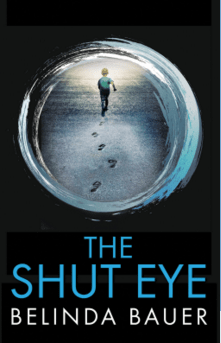
Day 833: The Shut Eye

Cover for The Shut EyeJohn Marvel is the main character of The Shut Eye, Belinda Bauer’s latest thriller. He has been an unlikable recurring character in her books, an abrasive police inspector, but previously, he has always been peripheral to the story.

Marvel is obsessed by an unsolved case, the disappearance of Edie Evans, who vanished on her way to school 11 months earlier. Her bike was found a few days later. Marvel has been fighting to keep the case open.

But it’s another case that we encounter first. Marvel saves a young woman from jumping off a bridge one night. She is Anna Buck, whose little boy Daniel wandered out of the house one day and hasn’t been seen since. Anna is distraught and blames her husband James for accidentally leaving the door open.

Marvel is revolted to have his new chief, Clyde, ask him to do him a favor, help find his wife’s dog. Clyde’s wife Sandra has been attending psychic sessions at a church, and Anna meets her there. The sessions are run by Richard Latham, who tried to help police in the Edie Evans case.

When Anna looks at the photo Sandra gives her of herself and her dog, she has her own psychic experience. She sees a garden that looks artificial. When she tells this to Inspector Marvel, he is disturbed to remember that Richard Latham made a similar remark. But he doesn’t believe in the supernatural, so he thinks Latham said something to Anna. Even more disturbing is the blurred picture of Edie on her bicycle that appears in the background of the photo, taken weeks after Edie’s disappearance and while her bicycle was impounded by the police.

We know that Edie has drawn a picture of a garden on the walls of her prison, because we periodically visit her. What we don’t know is when we see her within the time frame of the main story.

This is the first time I recall Bauer’s books having any supernatural content. I don’t know if she plans to have more or not. This is also the first time that Marvel is a main character, and although we don’t like him, we understand him better.

link to NetgalleyI did guess the identity of the perpetrator early on, but I think the guess was more intuitive than anything else. I did not, however, figure out what links the disappearances of the two children.

As usual, Bauer kept me riveted to the page. This novel is a little more mystery than thriller, but her last two novels seem to be moving in that direction.

Related Posts

Blacklands

Darkside

Finders Keepers

Day 832: Sweetland

Cover for SweetlandBest book of the week!
At the beginning of this novel, Moses Sweetland is an old man living in a small community on an island off the coast of Newfoundland. Although the island thrived at one time, now it is occupied by just a few families, including Sweetland’s niece Clara and her autistic boy Jesse.

All his life, Sweetland has lived on the island, which is called Sweetland after his family. Now, the Canadian government wants to buy out the remaining residents, move them off the island, and decommission it. The lighthouse where Sweetland worked for years is now a battery-driven beacon that gets serviced a couple of times a year.

At the opening of the novel, Sweetland is among only a few people who have refused to take the deal. If they don’t all take it, no one gets it, so someone has been leaving Sweetland threatening notes.

This is a powerful novel that covers most of the major events of Sweetland’s life in flashbacks. We see that events have left him very little except the life on the island, where he traps animals and catches fish, and his relationship with Clara and Jesse.

To tell much more would be to tell too much. Suffice it to say that Crummey gets us to care very much for this crusty old man and also for his community. As in Galore, which I really loved, Crummey brings back even the ghosts of the little island.

Related Posts

Galore

River Thieves

We, The Drowned

Day 831: Fresh from the Country

Cover for Fresh from the CountryOne of the pleasures I have not had for years is to read a novel by Miss Read, who wrote quite a few books over the course of 50 years, beginning in the 1950’s. Many of these novels are gentle stories about village life, but Fresh from the Country is about living in town.

Anna Lacey is a country girl who has recently finished training as a teacher and has taken a position as a primary school teacher in a new suburb of London. The school and the town are suffering the results of the post-war baby boom. Shoddy houses are going up quickly, and lodging is scarce. In the first scene of the novel, Anna inspects the grim quarters that will be her new home and is clearly cheated in her rent by her miserly landlady, who also underfeeds her throughout the novel.

The school, too, is crowded, as 48 children are crammed into her class in space meant for 20. The numbers in her class are a constant worry as she learns how to control the children, work in limited space, and keep the class productive. She also has to cope with the peculiarities of the various inspectors, since as a new teacher she is on probation.

Anna flees joyfully home on the weekends and holidays, to the large old farmhouse, her cheerful parents, and the beauties of the countryside. She finds the ugly scenery and the noise of the suburb hard to take.

Although Anna is a nice person, she at first tends to look askance at some of the foibles of her coworkers. It is her friendship with another teacher, Joan Berry, that teaches her not to be so hard on people who haven’t had the advantages of loving parents and a stable upbringing.

This is a gentle novel about the difficulties of being away from home for the first time, about learning new skills and learning to understand others, about the problems of the teaching profession. It has a tinge of light romance as well. It is mildly humorous, especially in the details of Anna’s life as a teacher.

Related Posts

South Riding

Miss Bunting

A God in Ruins

Day 830: The Nature of the Beast

Cover for The Nature of the BeastLaurent Lepage is known in the village of Three Pines as a boy with an active imagination. So, when he runs into the bistro and announces he’s found a big gun in the woods with a monster on it, no one pays attention. Then, the next day he is found dead of an apparent bicycle accident.

Isabel Lacoste and Jean-Guy Beauvoir send in a foresics team that establishes Laurent’s death as an accident. But retired Chief Inspector Armand Gamache has Jean-Guy take another look. The body was positioned incorrectly for the boy to have fallen off the bike while speeding down a hill, as was supposed. Laurent was murdered somewhere else and his body positioned to look like an accident.

While the police search for the site of the murder, Gamache also gets them to look for the gun that no one believed in. The murder site will be located by a search for a stick that Laurent always carried and pretended was a gun.

They find the stick, and next to it is a huge cannon, a missile launcher that is enormous, covered by camoflage, in the woods outside Three Pines. Eventually, the police find out that the gun is the invention of an arms dealer named Gerald Bull, 20 years deceased. His idea was to launch missiles into low Earth orbit to travel thousands of miles to their targets. The gun is completely mechanical, too, so that power outages won’t affect it. This weapon has always been considered a myth, but here it is, with an engraving of the Whore of Babylon on it. The firing pin and the plans are missing, however.

Shortly, three people arrive on the scene. Professor Michael Rosenblatt claims to be an undistinguished physics professor with an interest in arms. He is the person who fills Gamache in on Bull, but Gamache thinks he knows more than he is saying. Mary Fraser and her partner Sean Delorme identify themselves as from the CSIS (Canadian intelligence service), but say they’re just file clerks. Although they look unprepossessing, Gamache fears there is more to them. The goal for all these parties is to locate the firing pin and the plans before various arms merchants find out about the gun.

Another recent incident has disturbed the village. Several of the villagers have been rehearsing a play under the direction of Antoinette Lemaitre. The author of the play has been kept anonymous, but then the actors find out the play was written by John Fleming, a notorious murderer. When the actors learn that Antoinette knew who wrote the play, they all quit.

Once the gun is found, Gamache has an intuition that the two events are connected. But he can find no logical link. And then Antoinette is killed.

The novel is another excellent mystery for Louise Penny. Its characters are interesting as always, even the recurring cast of old friends. There is some action and danger, but the emphasis is on puzzle solving. Although the retired inspector seems to be encountering too many murders for a small town, Penny leaves hints that Gamache may come out of retirement.

Penny tells us in the afterword that the story of the gun is based on true events and that Gerald Bull was a real person.

As a totally gratuitous side-note, I have to say that with this cover, Penny’s series has lost the most beautiful mystery series cover award I bestowed on it some time ago. The cover is okay, but it isn’t gorgeous, like the others in the series.

Related Posts

The Long Way Home

How the Light Gets In

The Beautiful Mystery

Day 829: The Kreutzer Sonata Variations

The Kreutzer Sonata Variations“The Kreutzer Sonata” is a controversial novella by Leo (Lev Nikolaevich) Tolstoy. It was banned in several countries because of its provocative message and because of what was considered at the time prurient content. If your nature contains an ounce of feminism, it will enrage you. Yet its origins are in eccentric ideas that Tolstoy almost certainly considered to be for the benefit of women.

The Kreutzer Sonata Variations brings together this work with others by the family on the same subject. Tolstoy’s wife Sofiya Andreevna (I’m using the spelling from the book) disliked the novella intensely and wrote two stories in answer to it, “Whose Fault?” and “Song Without Words.” These stories were suppressed by the family. Tolstoy’s son, Lev Lvovich, also wrote a story, “Chopin’s Prelude.” These stories are followed by a section including review comments by several contemporaries, excerpts from diaries, and other writings of all three Tolstoys.

So, what was “The Kreutzer Sonata” about and why did it evoke all this controversy? It is a virtually plotless story about a man who meets another man on a train journey and tells him the story of why he murdered his own wife. Throughout the story, the main character, Pozdnyshev, expresses abhorrent opinions about women, sex, and marriage, and shows no understanding of women at all. Although this character is not completely describing Tolstoy’s own marriage, he is giving voice to Tolstoy’s ideas about marriage. This story is harsh, disturbing, and reflects ideas that show no understanding of human nature, or for that matter, many other things. Tolstoy posits that marriage is simply legal prostitution, that sex is disgusting, and that people should just strive to be celibate (something he notoriously had a problem with). Because Tolstoy saw his role in later years as one to instruct and had too high an opinion of his own ideas, this information is presented didactically, in a polemic.

Sofiya Andreevna disliked the novella intensely and was embarrassed by it, because she believed that others thought it reflected her own marriage. She insisted it did not but mostly, I think, because she didn’t want people to think she became attached to another man while married to Tolstoy (and who would blame her?). She also felt that the story showed no understanding of the wife, and so she wrote her own story. In both, the story is basically the same, a madly jealous husband comes to believe his wife is unfaithful when she is not and kills her in a fit of anger. It was Sofiya herself who convinced Tolstoy that his story would be more effective if the wife was innocent.

It is in the context of the responding stories and other writings that “The Kreutzer Sonata” is most involving. The story itself is ridiculous to modern sensibilities. Two pages of quotations by contemporaries provide some interest, particularly the two (not surprisingly) that I most agree with.

No wonder the Countess was often near the end of her patience.—George Bernard Shaw

“The Kreutzer Sonata” is a nightmare, born of a diseased imagination. Since reading it I have not the slightest doubt that its author is cracked.—Émile Zola

For an enlightening look at the Tolstoy’s marriage, I recommend the novel The Last Station by Jay Parini.

Related Posts

The Possessed: Adventures with Russian Books and the People Who Read Them

The Prague Cemetery

The House of Special Purpose

Day 828: Sex and Stravinsky

Cover for Sex and StravinskySex and Stravinsky is about two families that live far apart from each other but eventually meet. Caroline and Josh live in England with their daughter Zoe, while Hattie and Herman live in South Africa with their daughter Cat.

Caroline is Australian, tall, beautiful, and vastly capable. All her life she has been striving to please her mother, who continues to favor her other daughter Janet. Caroline leaves Australia to study in England and eventually marries Josh, a small, mild-mannered theatre academic. They struggle financially for their first few years. They are just able to afford their own house when Caroline’s mother moves to England without warning. She demands that they buy her a house and give her an allowance, and they seem unable to resist her commands. So, they continue struggling, living in a bus even though they have two professional salaries.

Hattie was Josh’s girlfriend until she met Herman. She was a ballerina despite the lack of support from her family. But when she married Herman, she started teaching and began writing a series of children’s books about a girl who wants to dance. Herman, a wealthy businessman, is away on business most of the time, and Hattie’s teenage daughter Cat treats her with contempt.

Caroline and Josh’s daughter Zoe has always wanted to learn ballet, and she adores the ballet series written by Hattie, who was Josh’s first love. But Caroline thinks Zoe is being silly about wanting to dance, even though Josh’s career deals heavily with ballet. Caroline says that in any case they can’t afford ballet lessons.

When Josh goes to a conference in South Africa, he reconnects with Hattie. Caroline finds out something shocking about her mother that sends her flying to South Africa to find Josh; Hattie finds out her lodger has a secret identity.

Trapido’s novels are witty and engaging. I always love them. They are sparkling with amusing dialogue, they have likable and not so likable characters, but ones that seem to be real people. Trapido continues to be one of my favorite writers.

Related Posts

Brother of the More Famous Jack

The Travelling Hornplayer

The Weird Sisters