
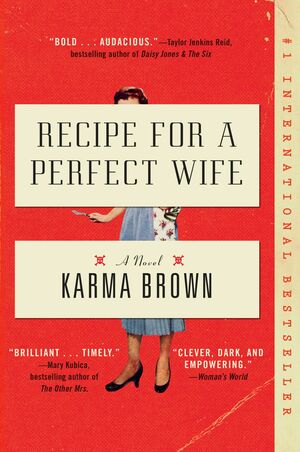
Today is another review for the Literary Wives blogging club, in which we discuss the depiction of wives in fiction. If you have read the book, please participate by leaving comments on any of our blogs.
Be sure to read the reviews and comments of the other wives!
- Kate of booksaremyfavoriteandbest
- Naomi of Consumed By Ink
- Rebecca of Bookish Beck
This month we welcome a new member, Kate of booksaremyfavoriteandbest!
My Review
In the present time, Alice Hale has no desire to move to the suburbs, but she finds herself doing so anyway, pushed along by her husband’s desire for a family and a white picket fence. Since she lost her job, she doesn’t feel as if she has as much say in the marriage. This situation is made worse because she told Nate she quit because she wanted to write a novel. Actually, she was fired after a stupid indiscretion, and she hasn’t written a word.
In the 1950s, Nellie Murdoch and her husband have moved into the same house that Alice and Nate buy later. She slowly begins to recognize that her husband, Richard, is controlling. Her culture tells her that this is her fault, but then he begins to be abusive.
Trying to adjust to having the whole day on her hands, Alice begins learning to garden and discovers a cookbook that belonged to Nellie’s mother. She begins cooking recipes from it. For his part, Nate is pressuring her to get pregnant, but she can’t bring herself to tell him she is not ready.
I was somewhat interested in the fates of these two women, but I was much more sympathetic to Nellie than to Alice, who seemed to be creating a lot of her own problems. Overall, though, I felt the novel was okay but nothing special. I had the biggest reaction to the revolting quotes from the old marriage manuals that headed each chapter.
What does this book say about wives or about the experience of being a wife?
These are two marriages with serious problems. The marriage of Nellie and Richard is more straightforward. Nellie does everything she can to be a good wife and housekeeper, as defined by the 50s (although to my memory things were starting to open up about then). However, Richard is an abuser and a philanderer. There isn’t much she can do about this except decide to leave him. She chooses another way, and I think we’re supposed to think her solution is fitting, but I didn’t. I don’t want to reveal it, but since she said she had the resources to leave, I think she should have done that.
I don’t see much hope for Alice and Nate, either. Alice pretty much lies her way through three-quarters of the book, some of the lies seeming totally unnecessary. On the other hand, Nate keeps stepping over the line in his desire to have a child and later exhibits some behavior that is much worse, supposedly done out of concern. (It seems to me that some guys think that if a wife isn’t working, she has no say in her own future.) But Alice doesn’t object, so although he should know he’s being too pushy (they seldom do), he doesn’t, and she doesn’t tell him.
By the end of the novel, Alice has found herself, but although there is some resolution, I foresee eventual resentments. Of course, Nate’s underhanded dealings toward the end of the novel are fairly unforgivable.
Finally, I don’t know what to think about Alice’s slowly turning herself into a replica of a 1950s housewife. Her excuse of “research” is nonsense. It seems like a such a step backwards. Certainly wives are still dealing with some of the same problems they’ve always had, but why go back? And why behave like a 50s housewife, which is sort of what she does until the end.
I know this book is supposed to be funny, but it seemed to be hitting some sore points for me, so I didn’t find it so.

 What? Me Read?
It was hard to believe that some of those quotes at the beginning of the chapters were even real!
The book made me think about how, these days, without the traditional husband/wife roles, defining our roles is a lot harder. Especially since circumstances can always be changing. For example, Alice and Nate seemed to be doing okay when they were both working outside the home and neither of the them were ready to start a family. But once Alice lost her job and Nate decided it was a good time to have a baby (and Alice didn’t tell him otherwise), things got messy really fast. They should have been talking a lot more about the changes and what it meant for them and their marriage. Which is a lot of work, when you think about it.
That’s a good point. I think that Alice was so ashamed of losing her job and there was also a status change involved that seemed to make both of them think she suddenly didn’t have as much say in the marriage that resulted in her lying or not saying what she felt while he just sort of took over and made some decisions without her that just blew my mind. He was so insistent on the baby thing, for starters, that I couldn’t believe she didn’t say something. But there was that status change, that I think she didn’t feel like she had any power.
Speaking from experience, even when you both know intellectually that you’re equals in the marriage, when one of you is making money and the other isn’t (even though they’re still working, just not making money), it’s hard not to feel a power imbalance. Luckily, in my case, we were always able to talk about it. And now we’re both back to working outside the home again. It’s surprising how much it can change things, even when you’re aware of it.
Yeah, I can definitely see that. It shouldn’t be so, because the other contribution is just as hard if not harder (housework and mothering), but it’s inherent in our society and doesn’t seem to be going away. And they weren’t talking about it, or even very much at all.
We had very similar reactions to this one. I didn’t find it humorous, except I guess for the irony of how different Alice’s life was from what the etiquette guides prescribed.
That was certainly ironic.
I didn’t find much to laugh about either. Quite the opposite.
You make a good point about Alice’s initial lie and how her deceptions flow from that – I didn’t reveal what happened in my post but I did find it very hard to believe that she wouldn’t have told Nate what had happened at work.
I could see her not wanting to say right away, but soon afterwards, yes.
Some books make me glad to be single! 😉
Sometimes I wish I still was.
😂 I hope your husband doesn’t read your blog!
Nope!
I started reading this a few years ago but abandoned it part way through
Thanks for sharing your review with the Historical Fiction Reading Challenge, and for your ongoing participation!
It wasn’t a favorite.