
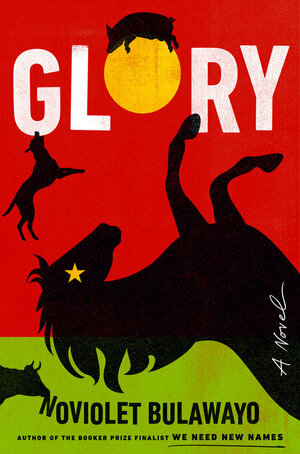
I tried really hard to finish this book, as it is on my Booker Prize project list. I read more than half the book, but it was really not for me. Despite raves by critics, for me it was a DNF.
The novel fairly straightforwardly covers the recent history of Zimbabwe, beginning with the overthrow of Robert Mugabe but then going back in time to show the beginning of his reign of terror. The twist is that all the characters are animals. Everyone is giving the nod to Animal Farm, but Bulawayo credits a cultural background of using talking animals in stories. Both novels are satires and deal with the use of language, though.
Although using animals as characters does nothing for me, I also felt as if it did nothing for the book except make the characters emblematic—hence, undeveloped and one-sided. What was worse for me was being subjected to so much political and religious speech. The first chapter is 30 pages long and consists almost entirely of one speech after another lauding the Father of the Nation, known as Old Horse, on the occasion of the anniversary of the revolution.
In the next chapter we learn that Dr. Sweet Mother, his wife, intends to take the position from him. Only there is a coup by the vice president, Tuvius Delight Shasha, and at least in the next 200 pages, we never hear from her again.
Next, there is supposed to be a free and fair election, so everyone gets excited, but you can guess how that turns out.
I quit because the plot finally seemed to be moving a little with the return of a goat named Destiny who has been missing for 10 years, but then we got yet another chapter where the different views of the election are aired. I just couldn’t take it. I wasn’t enjoying one word.
This is going to be a book you either love or hate, although in glancing at some reviews, I was astonished to see a five-star review by a person who only read 50 pages and then blamed her dislike on herself. At 400 pages, this novel is extremely repetitive, going over and over the same tropes, sometimes repeating a word or phrase many times for emphasis, and using the word “tholukuthi,” which is a word for emphasis, sometimes several times in the same sentence.
The characters have no depth and there is no real character development. There are lots and lots of political speeches and sermons.
This novel is deemed important because of its look in the recent history of Zimbabwe. Maybe it would have been too difficult to read with people as characters, but it would have been much more readable and relatable for me.

 What? Me Read?
I’d been waiting ages for her to produce another book after We Need New Names, but as soon as I saw this one had animals as the characters I decided against and, having now read your review, I’m sure I made the right decision! Sounds like she forgot she was writing a novel, not a history.
Yeah, I didn’t like it.
I’d read her earlier book (We Need New Names), which I moderately liked. This one had no appeal for me whatsoever, probably because I couldn’t imagine anything better in this line of literature than animal farm (yes, I know, the writer was working from a folk tradition & her novel centered on her country but still …). And 400 pages! Yikes! Not for me.
I had the same reaction to both books. Unfortunately, the second one was on my project list, so I gave it a try. I usually finish the ones on my project lists, even if I hate them, but I couldn’t finish this one.