
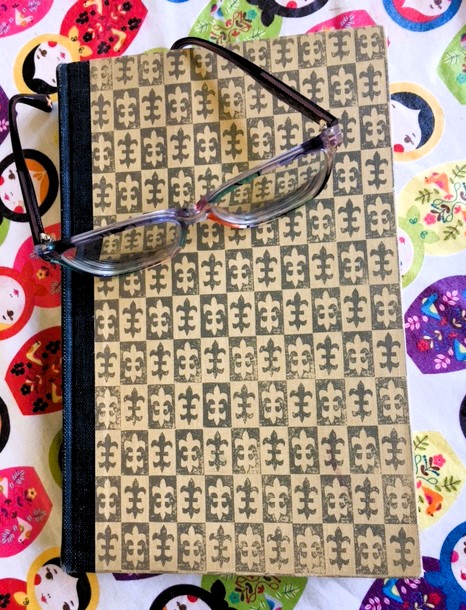
My copy of Germinal seems to be a special edition, released in 1942 by Nonesuch Press, and perhaps part of a book club, because inside its cover is a little insert that says it is part of a series called the Ten Great French Romances. Now, I’m not so sure of the other books, although some of them don’t strike me as Romances (not even using the original definition), but poor Zola would be rolling over in his grave. Why? Because he was basically the founder of a new kind of literary movement for his time that rejected Romanticism. It was called Naturalism and is supposed to be based in science and logic and takes an impersonal stance, observing but not commenting. It also takes determinism as one of its tenets—that is, a character’s fate is determined at the get-go.
One little personal comment before my review—I received this novel as a Christmas present from my brother after unthinkingly commenting that I had never read any Zola. After I started reading it, I realized there was a reason for that.
The novel begins and ends with Étienne Lantier. He is an engine-man who has lost his job after a dispute with the foreman, and he has been traveling north looking for work. He is starving and doesn’t expect to find any.
It’s 1866, and the revolution 70 years before has helped the middle class but not the poor. Étienne travels from place to place but finds nothing.
He meets an old man nicknamed Bonnemort whose family, the Maheus, has worked for the Montsou Mining Company for generations. He ends up hanging around one of the Montsou pits, the Voreau, and so is on hand when Maheu, Bonnemort’s son, learns that his best putter has died. (I never figured out what a putter is, but now I see it’s someone who brings empty containers up to the surface and brings filled ones down to the bottom.) Étienne has just walked off, but Maheu sends his daughter Catherine after him to fetch him back and gives him a job. (Yes, women worked in the mines, too.)
Étienne is a little better educated than the miners and has been writing to a representative of Workers International. Soon, he is talking about half-understood principles of socialism and unionism to the mine workers. The Maheus, whom he takes a bed with, are barely able to feed themselves on the wages of Maheu, Catherine, Bonnemore, and Zacharie, and in fact Zacharie is being prevented from marrying because his family needs his wages. Then the unexpected demand for repayment of a debt begins a period of starvation.
Although the novel is about an actual 1866 mining strike, a strong subplot is about Étienne’s relationship with Catherine. He at first takes her for a boy, she is so young, but because a man named Chaval is pursuing her, Étienne assumes she is loose, as most of the mining women are, so they start off badly. (Modern audiences may be upset, as I was, when they find that Catherine doesn’t enter puberty until long after she is involved in a sexual relationship with Chaval.)
After a period of hardship for all the miners, the company decides on a new policy of timbering that will essentially cut the miners’ wages. Étienne becomes their leader when the miners begin negotiations to avoid a strike.
This novel is unremittingly grim. Zola digs you right in to every detail of the miners’ lives and then includes a couple of passages that contrast this with what the middle class mine managers and owners are doing. For example, the village has just emerged from a period of starvation when Zola describes a several-course dinner party at the home of Hennebeau, the mine manager. Later, when the miners are destroying the mines, Hennebeau is too wrapped up in the discovery that his wife is unfaithful to pay much attention.
Although this novel is considered a very important work in French literature, naturalism is not for me. It is too brutal.
Related Posts
The Black Count: Glory, Revolution, Betrayal, and the Real Count of Monte Cristo

 What? Me Read?
I’ve liked some of Zola’s other books, but couldn’t finish this one. I’m not sure if I was just in the wrong mood for it, so I might try it again one day.
I certainly was in the wrong mood for it.
I read this recently too, though I haven’t got around to reviewing it yet. I agree about the brutality, and I struggled with it more or less all the way through. But in the end I thought it was really powerful and has left a lot of images in my mind – it’s one I’m glad I’ve read even if I didn’t ‘enjoy’ reading it.
I think it hit my ick factor too strongly.
Yes, some of it was pretty horrible.
Yes it’s definitely grim, bits of it still live with me years later, but I think it’s authentic so was probably quite important as a window into the time, and lives of those at the bottom of the social pile. It’s my favourite of his books for that reason, although they’re all quite grim.
Oh, goody! Something to look forward to if I read him again! I think you’re right, though.