
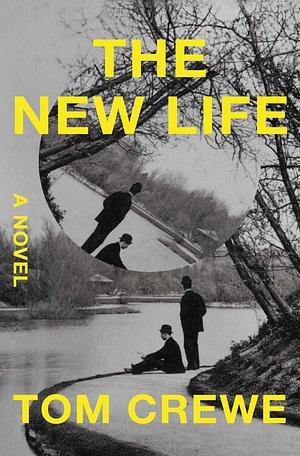
The New Life was a slow read for me. It took me almost a week, which is unusual for me with fiction. I read it for my Walter Scott Prize project.
The novel is loosely based on two men, John Addington Symonds and Havelock Ellis, who in the early 1890s wrote a book together. When I looked them up, it didn’t seem as if it was very loosely based—Crewe gives his characters almost identical names. But then I realized it is set after Symonds’ death in order to bring in the trial of Oscar Wilde.
John Addington is a gay man who is married and has three grown daughters. He is known for writing about a vast array of subjects. Henry Ellis is an idealistic, naïve younger man, a doctor. He marries a good friend, Edith, and their intention is to lead the way to the New Life. I wasn’t exactly sure what that entailed, but at minimum it seems to be that spouses are equal partners. Unfortunately for Henry, they never discussed the sexual side of marriage. He thought there would be consummation; Edith, a lesbian, did not. So, Henry continues a virgin with a fascination for the subject of sex. They live separately, and soon Edith has a new friend, Angelica.
Henry wishes to make a scientific study of sex and publish the results, and since he knows some gay friends, referred to at that time as “inverts,” he decides to start with them, having a theory that rather than an illness or perversion, inversion is natural. He decides to invite John Addington to join him in his project, not because he thinks he is gay, but because of his reputation as a writer about various topics.
John has been getting more tired of keeping his secret as an invert. He has confessed to his wife and occasionally has brought a man home for sex, an action that I thought was breathtakingly cruel. Now he meets Frank, a much younger, lower-class man who wants to be his friend. When John sees Henry’s proposal, he thinks such a project will change people’s ideas about inversion so that he can be free to do what he wants.
The men write the book and begin looking for a publisher. However, just at that time, Oscar Wilde is found guilty of inversion and is sentenced to jail. The backlash is such that the two fear their work is unpublishable.
If you are not a fan of graphic sex scenes, this won’t be the book for you, especially the first few hundred pages. The novel opens, for example, with a very explicit and detailed wet dream. I am not really a fan of explicit sex scenes in novels, so I found the first half of the novel hard going, despite it being well written and having vivid descriptions of life in Victorian London. (It has a wonderful description of a day that is so smoggy no one can see where they’re going.)
The novel picked up for me after the book, entitled Sexual Inversion, is published and the police go after a bookseller for selling indecent material, their book. Then it becomes about the reactions of the various characters once there is a threat to their own lives.

 What? Me Read?
I’ll be reading this eventually as it’s the only book I have left to read from last year’s shortlist, but I’m not sure if I’ll like it as I’m not a fan of graphic sex scenes either. At least it picked up for you in the second half.
Yeah, me neither. I hope you like it.
Sounds interesting, but it’s a no to graphic sex scenes from me! Thanks for the warning!
Yeah, I had to read it for my project, or I probably would have quit.
This sounds like a really interesting read, but I am not sure it is for me!
Thank you for sharing this review with the Historical Fiction Reading Challenge.
Yes, it wasn’t really for me, either.